


 Shkruar nga Pamfleti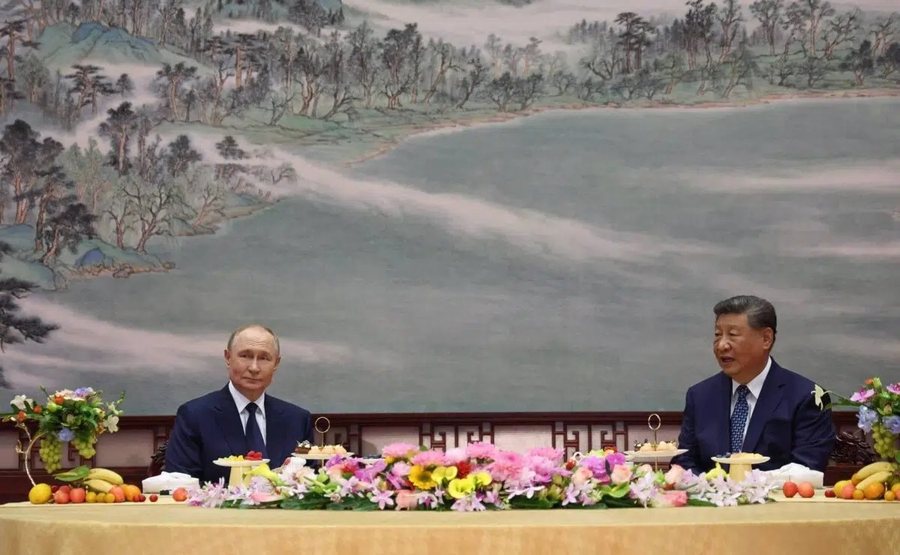
Like Mao and Stalin once did, Putin and Xi showed a typical obsession of autocrats: not official schedules, but longevity itself.
Mao Zedong’s arrival in the Soviet Union in December 1949 marked one of the most bizarre state visits in the history of diplomacy. Officially, the president of the People’s Republic of China had gone to Moscow to celebrate the 70th birthday of Joseph Stalin. In reality, Mao was seeking a new Sino-Soviet friendship treaty. At first, Stalin refused, but Mao decided to “talk” him out of it. He stayed in the USSR for more than two months, until Stalin gave in and signed the agreement.
This anecdote still rings true. First, because in China a revival of Mao's image has begun, while in Russia Stalin is being openly glorified. Second, because the balance of power seems to have reversed: this time it was Vladimir Putin who made the long visit to China to pay respects to Xi Jinping. From August 31 to September 3, Putin attended the Shanghai Cooperation Organization summit in Tianjin and the grand military parade in Beijing.
Dictators' obsession with time
Like Mao and Stalin, Putin and Xi showed a typical obsession of autocrats: not official schedules, but longevity itself. Microphones recorded a conversation between them in which Putin talked about advances in biotechnology and organ transplants, adding that perhaps humans could achieve “immortality.” Xi replied that there are predictions that humans could live to be 150 before the end of this century.
At a press conference, Putin confirmed that he had discussed longevity with Xi, recalling that he had had the same conversation with Silvio Berlusconi, who died in 2023 and was known for cosmetic surgery.
The socialist myth of revival
This conversation is not so coincidental. In the early 20th century, a philosophical movement known as the “biochemists” arose in Russia, who believed that socialism should not only eliminate private property, but also the ultimate limitation: death itself. They even called for the resurrection of the dead to share in socialist justice.
In the 1920s, Lenin's friend Alexander Bogdanov created an institute for blood transfusions, experimenting with the rejuvenation of body and mind. The utopia of immortality was also embodied in the decision to embalm Lenin after his death, in anticipation of a possible resurrection.
From "lifetime" to "worldtime"
Philosopher Hans Blumenberg distinguished between “lifetime” (the lifespan of the individual) and “worldtime” (the never-ending history). Ordinary people try to bridge this gap with small means – technology, speed, efficiency – to gain more free time. Dictators, on the other hand, try to erase this distinction altogether, perpetuating themselves as irreplaceable historical figures.
Hitler, for example, wanted the Nazi empire to be completed within his lifetime. When he realized defeat, he preferred that the entire world perish with him. This “absolute narcissism” of dictators is at the root of the obsession with immortality.
Vampire society
Putin and Xi are not Hitler, but the logic is similar: for them, political immortality feeds on the blood of others. Philosopher Boris Groys has called this model a “vampire society.”
Putin is the clearest example: the invasion of Ukraine has produced over a million Russian soldiers killed or wounded, not counting Ukrainian casualties. Xi, on the other hand, has put the entire Uyghur population in camps in Xinjiang. A real vampire could not drink that much blood.
In Beijing, at a public meeting with Slovak Prime Minister Robert Fico, Putin concluded with a sentence that clearly reflects his philosophy of life and power: “As long as I am alive, I am fine.” /Adapted from “Pamphlet” by “World Crunch”





Lini një Përgjigje