


 Shkruar nga Pamfleti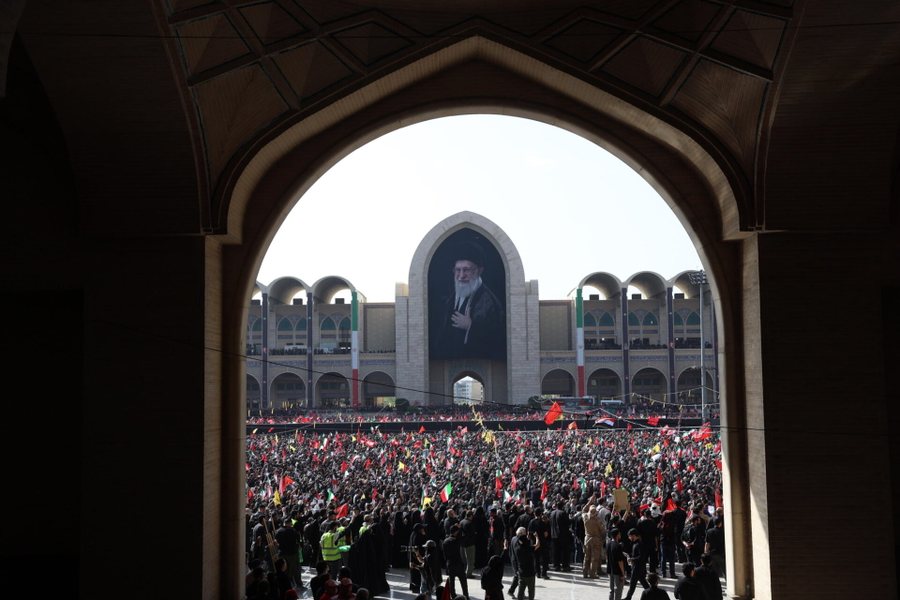
The funeral ceremony of Iran's Supreme Leader is turning into an arena of political and diplomatic messages, as Tehran seeks to prove that it is not isolated.
Ali Khamenei's funeral, held more than four months after his death in the first attacks of the Israeli-American war against Iran and after the end of the ceasefire between Tehran and Washington, represents not only a moment of symbolic, political and social weight, but also an opportunity for important diplomatic developments that under normal circumstances would be difficult to occur.
A similar situation was seen during the funeral of Pope Francis in April 2025, when the dialogue between Donald Trump and Volodymyr Zelensky under the dome of the Sistine Chapel became one of the symbolic images of that moment. Even in the case of the long funeral ceremonies of the Supreme Leader of the Islamic Republic, diplomacy is taking place on several levels, between attempts at dialogue and threats.
Khamenei's funeral amid threats and diplomacy
On the one hand, Israel and the United States are trying to prevent the funeral period from turning into a political success for the Pasdaran regime and its allies, undermining any efforts at international isolation of Iran.
Mojtaba Khamenei, the son and successor of the Supreme Leader, wounded during the first attacks of the Third Gulf War, will not participate in any public activities for security reasons, after Israeli Defense Minister Israel Katz recalled from Tel Aviv that the new Iranian leader was "sentenced to death," hinting at the possibility of a new phase of the war after the clashes of June 2025 and the February-April 2026 period.
On the other hand, the semi-official Iranian agency Tasnim reported that efforts by American diplomacy have been identified in Tehran to convince various world leaders not to attend Khamenei's funeral ceremony.
According to Tasnim, US Secretary of State Marco Rubio, after not directly participating in the ceasefire negotiations, has asked US embassies to remind host governments that attending the funeral would be considered a negative signal to Washington.
The Iranian agency adds that US ambassadors to several African countries have warned that US development aid could be suspended if representatives of these countries attended the ceremony.
Diplomacy in balance and an Iran that does not seem isolated
There is no independent confirmation of these Iranian claims. At the same time, the coincidence of Khamenei's funeral with the celebrations of the 250th anniversary of US Independence on July 4 has led Washington and Tehran to postpone any new negotiations after the ceasefire, while respecting the relevant ceremonies.
Debate continues within the US administration about how to deal with Iran, while Tehran is trying to show that it still enjoys diplomatic support.
On July 3, more than 100 official delegations attended a ceremony held at Tehran's Grand Mosque to pay homage to the Supreme Leader. Their presence was interpreted as an indication of a new diplomatic landscape.
Russia was represented by Dmitry Medvedev, a former president and prime minister, currently vice-chairman of the Security Council. China sent the vice-chairman of the National Assembly, He Wei. Two weighty delegations aimed at confirming Iran's importance in the security architecture of the two BRICS member countries.
Turkey, Pakistan and Saudi Arabia send high-level delegations
Turkish President Recep Tayyip Erdoğan was represented by Vice President Cevdet Yılmaz. Pakistan sent Prime Minister Shehbaz Sharif and Armed Forces Commander Asim Munir, two figures who had played a role in brokering the ceasefire.
Unexpectedly, Saudi Arabia's Deputy Foreign Minister, Waleed El Khereiji, also arrived in Tehran.
The presence of these delegations is seen as a political message in favor of dialogue and against a return to war. Turkey had tried to avoid the conflict that erupted on February 28, Saudi Arabia, although hit by the Iranian response, avoided further escalation, while Pakistan played an active role in achieving a ceasefire.
This triangle – Ankara, Riyadh, and Islamabad – shows that the willingness to dialogue with Iran and build bridges of peace remains a priority for the three capitals.
It is also about three allied governments of the United States, which are sending a message on the new security architecture in the Middle East, a vision that seems to differ from that of Israel or from the perspective of expanding the Abraham Accords with an anti-Iranian function.
The perception is that Iran cannot be excluded from determining the future regional order. And the funeral of the Supreme Leader is being used as an opportunity to reaffirm this reality. / Adapted from "Inside Over"



Lini një Përgjigje