


 Shkruar nga Pamfleti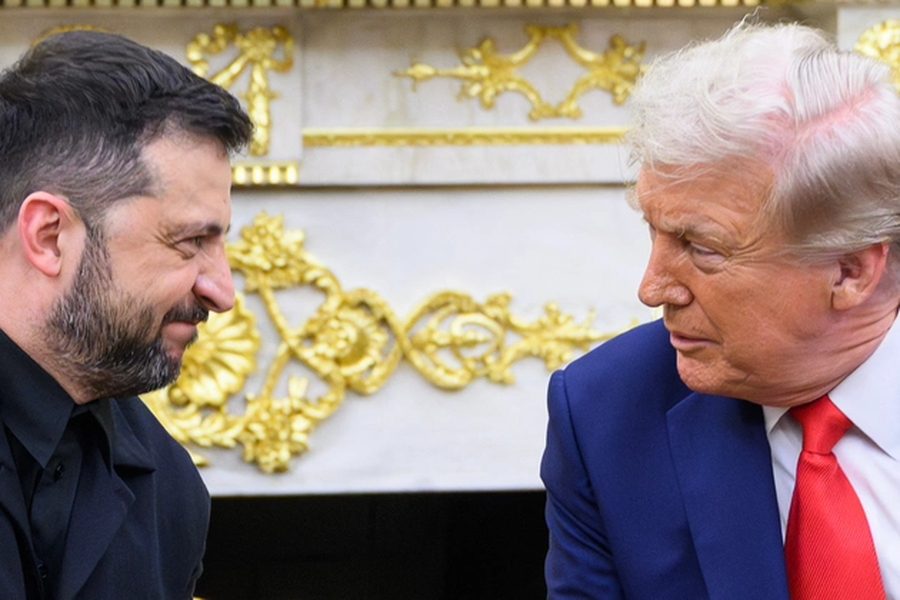
The trilateral talks could mean the start of serious negotiations to end the war, something Trump has vowed to do since taking office in January...
President Donald Trump has spent the last few days on a diplomatic sprint, preparing the ground for a possible trilateral meeting with Russian leader Vladimir Putin and Ukrainian President Volodymyr Zelensky, to discuss ways to end the more than three-year war.
But despite successive meetings with delegations from both countries, along with a contingent of European leaders, a large gap still remains between Putin's early demands and the conditions set by Zelensky and his European allies.
However, after official talks with Zelensky and European leaders ended on Monday, while the heads of state were still gathered for dinner at the White House, Trump announced on social media that he was organizing a bilateral meeting between Zelensky and Putin, which would be followed by a trilateral conference in which the US President himself would also participate.
While the trilateral talks could mean the start of serious negotiations to end the war, something Trump has pledged to do since taking office in January, he still has several steps to go to successfully orchestrate such a conference, starting with getting both leaders to the negotiating table.
Here are 5 questions that arise as the White House prepares for a possible trilateral meeting:
Will Putin really agree to meet with Zelensky?
Trump’s grand plan for a direct meeting between the leaders of the warring countries hinges on Putin’s willingness to meet face-to-face with his Ukrainian counterpart. That is not an option to be taken lightly. Russian Foreign Minister Sergei Lavrov told Russian state media on Tuesday that any meeting would have to take place “step by step, gradually, starting at the expert level and then going through all the necessary stages,” a similar line that the Kremlin has used to thwart previous attempts to get the two leaders in the same room. But Lavrov did not rule out a meeting altogether, saying Putin would not necessarily refuse to attend a bilateral or trilateral summit. It is not the first time the Kremlin has raised the possibility of a Putin-Zelensky summit to delay serious peace talks as Russia continues to attack Ukraine. Despite suggesting a meeting with Zelensky in May, Putin sent a delegation instead of attending the summit himself, after Zelensky called for a ceasefire as a precursor to negotiations.
What is the division of security commitments between Europe and the US?
According to NATO Secretary-General Mark Rutte, the main “breakthrough” to emerge from Monday’s summit was Trump’s willingness to commit to security guarantees for Ukraine, which Putin openly expressed during Friday’s summit in Alaska. But it is unclear how exactly U.S. participation might be achieved. During a call with “Fox and Friends,” Trump said that European allies would “preliminarily fulfill” security commitments and gave his “assurance” that the U.S. would not send troops to Ukraine. Instead, Trump said that “some countries,” namely France, Germany and the United Kingdom, would likely provide troops.
But the U.S. could still contribute in other ways, including air support, which Trump also announced on Fox on Tuesday. A senior official told Politico this week that he “don’t think there’s a red line” on a potential U.S. role in long-term peacekeeping efforts.
Where would the potential meeting take place?
The White House is in the process of selecting a location for the possible trilateral meeting if it takes place.
The list of possibilities is not long. Because of the active International Criminal Court warrant for Putin's arrest for his alleged role in the abduction of children in Ukraine during the war, the Russian leader is limited in the number of countries he can visit without facing possible arrest.
Switzerland would grant Putin “immunity” if he visited the country for peace talks, the Swiss foreign minister said Tuesday. But while French President Emmanuel Macron suggested Geneva as a possible meeting location, Putin pressed Moscow to host the meeting. But another location has risen to the top of the White House’s list of preferences. The U.S. Secret Service is making plans for the meeting to take place in Budapest, Hungary, although plans have not yet been finalized.
A summit in Budapest would make Prime Minister Viktor Orbán, a Trump ally, the host of this crucial meeting. It would also create a potentially painful historical echo for Ukraine. After the allies promised to protect the country’s territorial integrity in exchange for Kiev giving up its nuclear weapons in the 1994 Budapest Memorandum, their commitment proved meaningless when Ukraine’s partners failed to provide military support in the face of Russia’s attack in 2014.
Are territorial concessions still on the table?
Perhaps the biggest obstacle to a possible three-way deal: Putin’s demands for territorial concessions from Ukraine. Trump has been open about what he has called a “land swap,” which would involve Russia giving up some of the Ukrainian territory it has occupied during its war but keeping other landmasses, including parts of the Donbas region that Russia does not currently control. Putin has made it clear that he will not even consider ending his war in Ukraine without a successful territorial conquest. But Zelensky has no intention of exchanging land for a peace deal.
According to German Chancellor Friedrich Merz, who joined Monday's summit at the White House, the topic of territory did not come up in the day's talks, essentially postponing discussions until Zelensky and Putin meet face to face. But any conditionality on territorial concessions leading up to a hypothetical trilateral agreement would likely negate a guarantee of Zelensky's participation.
Will Trump change his stance again?
Trump's visit on Monday with Zelensky and a group of European leaders appeared to put the US president back on Ukraine's side. But there is no guarantee he will stay there.
Trump and his administration have, so far, largely refrained from praising Putin and berating Zelensky, while also halting arms shipments to the war-torn country, before finally recognizing Putin's lack of serious engagement in peace talks and expressing distrust of his intentions.
But the US president was swayed again by Putin after their meeting on Friday, for which he rolled out the red carpet, echoing Putin's demands to abandon talks on a ceasefire agreement in favor of long-term peace negotiations, as well as the Kremlin's early condition that Ukraine should never join NATO.
While Trump's support for Ukraine appeared to have returned after Monday's summit, Putin could pull Trump back into the Kremlin's orbit, potentially leaving Europe and Ukraine out in the cold. /Adapted from Politico.com/





Lini një Përgjigje