


 Shkruar nga Pamfleti

Italian meteorologists are warning of an arctic trough, saying much of the Old Continent could face Siberian frost.
The question behind their analysis is whether this weather development could be a transient Balkan intrusion, with a rapid influx of short-lived cold air, or a more structured change, supported by an anticyclonic cape capable of strengthened along the meridian axis.
Italian meteorologists point out that the meteorological development expected around the middle of January seems to outline a particularly interesting scenario, which has attracted some convergence between the main physico-mathematical models.
This rare alignment between predictions suggests that we may be facing a significant shift from the last phase characterized by mild temperatures and an overall changeable climate. Current forecasts indicate a hemispheric-scale weather pattern that could materialize between January 12 and 13. The European model, in particular, shows a hint of a polar vortex "split," a phenomenon that involves the fragmentation of the zonal flow and paves the way for more southerly dynamics.
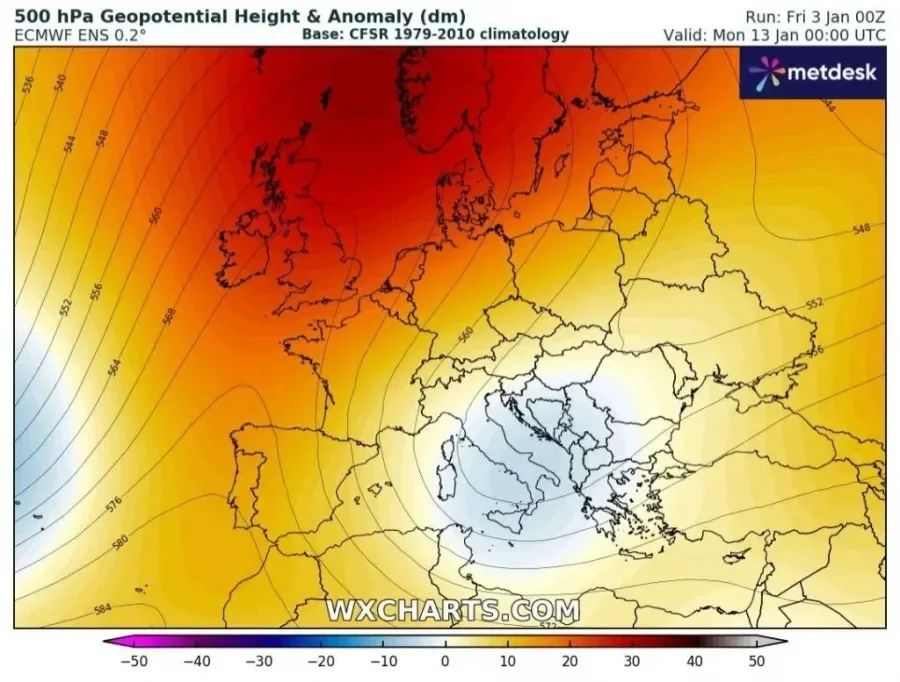
This process may be decisive in blocking the Atlantic flow and forming a closed low pressure system over the Mediterranean. Such a configuration, associated with eastern currents of continental origin, would represent a clear break compared to the last meteorological picture.
For fans of cold weather conditions, say Italian meteorologists at Meteoweb.eu, this development could mark a big step forward. However, questions about the actual impact and duration of this potential change remain open. It could be a transient Balkan intrusion, with a rapid influx of short-lived cold air, or a more structured change, supported by an anticyclonic cape capable of strengthening along the meridian axis.
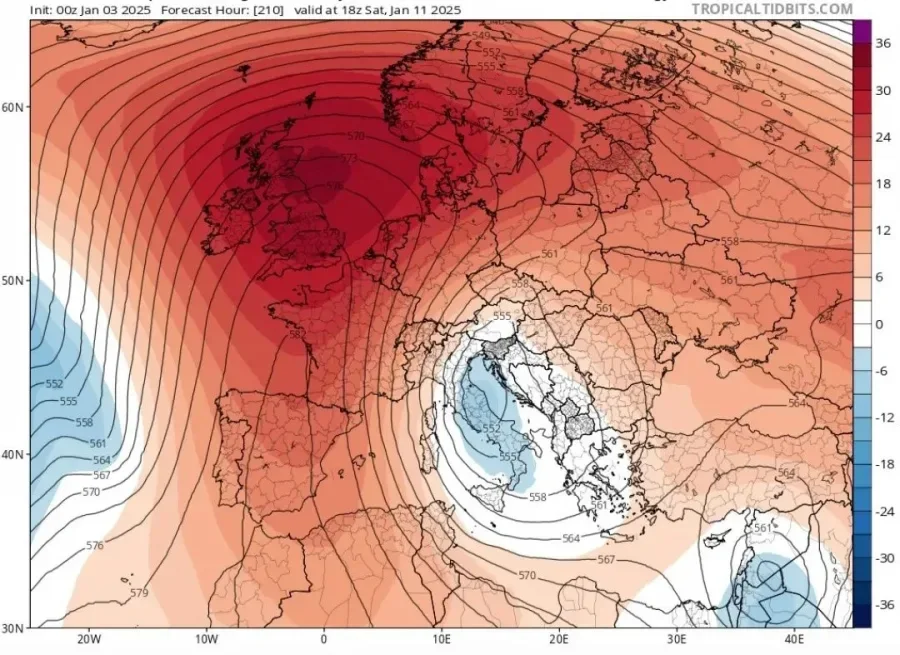
The latter scenario would provide a stable bridge between the cold air present in northeastern Europe and the Mediterranean depression, leading to more intense and persistent winter conditions.
If the Atlantic forcing proves too strong, the evolution towards a truly wintry climate may be jeopardized or reduced to a short-lived episode. In contrast, the weakening of the zonal flow may allow a marked drop in temperatures, with significant impacts in the central Mediterranean.








Lini një Përgjigje