


 Shkruar nga Pamfleti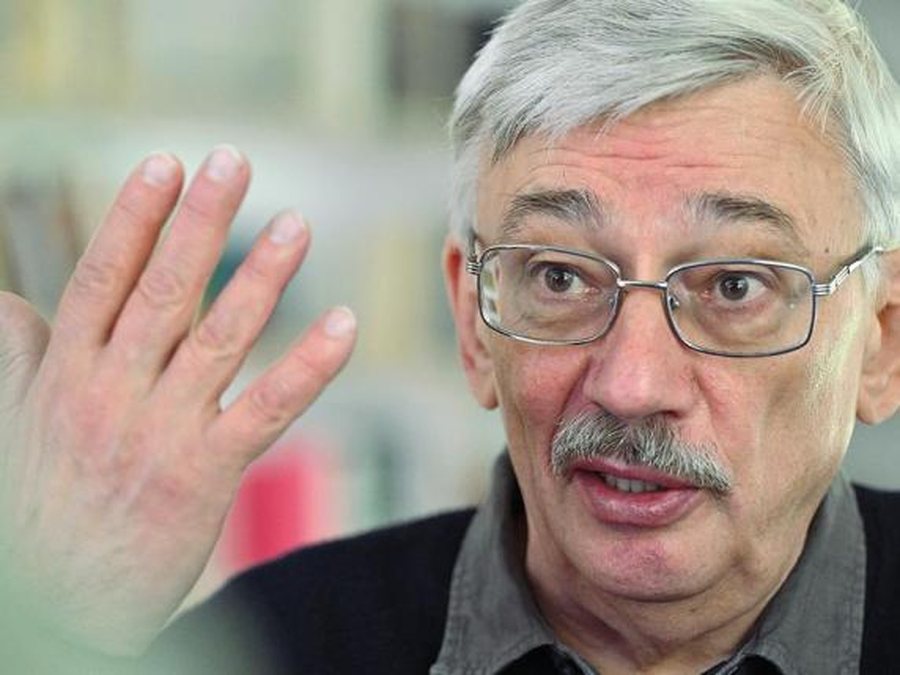
After Putin, another Putin may come very soon. An unnamed person who has probably been quietly supporting the dictatorship until now and may rise to power perhaps with the support of other foreign forces...
When we meet in Berlin, the Putin era has just completed a quarter of a century and a day: it was January 1, 2000, when Yeltsin's resignation gave him power.
Oleg Orlov, biologist, 71, had already spent twenty years as a dissident; or more precisely, as a "citizen who criticized the government. Until such a thing was declared a crime".
He distributed leaflets against the war in Afghanistan in 1979; in 1989 he helped found Memorial, the human rights network that won the Nobel Peace Prize in 2022; until 2022 he managed without a criminal record. But an article about the "new Russian fascism" brought a sentence of two years and two months in prison.
- On August 1, 2024 he became part of the exchange of prisoners (he refused, like other political prisoners, to ask for forgiveness) and now he cannot return to Russia, "which is my greatest wish. I miss the snow, the woods, my loved ones. But if I come back they will arrest me and it would be irresponsible to the next exchange of prisoners".
- How much has Putin changed in twenty-five years?
To me and to those around me, it was clear from the start that he was a dictator. But we had an eye trained by years of political engagement and we were in Russia. Where rights are immediately violated; where imperialist operations in the Caucasus immediately began. Europe saw worrying signs, but said to itself "let's not exaggerate" and continued to buy gas.
-Are there moments in which the regime changed pace?
The first is the speech in Munich in 2007, at the security conference. It was all there. Anger at the United States, attention to Ukraine and Georgia, weapons. Then in 2014, the invasion of Crimea. And the protests of 2012. When he regained the presidency, many people took to the streets. This dissent frightened him and he decided to suppress it.
- How have you seen Russians change in these 25 years?
They are annihilated. First, the feeling that nothing depends on the individual gained ground, and therefore the abandonment of politics and the return of the private sector. Meanwhile, the elections become a farce, the war takes away your relatives and friends, the economy falls... and the fear remains. I think you don't understand repression, but it works: nobody does politics anymore if the price is so high. Government men at the local level even control the conversations: this has not been the case since Brezhnev.
-Many of the Russian prisoners released in August live in Germany. Are you in touch?
Of course. We talk, we coordinate for marches or campaigns. See you often. There are associates of the Navalny network Liliya Chanysheva, Ksenia Fadeeva, Vadim Astanin, there is Ilya Yashin who is always traveling somewhere, Andrei Pivovarov, the artist Sasha Schokilenko, Kevin Lik, who now goes to school in Munich ...».
... arrested at 18.
I'm glad he's going to school now (his eyes shine).
-What are you working on?
For a series of practical measures to be taken if Putin dies. An amnesty, a new electoral law. It is essential not to be ambiguous, also because we are already on the verge of a catastrophe".
-What does it mean?
After Putin, another Putin may come very soon. An unnamed person who has probably so far quietly supported the dictatorship and may rise to power perhaps with the support of other foreign forces, of countries that will officially continue to say that they are in favor of freedom in Russia, but in reality they will be happy if they can buy gas and oil cheaper. The opposition may not succeed even if Putin dies. And you, dear Western friends, will have to face a new war.
-Have you always been so pessimistic about it?
No, but in recent months everything has gone in this direction. The election of Donald Trump. International politics turning right. Navalny's death. If he had been alive, he would have been able to unite the opposition and lead it to victory. Even from afar.
-Widow Yulia offered to lead the opposition.
Today there is no single figure in which the Russian opposition can recognize itself.
-Prison, exchange, new life abroad. How have you coped with these months?
Prison was humiliating, cruel. Scary. Political prisoners are often held in solitary confinement, with inhumane treatment. But I'm surprised I got out of it better than I expected.
- The Italian journalist, Cecilia Sala, is in isolation in Iran. What advice would you give her?
I'm sorry. It is important not to despair, to remember who you are and to hope that you will break free. Very quickly they despair. It doesn't help. / Adapted "Pamphlet" from "Corriere della Sera"


Lini një Përgjigje