


 Shkruar nga Pamfleti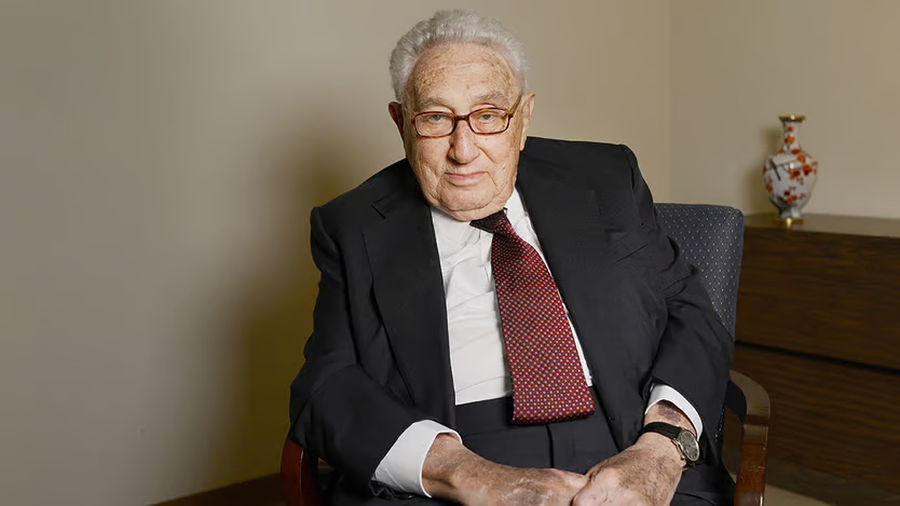
It would be a pity if Kissinger's vision of diplomacy died with him. A dangerous world sorely needs his mastery of the subtle interplay between interests, values and the use of force.
As a person who promoted his views so tirelessly, Henry Kissinger was strangely misunderstood. Many see him as the leading exponent of an amoral realism that tarnishes America. Of course, like any diplomat, he lied about his country and occasionally himself. More disturbing is the fact that he was willing to see tens of thousands of people killed if he thought it was in the national interest. Yet what distinguished Kissinger, who died this week at the age of 100, was not just his realpolitik, but the fact that his practice of diplomacy was also tinged with idealism.
His style of diplomacy is a style that holds valuable lessons even today.
Even the would-be Kissingers in the Biden White House are facing some daunting challenges. The rivalry between China and America is becoming increasingly poisonous. Bitter wars are raging in Ukraine and Gaza. Political divisions are tearing Western democracies apart.
Speaking to The Economist in April, his central theme was idealism. His life's work, he said, was devoted to preventing a repeat of the wars of 1914-18 and 1939-45 that had destroyed his childhood in Germany and much of the world. Today this means maintaining peace between China and America.
His method of diplomacy is still being examined.
In his later years, Kissinger was often criticized for being soft on China. But his concern was to shed the thought that portrayed him as a rising power like the Kaiser's Germany, bent on expansion.
China, he argued, saw the rule-based order as America's rules and order. She wanted room to adapt and not to overturn the system.
The dispassionate analysis leads to Kissinger's next prescription, to live and let live.
Drawing on his study of 19th-century European diplomacy, he argued that stability required states to tolerate each other's differences. The main threat to peace comes not from realists, he thought, but from zealots and proselytizers who are quick to condemn and demand change on a point of principle.
Kissinger therefore recommended that China and America talk, first quietly, to build trust and avoid issues, such as trade and Taiwan, where differences are insurmountable.
Analysis and tolerance are strengthened by Kissinger's call for military deterrence. America's assessment of China may be wrong or out of date, but the effort to co-exist may be essential. If not, what ultimately keeps the peace is the threat of war and the willingness to carry it out.
Kissinger's many critics hold him responsible for a killing spree in Cambodia and Bangladesh in the 1970s, as well as helping to overthrow elected governments. He replied that everything had to depend on peace between America and the Soviet Union. The idea that he was acting out of necessity is a sweeping and unrecognizable claim. However, as the world's reaction to Israel's attacks on Gaza shows, its willingness to sacrifice human life in the pursuit of stability would perhaps be seen as intolerable today.
In other ways, Kissingerian diplomacy is more difficult now than when he was roaming the Middle East as secretary of state. Secret back-channel meetings end up being plastered on TikTok. The world cannot be so easily ordered according to a hierarchy of allies and clients supported by the Soviets and Americans. Now she is multipolar. For all that, it would be a pity if Kissinger's vision of diplomacy died with him. A dangerous world sorely needs his mastery of the subtle interplay between interests, values and the use of force. And yet the search for stability must continue without him./ Adapted "Pamphlet" from "The Economist"



Lini një Përgjigje