


 Shkruar nga Pamfleti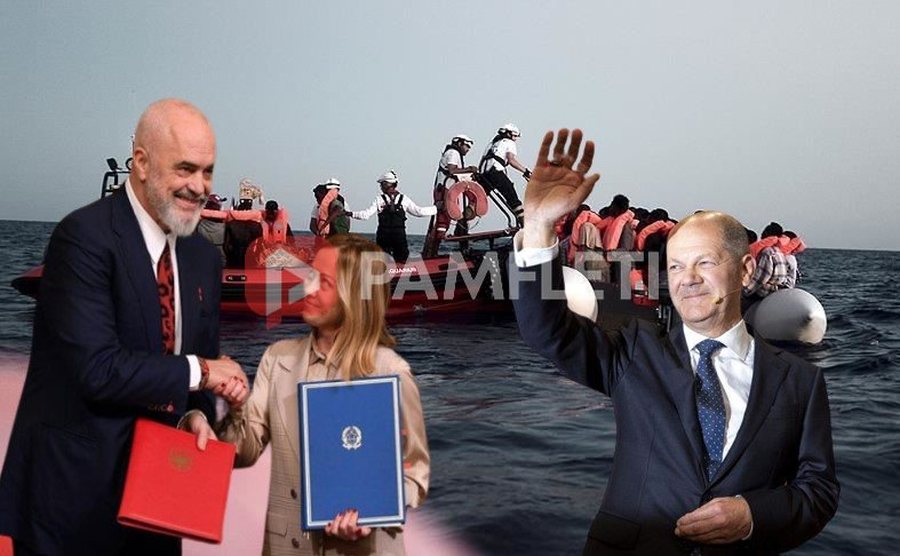
"Financial Times" has written an article on the refugee crisis, while also stopping at the Rama-Meloni pact. According to her, the EU was informed only an hour before the prime ministers went to the press conference...
Just weeks after EU countries reached a compromise on asylum reform, Italy, Germany and Austria are pressing ahead with their controversial plans to send asylum seekers to third countries.
But they will probably face an avalanche of legal issues, write Sam Jones and Giuliana Ricozzi.
Context: Italy has announced that it will handle the asylum requests of immigrants in Albania. Germany is also considering processing asylum claims outside its territory, while Austria has said it will cooperate on the matter.
The Italy-Albania agreement has taken Brussels by surprise. The European Commission was informed only about an hour before the pact was announced, officials said. "I don't like the way this happened, it was bad," said a senior EU official.
Giorgia Meloni, however, happily put aside his worries. "We informed the European Commission about the plan and received no criticism," she told the Italian newspaper "Il Messaggero," describing the agreement as a "cooperation model."
She emphasized that the reception centers financed by Italy in Albania will be staffed by Italian officials and "respect for human rights is fully guaranteed".
EU asylum laws, including the reform currently being finalized by member states and the European Parliament, stipulate that asylum seekers "shall be allowed to remain in the member state" during their asylum procedure.
This applies when people reach the territory of an EU country, including its territorial waters. It is therefore likely that Italy's plan will breach EU laws, although the details are still unclear.
Germany is a bit more cautious and the government has promised to only consider such a scheme. The idea has also gained support among some Green and Social Democrat leaders, but Olaf Scholz's government - despite putting the issue on the table publicly - behind closed doors still believes it is unworkable.
Legal obstacles can be insurmountable, say experts in the Ministries of Interior and Justice. And even if not, there is a practical problem: no suitable country outside the EU will do a deal with Germany.
According to Imogen Sudbery, director at the International Rescue Committee in Brussels, similar proposals have not gone ahead in the past because of "numerous flaws on moral, legal and practical grounds".
"This decision also deals a further blow to the principle of solidarity, which lies at the heart of a functioning European asylum system," Sudbery said. / Adapted "Pamphlet" from " Financial Times "







Lini një Përgjigje