


 Shkruar nga Pamfleti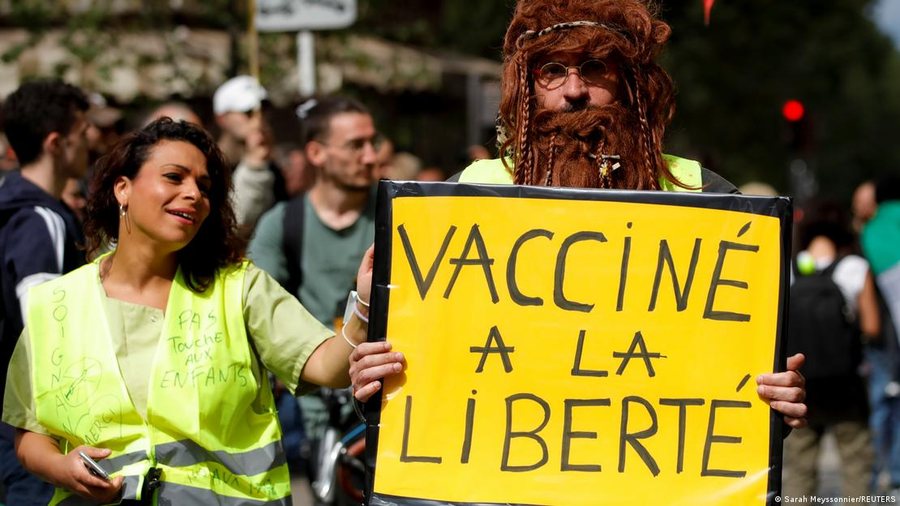
May 5, 2017 was a turning point for France: hackers posted 20,000 e-mails of Emmanuel Macron's then-electoral team on a website. The hacking took place directly before the May 7, 2017 runoff election between presidential candidates Macron and Marine Le Pen.
It was clear to the employees of the election team at the time that "We were dealing with a massive and coordinated hacker attack, which aimed to destabilize democracy." It is not clear who was responsible for the maneuver, according to the French daily "Le Monde", the attack was carried out by hackers who had been commissioned by Russia.
Actions and not words
Macron's so-called "unwanted information leaks" did not prevent his election as president. But they made people in France start to think differently. Meanwhile, the country is among the vanguard countries fighting the manipulation of information, experts say. This success could be especially important for the June 6 European elections and the Summer Olympics.
"Since 2017 we have been aware of how dangerous disinformation is," explains Marc-Antoine Brillant in a conversation with Deutsche Wellen.
He is the head of the French center (Viginum) for the control of digital influence from foreign countries and has 50 employees.
This center was created in 2021 and depends on the prime minister. "The recent yellow vest demonstrations of 2018, Corona, the assassination of history teacher Samuel Pati in October 2020, show that the manipulation has become more massive," says Brillant.
Frivolous information with a serious cover
Viginum regularly uncovers misinformation. This includes the so-called "Sozitë" campaign that took place in seven EU countries. In this campaign, false news from media outlets that on the surface appear to be popular media, but in fact are counterfeit brands.The objective was to justify the Russian occupation of Ukraine.
Or the so-called "Network-Portal-Kombat": 193 websites were created by an enterprise of the Crimean peninsula, occupied since 2014 by Russia, from where pro-Russian propaganda was distributed in France, Germany and Poland.
Warning: Attack!
"Viginum is a democratic, transparent way to fight such attacks, with the rule of law," says Brillant. "We create resistance, making people aware of the existence of such attacks."
France is among the vanguard countries, points out Jiore Craig, research associate at the London-based Institute for Strategic Dialogue. The digital integrity specialist has been dealing with the manipulation of elections around the world since 2013. "Since the US elections and the Brexit referendum in 2016, we know that fake information seeks to undermine our democracy," she tells Deutsche Wellen.
"Fact checks are not enough"
"The European parliamentary elections of 2019 and Corona have shown that fact-checking alone is not enough. What we need is a systematic approach that shows us who is spreading false news on which internet networks. This concept has been put in place by France be one of the first places."
For David Colon, professor of history at the University of Political Sciences in Paris, says that it has been a while since we are no longer dealing only with the attributes "true" or "false". "The attackers try to create as much confusion as possible and try to destroy our trust in democratic institutions," he says confidently. Colon is one of France's leading experts on information manipulation issues. Ukraine is the turning point.These attacks, which came mainly from the Russian side, had started earlier.
"In February 2004 Dimitri Medvedev, Putin's loyal man and later the country's president, said that the Kremlin should support European parties that are against the system - according to Moscow in France these parties are the extreme right party RN of former presidential candidate Marine Le Pen and the far left party, LFI,” he says.
Russia as the main actor of disinformation: "Sowing suspicion"
In 2014, Le Pen received a loan of nine million euros from a bank based in Prague, First Czech-Russian Bank. "By helping such parties, Russia wants to foment division in our society so that it destroys itself," Colon adds. France to organize the Olympic and Paralympic Games," he says.
Even Lutz Güllner, director of the sector for strategic communication in the European Ministry for Foreign Affairs (EAD), thinks that Russia is the main actor of disinformation. His department, with 42 employees, has created a network of European governments for the early warning of risks.
"France's structure is very well established," he emphasizes, and mentions another vanguard country: Sweden. "There, the so-called "Psychological Defense Agency" has been created, which deals mainly with detection but also with the reaction and creation of resistance through the campaigns of educational goals".
"France is not for nothing the target of manipulation campaigns," explains Arthur de Liedekerke. He is the director of European affairs at the Belgian consulting firm, Rasmussen Global, and previously worked as an adviser on strategic issues at the French Foreign Ministry. "Our army is present in several different countries, we often organize large high-level meetings and events where our politicians regularly present provocative issues, such as the one recently, according to which Macron does not support sending ground troops to Ukraine."
After the experience of the past years, the researcher Colon makes a positive balance of the systematic fight against disinformation: "France is perhaps often the target of these attacks, but now we are defending against them. It has been a while since France is no longer weak."/ DW



Lini një Përgjigje