


 Shkruar nga Johanna Treeck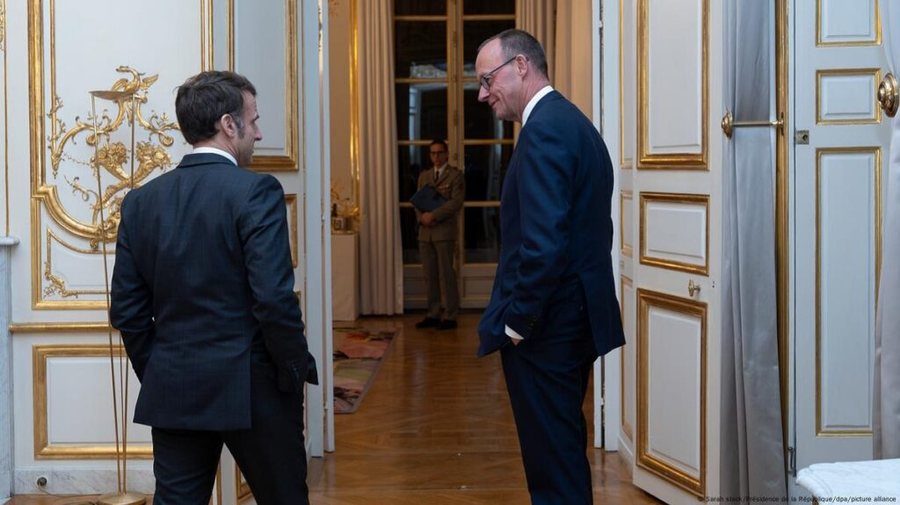
A typical European solution: symbolic, pragmatic, but unlikely to solve the fundamental problems of France or Germany.
The strange calm in financial markets that has accompanied the fall of yet another French government over budget problems owes less to a belief in France's strength than to an awareness of Germany's weakness.
With Russia's war in Ukraine continuing, the US withdrawal from Europe and the chaos of the German military, markets are betting that Berlin will do everything it can to avoid opening another front close to home, analysts say. They see Germany's silence in response to the unfolding events as implicit confirmation.
Prime Minister François Bayrou’s failure to secure parliamentary support for 44 billion euros in budget cuts for next year has deepened doubts about France’s ability to deliver long-needed reforms. France, which previously paid just a few cents more than Germany to borrow for 10 years, now has to pay more than Greece and as much as Italy.
However, fears that it will collapse under its debt burden have so far been contained. Despite this, ECB President Christine Lagarde has signaled a willingness to act, telling Radio Classique last week that the ECB is “closely monitoring” how much French borrowing costs are rising above those of Germany, a remark that some interpreted as a hint at deploying the central bank’s Transmission Protection Instrument (TPI) if necessary. The TPI allows the ECB to buy member countries’ bonds if it thinks unwarranted volatility is preventing its interest rates from working as intended.
In the past, such language from the ECB would have drawn an immediate rebuke from Berlin. When the CFI was created, Chancellor Friedrich Merz, the opposition leader at the time, criticized it as an unconstitutional overreach by the ECB, and then-Finance Minister Christian Lindner echoed his comments.
In a recent blog post, Robin Brooks, a senior fellow at the Brookings Institution in Washington, called the silence "extraordinary."
“These kinds of comments were Germany’s worst nightmare before the euro was introduced ,” Brooks wrote, adding that it has become a quasi-fiscal authority with its willingness to “micromanage” long-term bond yields.
Today, even members of Merz's CDU discuss ECB bond purchases with a nonchalance that would once have horrified the late Wolfgang Schäuble, a political architect of the euro and icon of austerity during the sovereign debt crisis.
“ All countries in the eurozone are in the same boat. If France is not able to reduce its national debt on its own, it will undoubtedly have to take measures to stabilize France’s precarious situation. This could include, for example, buying government bonds,” said CDU lawmaker Roderich Kiesewetter. While Kiesewetter’s comments may not be the official line, he is still a member of the Bundestag’s foreign affairs committee.
Clemens Fuest, head of the ifo research organization, attributes the new tone to Berlin's realization that it cannot afford tensions with Paris, Europe's most powerful military power, at a time when security concerns are so acute.
"Geopolitical pressures on Europe are great and Franco-German cooperation is more important than ever. France is the only nuclear power in the EU ," he said.
Fuest also sees the silence as a sign of good diplomacy. "German politicians know that calls for austerity measures from Germany would be counterproductive in the current situation. They would only serve as fodder for parties on the right and left of the spectrum," he said.
Jurgen Stark, who resigned from his post as ECB chief economist in 2011 over the bond-buying issue, sees things more bleakly.
“Germany’s silence is also a sign of helplessness. They want to avoid follow-up questions about what Germany will do if markets stop trusting France. Would Germany be willing to offer bilateral aid? Would they agree to more joint debt issuance, or would they allow the ECB to activate the CPI? ” he told POLITICO.
Berenberg's chief economist, Holger Schmieding, thinks the answer is that Germany will accept ECB bond purchases through the TPI if things get worse, but only after growing market pressures force Paris to take sufficient steps in the right direction.
Stark and Michels believe the most likely way out of the current impasse is for Germany to pursue some kind of plan under which the EU effectively takes over more of France's borrowing. Michels argued that French President Emmanuel Macron could signal the collapse of his government and use the risk of the far-right National Rally forming the next government to pressure Berlin into a new borrowing deal.
Merz had spoken out strongly against any expansion or extension of joint borrowing soon after coming to power earlier this year, but may find his hand forced, influenced by circumstances, the two argued.
“France will open its nuclear umbrella and Germany will open its wallet,” Michels said in what Stark called “a typical European solution”: symbolic, pragmatic, but unlikely to solve the fundamental problems of France or Germany. / Adapted from “Pamphlet” by “Politico”




Lini një Përgjigje