


 Shkruar nga Pamfleti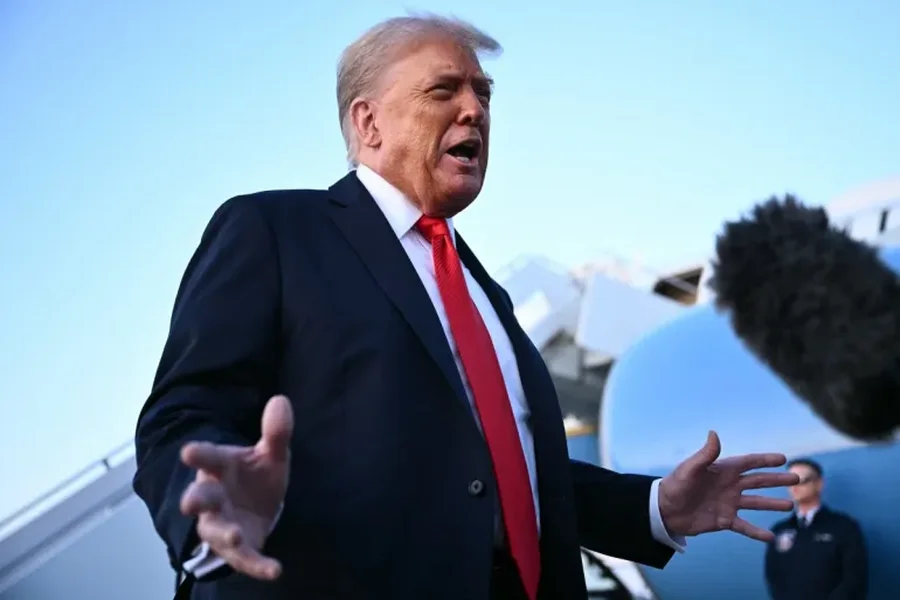
In an effort to end Russia's war in Ukraine, the US president is proposing tariffs targeting Vladimir Putin's main trading partners...
US President Donald Trump has called on NATO and EU member states to impose tariffs of up to 100% against China and India, with the aim of forcing Russian President Vladimir Putin to stop the war in Ukraine.
Trump, who had previously vowed to end the conflict "on day one" of taking office, made the demand during a meeting between US and European Union officials last week. The move is seen as an attempt to speed up a peace deal between Moscow and Kiev.
Trump’s request, first reported by the Financial Times, follows statements by US Treasury Secretary Scott Bessent, who said Washington was preparing stronger economic measures against Russia but wanted greater European support. In a letter published on September 13 in Truth Social, Trump wrote that he was “ready to impose major sanctions on Russia” once NATO agreed to do the same. He also claimed that high tariffs on China would weaken Beijing’s “control” over Russia.
The main reason is that China and India are the biggest buyers of Russian oil, which keeps Moscow’s economy afloat. China alone imported 109 million tons of crude oil last year, accounting for about 20% of its energy imports. India imported 88 million tons, about 35% of its imports. Trump has already imposed an additional 25% tariff on India on Russian oil, but has been reluctant to do the same with China because of the trade truce between the two countries.
However, on Saturday, he called on NATO to impose 50–100% tariffs on China to weaken its influence over Russia. According to Trump, a ban on Russian energy purchases, combined with high tariffs on Beijing, would go a long way to ending the war.
Meanwhile, Europe's dependence on Russian energy has fallen sharply since February 2022, when the full-scale invasion of Ukraine began. At the time, the EU imported 45% of its natural gas from Russia, while this year that figure is expected to drop to 13%. But Trump wants Europe to do even more.
The calls come at a time of heightened tension between NATO and Russia, following the violation of Polish and Romanian airspace by Russian drones. Poland called the incident a deliberate provocation, while Romania scrambled fighter jets to intercept a similar drone. France and Germany have warned of sending additional forces to NATO's eastern flank.
In an interview with Fox News, Trump said his patience with Putin was “running out,” following face-to-face talks in Alaska and intensified airstrikes on Ukraine, including the largest airstrike Russia has ever carried out this month. “We’re going to have to act very, very strongly,” he declared, warning of new sanctions on Russian banks and energy.
However, Trump’s efforts to use tariffs as a leverage tool have been questioned within the US. In May, a US trade court ruled that the tariffs “exceed any authority granted to the president” under the IEEPA. An appeals court upheld that ruling in August, and the case is now before the Supreme Court, where a decision is expected in November.
For its part, the EU has a high dependence on Chinese imports: bilateral trade between Brussels and Beijing reached 732 billion euros in 2024, with a deficit of 305 billion euros in favor of China. The main European imports from China are consumer electronics, heavy industrial equipment and textiles. From India, the figures are much smaller: the EU had a deficit of only 22.5 billion euros. This makes it very difficult for Europe to impose such tariffs without major consequences for its industrial chains and prices for consumers.
However, some EU countries have expressed readiness for targeted measures against China. On September 12, G7 finance ministers (including France, Germany, and Italy) discussed new sanctions against Russia and tariffs on countries deemed to be “supporters” of the war in Ukraine.
On the other hand, there are contradictions even within NATO: Turkey, a member state, is the third largest buyer of Russian oil products after China and India. Hungary and Slovakia also continue to import Russian energy.
Within hours of Trump's statement, Beijing responded by saying that China does not engage in wars and that sanctions "only complicate problems." Chinese Foreign Minister Wang Yi said that war is not a solution. On Monday, U.S. Treasury Secretary Bessent will meet with Chinese Vice Premier He Lifeng in Madrid to ease trade tensions.
At the same time, Trump stressed that negotiations with India on trade issues are going well and that a quick agreement with Prime Minister Modi is expected. The latter confirmed that the countries are "natural partners and close friends" and that the relevant teams are working to conclude the agreement as soon as possible. /Adapted from "Al Jazeera"


Lini një Përgjigje