


 Shkruar nga Pamfleti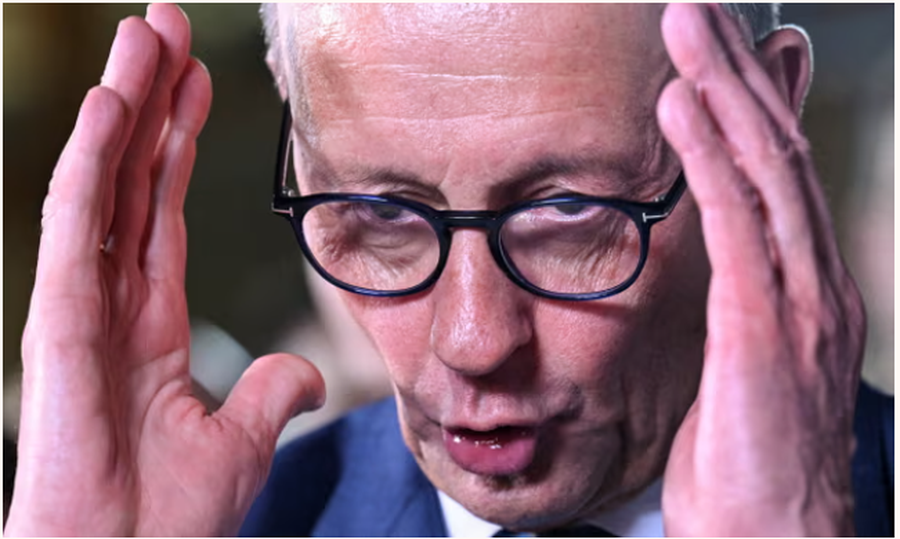
It was heartening to hear the chancellor-elect deny this unprecedented interference in German affairs. He must know that the vindictive Trump administration will most likely want to make him regret his choice of words.
It is difficult to overstate the importance of Friedrich Merz’s urgent message to the nation after his victory in the German elections. After all, this is the beginning of a new, dangerous era in European security. It would be “an absolute priority,” Merz said, immediately after the CDU/CSU victory was confirmed, to create unity in Europe as quickly as possible, “so that step by step we can achieve independence from the US.”
He added: "I never thought I would have to say something like that on a television program."
Indeed. For the leader of the conservative CDU, a lifelong believer in the transatlantic security alliance, this is a significant change. And it is deeply personal for Merz: there is hardly a more pro-American politician in Germany than the man who worked for the investment company BlackRock and was long-time chairman of the influential lobbying group Atlantik-Brücke (Atlantic Bridge).
Washington's interference in the German election campaign had been "no less dramatic and drastic and ultimately savage than the interventions we have seen from Moscow," Merz said, referring to Elon Musk's increasingly rabid support for the far-right AfD and the controversies of US Vice President JD Vance.
Germany was under "massive pressure from both sides" and Donald Trump's government was "largely indifferent to the fate of Europe", Merz said, warning that it was unclear whether, by the NATO summit in June, "we will still be talking about NATO in its current form or whether we will have to create an independent European defence capability much sooner".
The unusual frankness of his comments reflects a deep frustration that has built up in traditionally pro-US conservative circles in Germany, particularly over the interventions led by Musk and Vance. Their coordinated campaign sought to undermine the center-right Christian Democrats in favor of the far right in the run-up to the vote. Musk posted a flurry of tweets on his X platform, including several on election day. He has also tweeted his support for one of the AfD’s most extreme supporters, Björn Höcke – a man convicted twice of using Nazi slogans.
Even more intrusive were Vance’s repeated statements linking the CDU’s firewall policy, which keeps the AfD out of power, to the US security guarantee for Europe. The vice president’s threatening message to Germany was: if you continue to exclude the far right from power, the US can’t do much for you.
It was heartening to hear the chancellor-elect deny this unprecedented interference in German affairs. He must know that the vindictive Trump administration will most likely want to make him regret his choice of words.
There is an irony here in that Merz had tried Trumpism just a few weeks earlier, when he reacted to a series of violent attacks in Germany by announcing a tough migration policy that he would implement “on day one” as chancellor. He put pressure on the center-left parties, the Social Democrats, and the Greens. If they refused to support him, he would have no choice but to accept the far-right votes for his proposals. To the shock of many, Merz’s non-binding motion (which included controversial measures such as pushing all asylum seekers back to the border) was passed with AfD votes.
This left Merz with a mixed message for the rest of the campaign: he promised radical change but continued to vow not to cooperate with the far right. Key voters who wanted a more restrictive migration policy but not with the help of the far right were left with doubts: how trustworthy was Merz? Would he do it again? The conservatives’ crushing performance in the election is evidence of his miscalculation.
To make matters worse, Merz had made his stance on the AfD clear, saying it lacked the stability to pursue and form a right-wing majority coalition. Our hand remains outstretched, AfD co-leader Alice Weidel has maliciously repeated since election day, but if you continue to close the door on us, we will crush you next time.
Expect to hear this song a lot in the coming weeks. Merz’s gambit backfired. His only option now is coalition talks with the dwindling Social Democrats. If the two parties manage to form a government, it can hardly be called a “grand coalition.” The two “people’s parties” barely manage to reach a majority in parliament.
However, there is an opportunity arising from these pressures. The Social Democrats may find it easier to compromise on migration policy when in coalition with the Conservatives. The next government must urgently exercise more border control to counter the far-right narrative.
Merz’s candid assessment of an emerging post-transatlantic order opens up a long-overdue debate in Germany. It is, in fact, a remarkable moment for the country’s strategic defense community, an overturning of the core beliefs that have guided Germany for the past 80 years.
It was the CDU that irrevocably tied Germany to the Western alliance. This was a major historical achievement, because it was not at all popular at the time, especially among German conservatives who had traditionally been anti-US. Konrad Adenauer, the first post-war chancellor, risked all the political capital he had when he led a fiercely anti-Western and pacifist Germany towards rearmament and NATO membership in 1955. Moreover, he rejected the alternative path suggested by the French president, Charles de Gaulle, of opting for a European defence community.
All German governments since Adenauer, regardless of their left or right leanings, had argued against the French project of "European strategic autonomy" for fear that it would weaken NATO. A security partnership with the US was the indispensable guarantee of peace on the continent. But now the US government is questioning NATO, thus making a more independent Europe a necessity.
The consequences are not limited to the continent. Merz wants to explore closer security cooperation with London, and he already has his eyes on the UK’s nuclear arsenal, as well as France’s. What a twist: Germany, once proud of its nuclear-free future, is buying a new nuclear umbrella.
Ironically, these worrying twists could help Merz succeed in forming a coalition with the Social Democrats. Reforming the strict fiscal regime known as the Schuldenbremse, or “debt brake,” has always been a source of friction between them.
The rigid borrowing limit, stipulated in the German constitution, must be exceeded. Everyone knows this: there is no way to replace the protection provided by the US while maintaining a balanced budget.
Changing the constitutional debt limit requires a two-thirds majority in the Bundestag, which leads to the ultimate irony: Merz will have to make a deal with the parties on the left to win their support for spending cuts. More budget for defense, but also for infrastructure investment. Only a conservative could do this, just as only Richard Nixon could go to China.
There is a lot of poetic justice in this development. Merz has gone from flirting with Trumpism to easing Germany's austerity policies in just a few weeks. /Adapted from The Guardian Pamphlet/



Lini një Përgjigje