


 Shkruar nga Pamfleti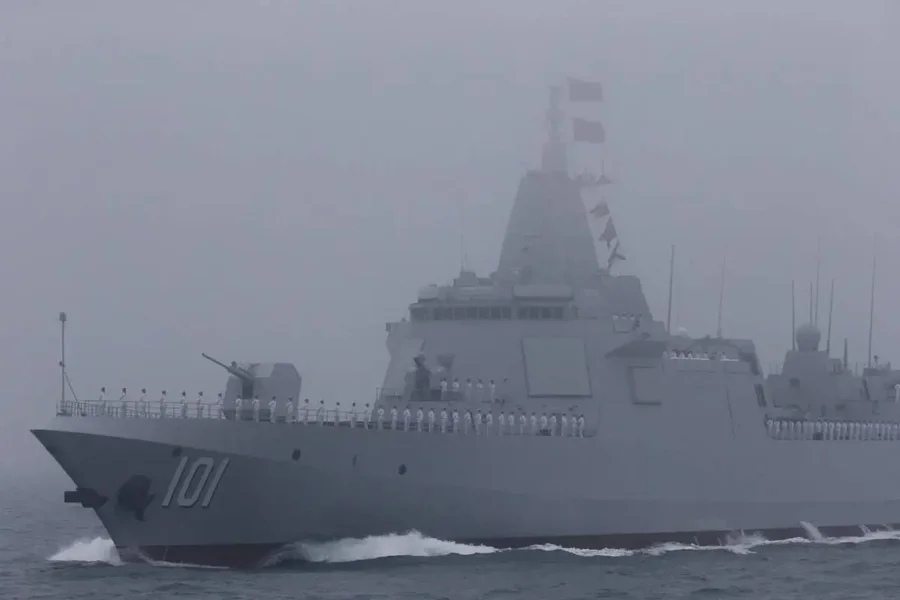
China is reportedly mobilizing an armada of civilian ships that could contribute to a phantom invasion of Taiwan, a mission that, if realized, could rival the Normandy landings of World War II.
Reuters used tracking data from these ships, referred to as the shadow fleet, and satellite imagery to monitor the role these ships played in recent summer naval exercises. The operations reportedly revealed that China is developing concrete invasion plans and experimenting with new techniques to speed up the landing of troops and equipment on beaches in an effort to overwhelm Taiwan's defenders.
China's strange moves
Analysts are focusing on two types of ships: decked cargo ships and ferries. These are the same ships that were seen moving from northern China to land on a beach in the southern province of Guangdong. This fleet, made up of dozens of ships, is said to have organized several amphibious operations, reenacting a hypothetical offensive against Taiwan. Earlier this month, Beijing also launched the latest sign of its growing naval power with the commissioning of its third aircraft carrier, the Fujian, an 80,000-ton naval colossus. “The Taiwan issue is purely China’s internal affair and how it is resolved is entirely a matter for the Chinese people,” the Chinese Foreign Ministry continues to repeat.
On the other hand, Taiwan's Defense Minister, Wellington Koo, explained that the island maintains "continuous surveillance" over China's use of roll-on-roll-off ships.
"We closely monitor how they support military operations," Koo said, adding that Taipei has "developed relevant contingency plans."
However, beware of the Dragon Muscle: the arsenal of weapons displayed by Xi Jinping during the recent mega-parade included amphibious assault vehicles essential for taking control of Taiwan. Moreover, with specialized cargo ships and ferries, combined with the world's largest navy, Beijing can fully utilize its vast naval power to prepare for an attack on Taiwan.
Dragon Ships
China's use of civilian cargo ships in this summer's exercises represents "a significant step forward" toward being able to transport sufficient troops, equipment and supplies to Taiwan's beaches as part of an invasion, said Thomas Shugart, a former U.S. submarine officer who closely follows the Chinese navy.
“This is a very significant development,” Shugart said, referring to China’s use of decked cargo ships to unload vehicles directly onto the beach, which he recently wrote about in X.
China's civilian ships are the product of its vast merchant shipbuilding industry. In less than 30 years, Chinese shipyards have built the world's largest navy and now account for approximately 53% of global shipbuilding. This vast merchant fleet would be crucial in a full-scale invasion of Taiwan.
Of course, China's advances in training, tactics, and equipment would not necessarily guarantee success. Invading the island would pose a major challenge for a landing force launched from the Chinese coast. The waters of the Taiwan Strait are also dangerous, with storms, rough seas, strong tides, and fog.
High mountains stretch along much of Taiwan's east coast, and the few more suitable landing sites on the densely populated northern and western coasts, closer to China, are closed off by Taipei.
However, Beijing is scaring Taipei...








Lini një Përgjigje