


 Shkruar nga Jacopo Barigazzi
Donald Trump's claims over the island nation could derail the Copenhagen EU Council presidency at any time...
Denmark is taking the lead on EU affairs. Just don't tell Donald Trump.
This is a joke that is spreading in Brussels, as the government in Copenhagen prepares to begin its presidency of the Council of the EU, but seeks to avoid a war of words, or worse, a war with the US president over Greenland.
The fear among some diplomats and officials is that Trump could use the greater visibility of Denmark, which considers Greenland as territory, to increase his provocations.
Copenhagen is trying to keep a low profile, talking instead about its EU agenda on migration, defense, security and climate.
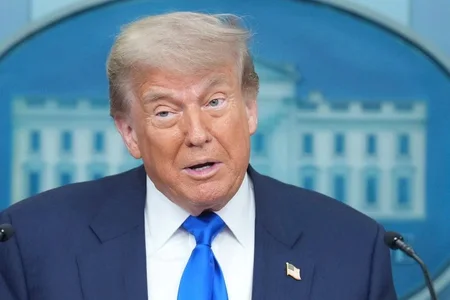
Since taking office, Trump has made outlandish claims over Greenland, citing security reasons to gain control of the mineral-rich, independent Danish territory, and even repeatedly threatening to use military force. "We're going to take Greenland. Yes, 100 percent," he told CNN in March.
Trump could use tougher language "if the focus on Denmark is much higher and if Donald Trump really finds out what the EU Council presidency is," said Rasmus Grand Berthelsen, senior director at Rasmussen Global, a political consulting firm.
A new escalation on this issue would inadvertently draw the European Union and its national member governments even further into this debate.
“It is clear that, with the Danish presidency, the topic of Greenland's sovereignty will naturally become even more prominent,” said Brando Benifei, chairman of the European Parliament Delegation for Relations with the United States.
But, according to him, "this is now a red line for European governments and for all institutions: any attack on Greenland's freedoms is an attack on Europe."
Denmark has worked hard to avoid further confrontation with the US on this issue.
A Danish official with knowledge of the presidency preparation, who was granted anonymity to discuss internal opinion, said: “We do not expect the US administration’s approach to Greenland to affect the Danish presidency of the Council. From the beginning, we have received clear support from EU institutions and member states on this issue.”
"Even in a situation where it might be of interest to discuss issues related to Greenland at the European level, this would be the prerogative of the European Council [of EU leaders] and the Foreign Affairs Council [which brings together foreign ministers], which are not chaired by the current Council presidency," the Danish official said.
Denmark's presidency begins just days after the NATO summit on June 24-25 in The Hague, where allies are expected to agree on a new defense spending target of 5 percent of national gross domestic product.
The Danish presidency will play a key role in negotiating legislative files that will determine how European Union members will increase their protection.
But in Brussels, diplomats fear that Trump's threats against Greenland could surface at any time and derail the Copenhagen agenda.
Trump's slogan "Make America Great Again" "has become a geographical concept; he wants to go down in history as the man who made America 'greater' in geographical terms," said an EU diplomat, who was granted anonymity to speak freely.
When US Vice President JD Vance accused Denmark of insufficient investment in Greenland, Danish Foreign Minister Lars Løkke Rasmussen responded with a video in English saying: “Of course we are open to criticism, but let me be completely honest: We do not appreciate the tone in which it is being spoken.”
According to press reports, Denmark has even hired a lobbying firm to help make its voice heard in the US capital.
Meanwhile, EU leaders have expressed solidarity with Denmark. The most likely response to any new escalation would be a text agreed by European heads of state.
For years, Denmark had an opt-out from participating in the EU's common defense policy. But after Russia invaded Ukraine in 2022, Danish citizens voted to remove the opt-out.
This has made Denmark, along with the newest NATO members, Sweden and Finland, part of a bloc of countries that are fully integrated into both the transatlantic alliance and EU defense policy. All three are also close to the Baltic states and strongly support Ukraine.
Trump's threats have convinced Denmark's socialist Prime Minister Mette Frederiksen of the need for a strong EU, said an official with knowledge of Frederiksen's thinking.
One question is whether the bloc will ever include Greenland itself.
The Arctic country, the world's largest island that is not a continent, is home to Pituffik Space Base, a US-operated installation in northwest Greenland. Pituffik is one of the most strategically important military sites in the world; if Russian President Vladimir Putin were to launch missiles towards the US, their shortest route would be through the North Pole and Greenland.
One option would be to try to bring Greenland back into the EU, said former Lithuanian Foreign Minister Gabrielius Landsbergis. “If we invite Greenland back into the EU, I think that would... potentially change Trump’s narrative,” he said. /Adapted from Politico Pamphlet /





Lini një Përgjigje