


 Shkruar nga Michael George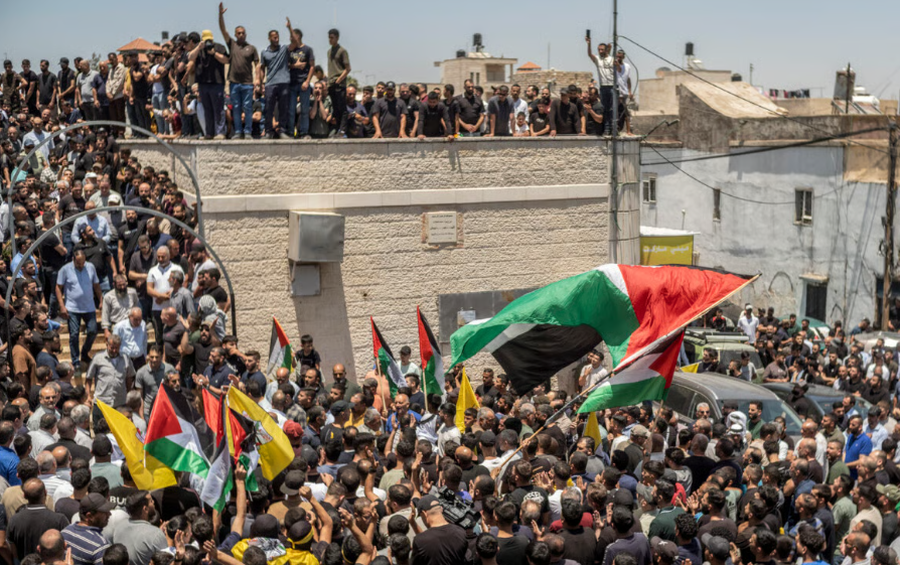
The most violent attack in a month against the village of Kufr Malik: houses burned and bullets, three young Palestinians killed…
"There were dozens, maybe more, all armed. They shot to kill, not to injure. Do you understand? They weren't trying to scare us, they wanted to kill us. They tried to set fire to the houses, cars and land at the foot of the village."
Atef Al Naji tells us about the horrific night experienced by the people of Kufr Malik, occupied on Wednesday evening at sunset by dozens of Israeli settlers.
"The three martyrs," he adds, "were hit when we tried to resist the aggression. The Israeli army arrived after the settlers, not to protect us, but to help them. We can't say for sure who shot at the boys who were killed: all the Israelis were shooting. And anyway, it doesn't matter, the soldiers and the settlers are the same. They came here and killed Muhammad Al Naji, Lutfi Bairat and Murshid Hamayel. Three lives were taken suddenly, for no reason."
Atef Al Naji is a relative of Muhammad Al Naji and, with the rest of the family, greets and thanks those who come to express their condolences. Behind us is the traditional tent set up for the three days of Islamic mourning. Dozens of plastic chairs are lined up to welcome the residents of Kufr Malik, who come and go.
People enter, shake hands with the victims' families, sit down and, after drinking the coffee served on these occasions of mourning, leave, making way for newcomers. Yellow flags with the Fatah symbol wave around, but no one confirms the affiliation of the three victims with the political movement led by the president of the Palestinian National Authority, Abu Mazen.
There is no doubt: it was a planned attack, one of the most violent in the last two years. The settlers arrived with rifles, ammunition, Molotov cocktails; they set houses on fire and, according to witnesses, fired into the air to spread panic. Israeli soldiers, others report, arrived an hour later. But when the residents of Kufr Malik tried to protest against the settler violence, even throwing stones, shooting began at the Palestinians. The bodies of the three young men were left on the asphalt. The army admitted that it had opened fire on the demonstrators.
The incident is part of a broader strategy that has been suffocating Palestinian communities in the eastern West Bank for months, especially between Ramallah and Nablus. Smaller and more isolated villages are being attacked by settlers, often teenagers, who are busy setting up new checkpoints everywhere. Sinjil, Deir Diwban, Taybeh, Turmus Ayya, Abu Falah, Al-Mughayyir are just some of the centers hit several times. Residents are resisting, but some are fleeing for fear of increasingly serious violence. There are also revenge attacks. According to some, Kufr Malik was also attacked because of the seven Israeli soldiers killed days earlier in Khan Yunis (Gaza) by an explosive device.
"Life has become impossible," Saber Amin, who lived in New York for 15 years and returned to the village 10 years ago, told Il Manifesto. "Since the day I returned, I have noticed a constant deterioration of the situation and an increase in violence by settlers and soldiers. Kufr Malik is increasingly surrounded, we only have one access road to the village and when the army closes it, we become prisoners. Children and young people, to go to school, have to travel along the village roads because they can no longer pass by the military posts and settler posts. They want to push us to leave." It is time for prayer. Those present fall silent, then begin to recite them under the lenses of local and foreign television cameras.
With the death of 3 young people in Kufr Malik, the number of Palestinians killed in the West Bank since the beginning of 2025 rises to 164, 9 of whom in the Ramallah and al-Bireh areas alone. The spiral of violence and attacks seems unstoppable: earlier this week, again near Kufr Malik, Israeli forces killed 13-year-old Ammar Hamayel. Witnesses recall that he was left on the asphalt: soldiers prevented ambulances from intervening immediately. Taken to the Ramallah hospital, he died a short time later. On Wednesday, in Yamoun (Jenin), another boy was killed: Rayan Hawshiya, 14, hit in the neck by a bullet fired by the army during a check.
In Surif, in the southern West Bank, settlers set fire to cultivated fields near the al Quraynat area on Thursday. Residents rushing to put out the flames were met with gunfire from soldiers. Muhammad al Hour, 48, was killed by a bullet to the throat; his brother Ali was among eight seriously wounded. Mayor Hazem Ghneimat said the settlers had set up a new outpost between Surif and al-Jabaa, protected by the army. In East Jerusalem, two days earlier, Zahia Al Obaidi, 66, was killed during another police raid in the Shuafat refugee camp. Officers were looking for her husband for questioning, but the bullet hit him.
The camp, which has been subjected to constant military operations, arrests, demolitions and threats, has woken up with another victim to mourn. The harassment, provocations and threats are increasing.
In Turmus Ayya, a few kilometers from Kufr Malik, young settlers attacked Palestinian drivers by spraying them with pepper spray and throwing stones at cars stopped at traffic lights near the Shilo settlement.
The Israeli armed forces, which in the northern West Bank continue the "Iron Wall" offensive in the refugee camps of Jenin, Tulkarem, Nur Shams and Faraa, claim to be committed to "restoring order" and preventing "clashes between Palestinians and Israelis."
On the ground, the reality tells a different story. The Netanyahu government not only does not condemn the settler attacks, but, through figures such as ministers Itamar Ben-Gvir and Bezalel Smotrich, openly legitimizes them. /Adapted from Pamphlet by Il Manifesto/





Lini një Përgjigje