


 Shkruar nga Pamfleti
Donald Trump has said he is ready to move to a second phase of sanctions on Russia, just hours after Moscow launched the largest airstrike of the war so far.
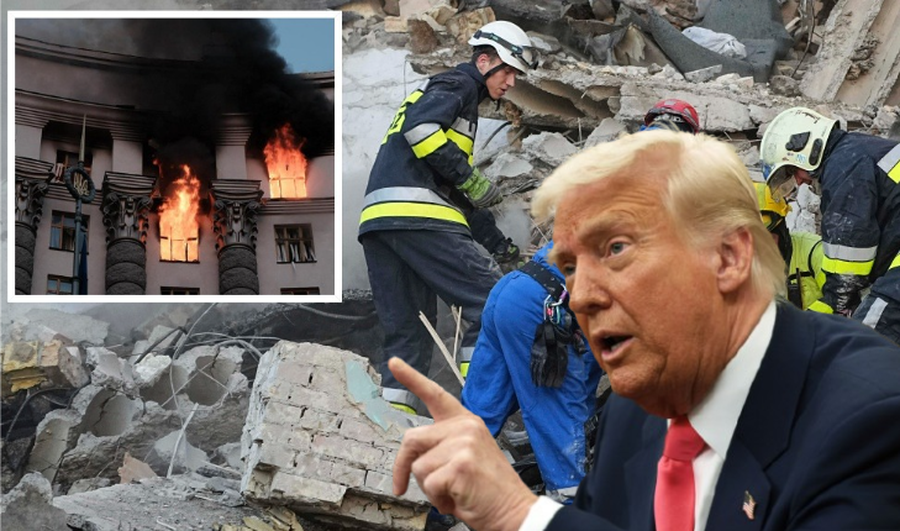
Donald Trump says he is "ready to impose new sanctions against Russia".
Treasury Secretary Scott Bessent explained to NBC television: "We are in a position to increase pressure on Russia, but we need our European partners to follow suit. If the US and the EU impose more secondary sanctions, the Russian economy will collapse and that will force Putin to sit at the negotiating table."
Bessent's words are very similar to those spoken by several European leaders, in particular French President Emmanuel Macron and British Prime Minister Keir Starmer, whenever they have had the opportunity to communicate with Trump.
But now European diplomats seem to be paying no attention. The key point, however, is to understand whether this time the American administration is talking seriously. In Paris, London, Berlin and Brussels, skepticism prevails. Giorgia Meloni's government remains, in general, the most credible. In the television interview, Bessent touched on another fundamental aspect: "The duel now is between the duration of the Ukrainian army's resistance and how long the Russian economy can hold out."
Several predictions are circulating about Moscow's resilience. One of the most accurate is the one formulated by NATO experts and presented last June, in The Hague, on the sidelines of the summit of heads of state and government. In the current conditions, the restoration of the production apparatus ordered by the Kremlin could feed the war machine for at least another two years. Can the Ukrainian resistance withstand another 24 months of bombing, attacks on the civilian population? Much of the answer depends on Trump's choices. But so far the American president has failed on every front. Let's leave aside the grotesque campaign slogan ("I will end the war in 24 hours"). What matters is that the leader of the White House has worsened both sides of the equation announced yesterday by his Treasury Secretary.
On the one hand, he continues to weaken the Ukrainian army in many ways. The most obvious: the Pentagon is no longer sending more weapons to Kiev, but is selling them to NATO allies, who are still struggling to find the resources needed to buy Patriot missiles, drones, and artillery ammunition. On the other hand, so far, Trump has effectively accepted the unacceptable conditions set by Putin to start negotiations.
Now the US president and Bessent are announcing a turnaround. It could be argued that Washington has already taken a significant step, punishing India, one of the buyers of Russian oil, with a 50% tariff on imports. Missing, however, is the other key player, China, which buys about 20% of Putin's total oil production, for a value estimated by Comtrade (the UN agency) at around $62 billion in 2024. Russian oil supplies to India are worth $52.7 billion.
Trump has started to hit New Delhi, without any political negotiation, simply thinking that Narendra Modi would bow down like other allies have done. Instead, he has achieved the opposite result. The Indian Prime Minister has not only not been convinced, but has openly shown, in front of the cameras, his rapprochement with Xi Jinping and Putin. So much so that now the American media is criticizing the president for pushing Modi into the camp of opponents.
At this point, Trump finds himself facing a difficult coalition. Rumor has it that he would like to try to re-engage with North Korean leader Kim Jong-un at the end of the year, with a face-to-face meeting. Meanwhile, the dictator has continued unabated to increase his nuclear arsenal, which has almost reached the level of the United Kingdom. Not to mention the fact that North Korea has sent thousands of soldiers to fight in the Russian region of Kursk against the Ukrainians./ Corriere della Sera



Lini një Përgjigje