


 Shkruar nga Pamfleti
After Hormuz, tensions in the Middle East shift attention to the "Gate of Tears," a key hub for oil and maritime transport...
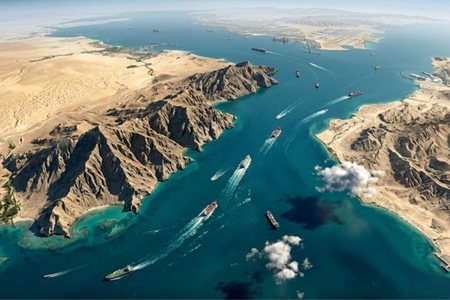
For weeks, global markets have focused their attention on the Strait of Hormuz, one of the most important arteries for the supply of oil and gas. But the escalation of the conflict in the Middle East and the involvement of Houthi rebels in Yemen are highlighting another critical point: the Bab el-Mandeb Strait, which connects the Red Sea with the Gulf of Aden and further to the Indian Ocean.
Known as the “Gate of Tears,” from the Arabic Bab el-Mandeb, this strait has historically been synonymous with danger to navigation. At around 113 kilometers long and just 32 kilometers wide, it is one of the most sensitive “straits” of global maritime traffic. Under normal conditions, about 12% of the world’s oil trade transported by ship passes through it.
Its importance is also direct for Europe and the Mediterranean, as it constitutes the southern entrance to the Suez Canal. Any disruption at this point is immediately reflected in the flow of goods and energy to the continent.
Traffic already reduced
Even before the recent escalation with Iran, the Bab el-Mandeb had become a high-risk area. During the 2023 Gaza war, Houthi rebels hit several ships with drones and missiles, forcing companies to avoid the Red Sea and the Suez Canal.
Following the recent US and Israeli attacks on Iran, many shipping companies have suspended passage through the corridor. According to Bloomberg data, traffic in the Suez had fallen from about 75 ships a day to just 32 — and since the outbreak of the conflict, it has shrunk even further.
According to Alessandro Pitto, president of the Italian Federation of International Transport Companies (Fedespedi), the situation is now clear: the crossing of the Red Sea is practically avoidable.
The Houthi threat
Against this backdrop, recent statements by the Houthi rebels have heightened tensions. A senior Houthi official has warned that closing the strait is a real option, in coordination with Iran and its allies.
However, according to sector experts, even without a formal closure, the effect is already the same: companies no longer use this route due to the high risk.
Alternative route: Africa
Faced with this situation, the maritime industry has adapted by using a longer and more costly route: circumnavigating Africa via the Cape of Good Hope.
This alternative has now become standard for connections between Europe and Asia. Meanwhile, for the Middle Eastern regions, hybrid solutions have been created — combining sea and land transport to avoid risk areas.
Much higher costs and delays
The economic consequences are significant. The cost of shipping a container can reach up to $10,000, compared to less than $1,000 before the crisis. So, an increase of up to tenfold.
But the problem is not just financial. Alternative routes are longer, ports are busier, and delivery times are becoming more unpredictable. Moreover, the existing infrastructure is not designed to fully replace large hubs like Jebel Ali, one of the world's most important ports.
A crisis that is displaced, not resolved
The situation shows that the global supply crisis is not limited to a single point. While Hormuz remains in the spotlight, Bab el-Mandeb is emerging as another critical node that could directly affect global trade.
At this stage, traffic is not officially blocked — but in practice, the road is increasingly less usable. And that is enough to change the balance of international trade. / Adapted from "Corriere Della Sera"






Lini një Përgjigje