


 Shkruar nga Pamfleti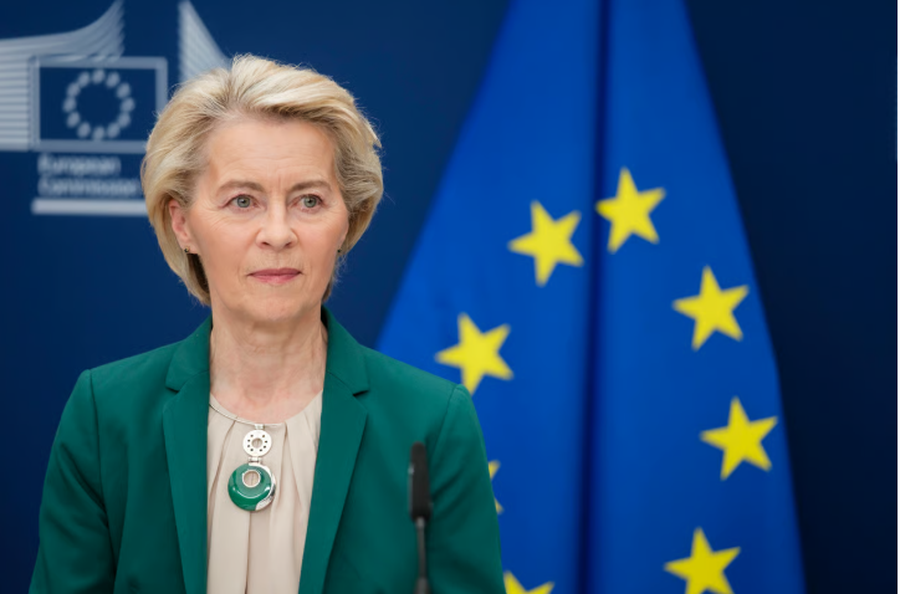
Ursula softened her approach to removing direct funding from Europe's regions...
The threat of internal revolt in the European Commission has prompted President Ursula von der Leyen to back down and promise more money for poor regions than previously thought when she presented her plan for the EU's seven-year budget.
Ursula von der Leyen has made a series of last-minute concessions in an attempt to appease two of her team members at opposite ends of the political spectrum: Italy's right-wing Raffaele Fitto and Romanian socialist Roxana Mînzatu.
Von der Leyen's turnaround is a signal of the path the President must take to keep her Commission's competing voices on side, while also offering a spending plan that will work for the increasingly unruly European Parliament and the 27 national governments, which must approve the budget before the end of 2027.
The move, which would see the Commission continue to allocate a large share of its funds to Europe's poorest areas from 2028, is seen as sufficient to secure the political support of the EU's 27 commissioners, two EU officials said.
“The regional dimension has not been completely lost” from the draft budget, said an EU official, who, like others quoted in this article, was granted anonymity to speak freely.
Von der Leyen's decision is a retreat from her initial plan to significantly increase the power of central governments in managing EU regional funds, which are currently worth 400 billion euros and account for a third of the bloc's total spending.
The idea was that empowering national capitals would act as an incentive to complete reforms and reduce bureaucracy. However, critics said this would only have reinforced existing inequalities within individual countries, leaving regions out of the process.
Persistent doubts
The whole issue is a hot topic for the EU. Improving individual regions within countries has played a key role since the so-called cohesion policy was introduced in the 1970s to narrow the gap between the poorest and richest areas in Europe.
Critics welcomed von der Leyen's concessions, but they have lingering suspicions that this is nothing more than politics.
“They are only making minimal concessions, but their initial ideas were so unpopular that they were forced to give up,” said Siegfried Mureşan, the Parliament’s budget negotiator for von der Leyen’s center-right European People’s Party.
The latest move came after von der Leyen met with commissioners and senior officials over the weekend.
The Commission pledges to "reduce regional disparities in the Union and the backwardness of less-favoured regions and promote European territorial cooperation," according to the internal document.
However, these concessions are unlikely to be enough to quell criticism from lawmakers and some governments.
Supporters of cohesion policy are calling on von der Leyen to maintain a set of criteria, known as the Berlin formula, that allocates a large portion of money to underdeveloped regions across the bloc.
The document, which could still be revised before Wednesday's presentation, says the poorest countries, measured by total population, national wealth per capita, rural poverty and regional output per person, will still receive the bulk of the money.
But critics point out that central governments will have more say than before over the amount of this funding that should go to the regions.
"We have not yet seen any other credible alternative to the Berlin formula," Mureşan said, adding "we know that attempts to change it in the past have failed."
In a further late-night concession, the Commission kept alive the European Social Fund (ESF), which looks after training for young people and the unemployed, and other programmes that were believed to have disappeared from the budget.
This was a key demand from Mînzatu and the left-leaning Socialists and Democrats, who linked their support for von der Leyen in last week's no-confidence vote to preserving the ESF.
But the Commission's draft proposal did not attach a specific amount to the ESF, prompting a second EU official to say that "the socialists did not benefit much" from von der Leyen's support.
Slippery slope
Separately, Germany criticized the Commission for offering cheap loans to countries that spend more than specified in their spending plans.
The German government fears that this could become an obstacle to the introduction of a permanent EU-wide debt mechanism, which they have traditionally opposed.
"We support the Commission's reform course and are pleased with the bold proposals," said a German official.
He added that "debt instruments in the EU can only be an absolutely exceptional instrument in an acute crisis. A permanent debt instrument for general spending would be a red line for us."
However, Berlin is not the only one harboring these fears.
"The solution cannot be to borrow more money permanently to supplement national plans," said an EU diplomat, adding that this is closing one gap with another.
"This only leads to higher debts and even less fiscal space," he said. /Adapted from Politico Pamphlet/





Lini një Përgjigje