


 Shkruar nga Richard D.Wolff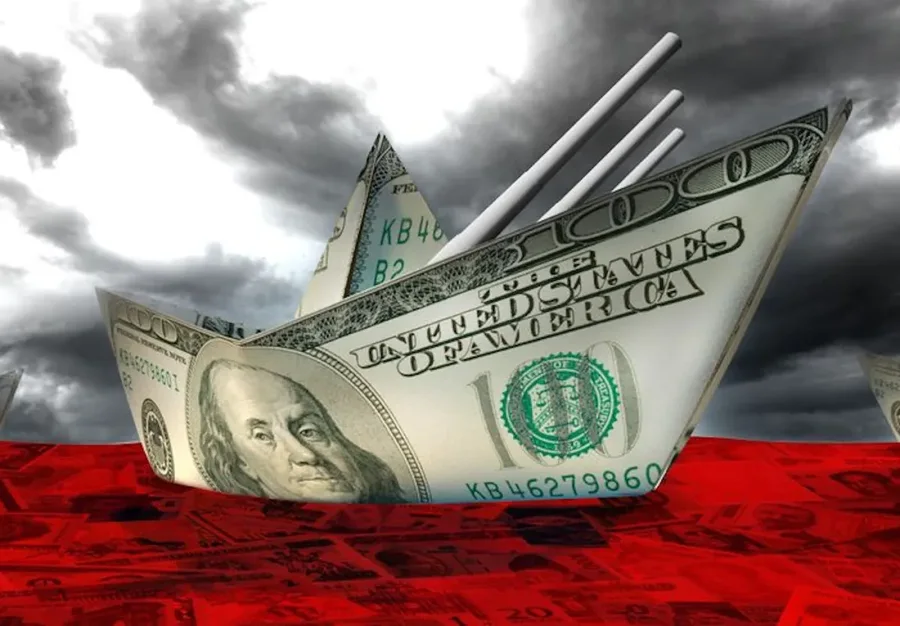
One sign is the decline of the US dollar as a central bank reserve. Another is its decline as a means of trade, credit and investment.
Evidence suggests that empires often respond to periods of decline by straining their crisis coping mechanisms. And military actions, infrastructure problems, and social welfare demands can combine or collide with each other, accumulating costs and adverse effects that the declining empire cannot manage.
Policies that were intended to strengthen the empire now undermine it. Contemporary social changes inside and outside the empire may reinforce, slow, or avert the decline. However, when decline leads leaders to deny its existence, it can become self-accelerating.
In the early years of empires, leaders may shun those who emphasize or simply mention decline. Social problems can be denied, minimized. Or even if they are accepted, they can be blamed on others: immigrants, foreign powers or ethnic minorities. The US empire, boldly proclaimed by the Monroe Doctrine, immediately after two wars of independence won against Great Britain, greatly strengthened during the 19th and 20th centuries, and reached its peak between 1945 and 2010. The expansion of the American empire happened in parallel with the decline of the British empire.
The Soviet Union represented a limited political and military challenge, but never any competition or serious economic threat. The Cold War was a one-sided contest whose outcome was predetermined from the start. All competitors or potential economic threats to the American empire were destroyed by World War II.
In the years that followed, Europe lost all its colonies. The unique global position of the United States, with its disproportionate position in world trade and investment, was anomalous and likely unstable. The United States was unable to militarily dominate all of Korea in the 1950-1953 war.
Also, the US lost its subsequent wars in Vietnam, Afghanistan and Iraq. The NATO alliance was not enough to change any of these outcomes. US military and financial support for Ukraine and economic warfare through US and NATO sanctions against Russia have been failures to date and are likely to remain so.
The US sanctions against Cuba, Iran and China have also failed. Meanwhile, the BRICS alliance is opposing US policies to protect its empire, including its war through sanctions, with increasing effectiveness. In the realm of trade, investment, and finance, we can measure the decline of the US empire differently.
One sign is the decline of the US dollar as a central bank reserve. Another is its decline as a means of trade, credit and investment. Finally, see the US dollar decline slightly as the preferred international vehicle for holding wealth. In the Global South, countries, industries or companies looking for trade, credit or investment went for decades to London, Washington or Paris.
Now they have other options: they can go to Beijing, New Delhi or Moscow, where they often provide more attractive conditions. The empire offers special advantages, which translate into tremendous profits for companies located in the country that dominates the empire.
And the decline of any empire can increase opportunities for competing empires. This could be our future with this century becoming "China's". But the history of this country also includes previous empires that rose and fell. Is it likely that China's past and its hybrid economy will influence Beijing to become not just the next empire but a truly multipolar global organization?
Can the dreams and hopes behind the League of Nations and the United Nations be realized if and when China does? Or will the latter become the next global hegemon against increased resistance from the US, bringing us closer to the danger of nuclear war?
A rough historical parallel may shed some additional light from another angle on where today's class of empires may lead us. The movement towards independence of its North American colony angered Great Britain so much that it waged 2 wars (1775-1783 and 1812-1815) to stop it.
Both of them failed. Thus Britain learned the valuable lesson that peaceful co-existence with some joint planning and accommodation would enable both economies to function and grow, including trade and investment on both sides across their borders.
That peaceful coexistence expanded, allowing the imperial ambitions of one to give way to those of the other. And why not hypothesize a similar trajectory for US-China relations over the next generation? Except for ideologues detached from reality, the world would prefer just that to the alternative of a nuclear war.
Addressing two major unintended consequences of capitalism—climate change and the unequal distribution of wealth and income—offers blueprints for a US-China partnership that the world would applaud. Capitalism changed a lot in both Britain and the US after 1815. It is likely to change again after 2025. The possibilities for this are very attractive./ Adapted "Pamphlet" from " Asia Times"
Note: Richard D. Wolff, professor of economics at the University of Massachusetts, Amherst, USA.





Lini një Përgjigje