


 Shkruar nga Giorgio Livas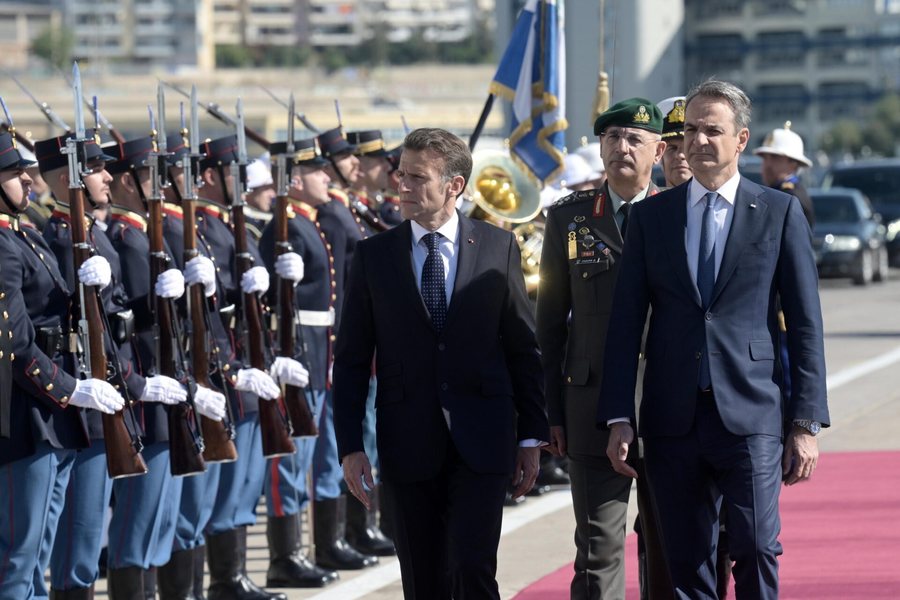
The meeting between Emmanuel Macron and Kyriakos Mitsotakis reaffirms the Franco-Hellenic strategic axis at a time of new tensions in the Eastern Mediterranean. Beyond military cooperation, Paris and Athens aim to build a common front in the face of Turkish ambitions and rivalries for regional influence.
The recent meeting between Emmanuel Macron and Kyriakos Mitsotakis in Athens was not simply a diplomatic summit between two European governments. Beyond the official photos, handshakes, military visits and declarations of strategic cooperation, something deeper stood out: the reaffirmation of a historical axis between France and Greece, spanning two centuries of European and Mediterranean history.
This relationship cannot be interpreted solely in military or geopolitical terms, because it affects identity, historical memory, civilization, and even the very concept of Europe.
The scene chosen for the meeting was not accidental.
The visit to the frigate "Kimon", symbol of the new Franco-Hellenic naval cooperation, clearly materialized Greece's new strategic positioning in the Eastern Mediterranean. After years of economic crisis and the contraction of its military capacities, Athens has launched one of the largest rearmament programs in its modern history, relying mainly on the partnership with Paris.
The purchase of 24 French Rafale fighter jets, three Belharra frigates and Exocet missile systems is not simply a technical or commercial choice, but a purely geopolitical decision. Franco-Hellenic military cooperation already exceeds the value of 5.5 billion euros.
For its part, France uses its privileged relationship with Greece to present itself as the main European military power with real projection capabilities in the Mediterranean. In a fragmented Europe, without a functioning common foreign policy and still dependent on the American security umbrella, Macron is trying to build the image of a France capable of acting as a strategic guarantor of the Mediterranean space.
Defending Greece also means defending France's own international role. However, within the Greek state apparatus, there is still a dilemma as to whether Paris would actually be willing to enter into a direct conflict with Ankara.
The Turkish issue and the "Blue Homeland" doctrine
At the center of this cooperation is inevitably the Turkish issue. The “Mavi Vatan” (Blue Homeland) doctrine, developed in recent years by the Turkish strategic establishment, has redefined Ankara’s approach to the Eastern Mediterranean.
Për Athinën, kjo doktrinë përbën një kërcënim të drejtpërdrejtë ndaj ekuilibrave në Egje, zonave ekonomike ekskluzive greko-qipriote dhe, më gjerësisht, pranisë helene në Mesdheun Lindor. Në këtë kontekst, forcimi i pranisë franceze merr një kuptim që shkon përtej bashkëpunimit dypalësh.
Edhe vendosja së fundmi e forcave detare franceze pranë Qipros, pas përshkallëzimit rajonal dhe tensioneve rreth bazës britanike të Akrotirit, është interpretuar nga shumë analistë jo vetëm si një mesazh ndaj Iranit apo Hezbollahut, por edhe si një sinjal i tërthortë frenues ndaj Turqisë.
Franca kërkon të tregojë se është e aftë të operojë në mënyrë të qëndrueshme në Mesdheun Lindor dhe të mbrojë aleatët e saj rajonalë.
“Konkurrenca” e Izraelit
Në këtë skenar, Izraeli mbetet ndoshta partneri ushtarak më efikas dhe operacional për Greqinë dhe Qipron në përballimin e ambicieve turke. Boshti energjetik dhe strategjik mes Jerusalemit, Athinës dhe Nikosias është konsoliduar vitet e fundit sidomos në fushën e inteligjencës, sigurisë dhe bashkëpunimit detar.
Megjithatë, Franca ofron diçka që Izraeli nuk mund ta ofrojë plotësisht në planin simbolik dhe diplomatik: legjitimitetin evropian. Parisi arrin që ta paraqesë mbrojtjen e Greqisë jo si një aleancë rajonale të zakonshme, por si mbrojtje të një kufiri evropian dhe mesdhetar.
Një lidhje me rrënjë historike të thella
Marrëdhënia mes Francës dhe botës helene nuk lindi sot. Rrënjët e saj shtrihen në shekullin XIX dhe lidhen me vetë lindjen e shtetit modern grek. Iluminizmi francez, Revolucioni Francez dhe luftërat napoleonike ndikuan në përhapjen e ideve kombëtare dhe revolucionare në Ballkan dhe në Mesdheun Lindor.
Shumë intelektualë grekë që përgatitën revolucionin e vitit 1821 u frymëzuan drejtpërdrejt nga kultura politike franceze. Për një pjesë të madhe të filohelenizmit evropian të kohës, çlirimi i Greqisë nuk përfaqësonte vetëm një luftë kombëtare kundër Perandorisë Osmane, por një ngjarje simbolike për vetë Evropën.
Greqia shihej si djepi i qytetërimit evropian dhe ringjallja e saj merrte pothuajse një dimension mesianik. Në kujtesën historike helene ka mbetur e fortë ideja se revolucioni grek hapi simbolikisht epokën e çlirimeve kombëtare evropiane të shekullit XIX.
Edhe gjatë shekullit XX, marrëdhënia me Francën ruajti një dimension pothuaj ekzistencial për një pjesë të elitës greke. Gjatë Diktaturës së Kolonelëve, shumë kundërshtarë politikë gjetën strehim në Paris.
Vetë Konstantinos Karamanlis jetoi në kryeqytetin francez gjatë mërgimit të tij. Franca u shndërrua kështu në një nga qendrat politike dhe kulturore të opozitës demokratike greke, duke forcuar më tej lidhjen mes dy vendeve.
Një marrëdhënie komplekse dhe kontradiktore
Megjithatë, marrëdhënia mes Francës dhe helenizmit nuk është pa ambiguitete. Nëse nga njëra anë Parisi shihet si aleat historik i Greqisë moderne, nga ana tjetër, në disa qarqe ortodokse tradicionaliste, Franca perceptohet si atdheu i iluminizmit radikal, shekullarizimit dhe laicizmit evropian.
Here the concept of “Romiosini” appears, the spiritual and cultural continuity of the Romano-Byzantine world within the Hellenic identity. For a part of conservative orthodox thought, the Western model born after the French Revolution has gradually distanced modern Hellenism from its Romano-Byzantine matrix.
Not a few monks or traditionalist circles view French secularism, anticlericalism, and the cultural transformations of contemporary Europe with distrust. In this polemical interpretation, the “Latin West” is often accused of having accelerated the de-Christianization of Europe.
In some of these circles, there is also a perception of Russia as a potential defender of traditional Orthodox values in the face of Western secularization.
However, behind Macron's Mediterranean protagonism lies an economic agenda. France plans over 430 billion euros in military spending for the period 2024–2030, with an increase of 36 billion euros for the armed forces.
But according to French media and the French Court of Audit, Paris's strategic ambitions could clash with increasingly obvious fiscal weaknesses and a level of public debt among the highest in the last fifteen years. As often in its history, France aims to play on several fronts as a protagonist, but the financial and industrial cover risks not being sufficient. / Adapted from "Pamphlet", from "Inside Over"






Oh, si i ka percare Putani keta të Perendimit, keta shaj e ai perlaj.