


 Shkruar nga Pamfleti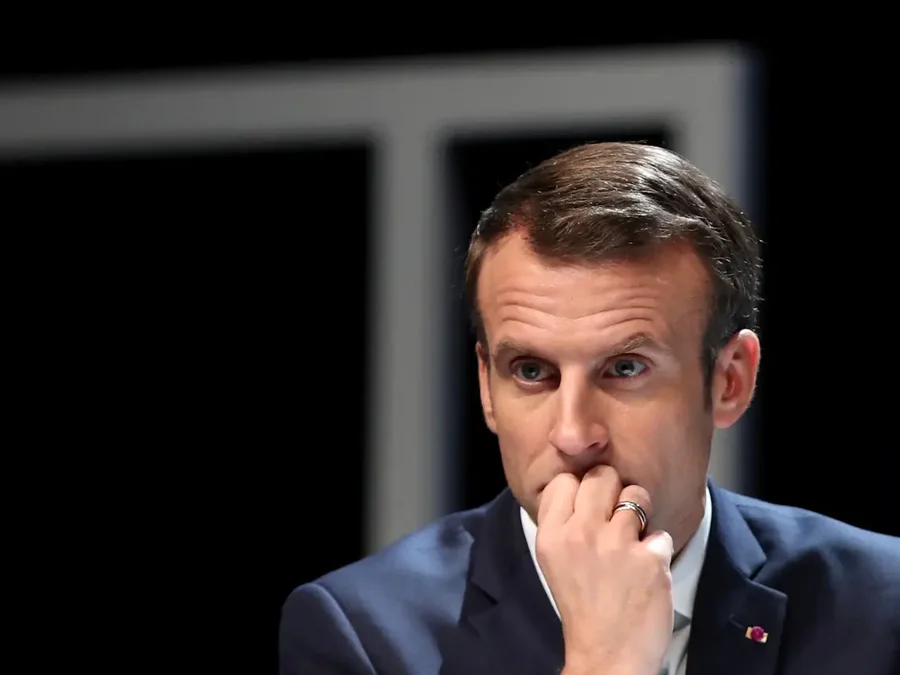
There is the impression that in such an international geopolitical situation, France repeats the contradictions that already characterize the world order. This order can go into crisis, but this should not lead to a complete breakdown of the system.
The French celebrated Bastille Day on Sunday, when the first act of the "great revolution" of 1789 began, when the infamous fortress was stormed by the people spurred on by the electrifying words of Camille Desmoulins. July 14 evokes wonderful memories for all Europeans and this year it seems that it will take on an even more special character.
Exactly on July 14, the Olympic torch arrived in Paris, and after a journey across France, it will return to the capital on Sunday, July 26, the day of the start of the Olympic Games. It should be a day of great celebration, even greater than that of the anniversary of the revolution.
But paradoxically, President Emmanuel Macron's France spent the national holiday in the midst of a very difficult, complicated political crisis. And at the moment, without a real possibility for a solution. In the end, it seems as if Macron has become an interpreter of the fortunes of a power like France, where everything is often resolved by constant twists and turns.
The president emerged politically crippled from the European elections, with less than half the votes of Marine Le Pen's far-right party and half the votes of the Popular Front, made up of the leftist France Inflexible and Mélenchon, the Socialists of Glucksmann, as well as from the Greens and the Communists.
At this point, weakened by years of unpopular policies, Macron launched a big game: he dissolved the National Assembly, the cornerstone of French legislative institutions, and announced new elections, hoping that the French electoral system, and especially the second round, would to create a resistance against the Lepeninist right.
In fact, these elections re-balanced the situation, but only partially. The left-wing Popular Front took 182 seats in parliament, Macron's centrists 168, while Le Pen's far-right took 143 seats. Three blocs, with the first two very heterogeneous, and no coalition reached the absolute majority quorum of 289 seats.
At this point, how can a government be created in the French tradition? Talks are definitely taking place, there are attempts to reach an agreement, but also tough positions, with Mélenchon currently attacking Macron more than Le Pen.
So, despite Macron's attempt to buy time and weaken both extremist wings of parliament, and to split them, thus trying to create a stable majority, this mission is looking increasingly difficult.
It is not in the French political spirit to have a National Assembly which does not have a clear majority. Or maybe with a different attitude from those of the President of the Republic, or with a different coexistence between the Elysee (seat of the presidency) and Matignon (that of the parliament).
But in any case, we have an Assembly, which cannot govern with improvised and unclear coalitions, and which cannot use the tool we Italians are used to: so-called technical governments. In a situation similar to this, historical references continue to be made in France unchanged.
We remember the great French historian François Furet, who always remembered that in a few years there were 3 French revolutions, because it was not possible to find a balanced solution. It all ended with the Consulate and then with the Empire.
There are also those who, guessing, remember that after being considered the hero of the Bastille, Desmoulins died executed on the guillotine in April 1794, together with Georges Danton. These acts preceded the execution shortly afterwards of 2 other famous revolutionaries, Robespierre and Saint Just.
So old memories, which are not very happy in a very honest atmosphere. But there are those who focus only on Macron's dangerous move, that of dissolving parliament and holding new elections, which some compare to the big games that Napoleon used to play.
At Austerlitz, the emperor was in trouble at first, but then won his greatest battle. At Waterloo he was still struggling, but ultimately lost the battle. In this regard, we also remember the bet of the famous economist David Ricardo, who bet his entire fortune on Napoleon's defeat at Waterloo.
He subsequently became a millionaire, and then retired to the countryside to write his magnum opus. But aside from the memories, the uncanny similarities, there are some coincidences that are too subtle at this point. The French National Assembly meets on Thursday to elect its president, who has many powers.
But on Thursday, the European Parliament also meets to confirm Ursula Von der Leyen's majority. So there is a series of intersecting events that can hinder possible solutions. What negotiating power might there still be in the old Franco-German axis, now that it is left without a credible government?
How long can Macron wait to have a credible government after the meeting of the French Assembly? And in the face of this situation, where movements often contradict each other, and where Jean-Luc Mélenchon is propagating and perhaps even influencing Glucksmann's socialists, what choice can Macron really make?
There is the impression that in such an international geopolitical situation, France repeats the contradictions that already characterize the world order. This order can go into crisis, but this should not lead to a complete breakdown of the system.
The same goes for France. Otherwise, after a failure, and the 3 anemic years in office that Macron has left in the presidency, the French Constitution itself may be destined for a deep change and that the country suddenly becomes the "Sixth Republic"./ Adapted "Pamphlet " From " Il Sussidiario "


Lini një Përgjigje