


 Shkruar nga Pamfleti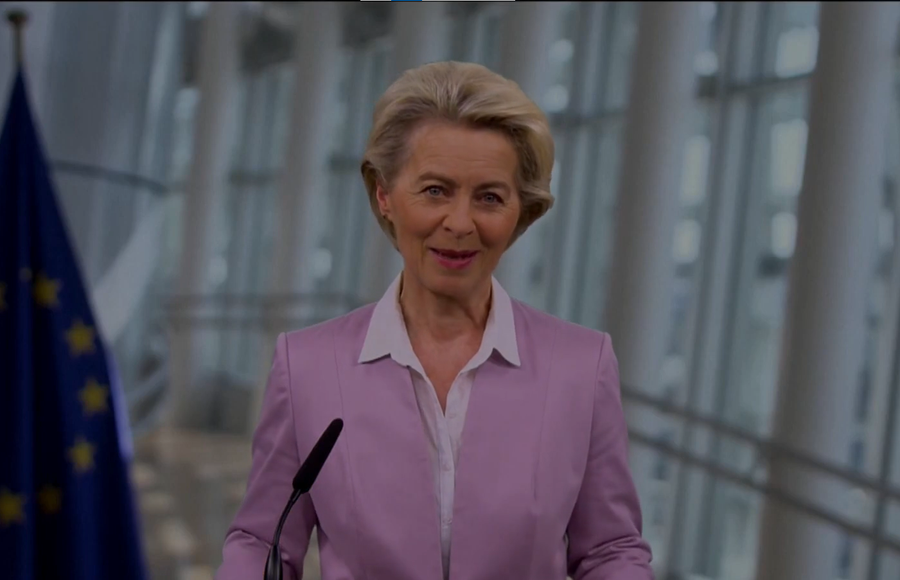
Lifting the curse of Von der Leyen could also lift the curse of Brexit.
“ We all know what we need to do, but we don’t know how to get re-elected after we’ve done it .” So said Jean-Claude Juncker in 2007 when he was president of the European Commission. Fast forward to 2025, where the “new Juncker curse” for Europe; “is that its politicians know what they need to do, but they don’t know how to get it done.” Referring to the current president of the commission, we will call current EU politics the “Von der Leyen curse.”
No less than three major reports published last year – by Enrico Letta, Mario Draghi and Sauli Niinistö – call on European leaders to continue deepening market integration, boosting innovation and investment in critical sectors and technologies, and building self-confidence to cope with crisis and conflict.
This quest for prosperity, strength and security comes at an unprecedented price. Draghi alone advocates an additional €800 billion in annual spending. Where should the EU find this kind of money, and how can spending on such a scale be mobilized to support shared priorities rather than narrow national preferences?
The most elegant solution would be massive public-private partnership schemes. In an ideal scenario, the EU, together with the European Investment Bank, would make institutional investors and venture capitalists an offer they cannot refuse: the ability to claim a stake in the continent’s economic and technological future with guaranteed government spending and/or a potential protected market as a revenue model. But coordinating this from Brussels across the 27 member states would be a Herculean task. Just consider how the much simpler common European defence bond has failed to materialise, despite the horrors in Ukraine.
Then there are taxes. An EU that raises import tariffs, emissions taxes and other taxes to make the playing field fair and stable in the European market could potentially invest tens of billions a year. However, taxes can be counterproductive if they harm the European industry that we seek to maintain and protect. And they can be downright devastating if they end up hurting companies from countries with which Europe does not want a trade war.
What remains are the debt mechanisms. But the stability of Europe's unfinished monetary union imposes preventive budgetary discipline on member states. Deficits for strategic investments remain possible, but require country-by-country negotiations with the commission. European mutual debt invested directly by Brussels is a political problem that the Rubicon member states have yet to cross.
The EU not only has too few resources, but it also doesn't know how to spend what it has quickly and efficiently. The processes are slow, bureaucratic and generally not very transparent to the companies or countries involved. The bloc has to compete with China, Russia and the US in what has become a global arms race of state capitalism and mercantilism. But Brussels has neither the political nor the financial clout to compete with Beijing, Moscow or Washington.
If the EU really wants to achieve its ambitions, the existing platform for important projects of common European interest could be a step, provided it is scaled up and accelerated. More likely, it is an ecosystem of investment initiatives and tools outside the formal EU programmes, through coalitions of investors and/or member states.
First-mover advantage will play a role as countries with stakes in strategic sectors can claim future market share by contributing to the EU’s collective ambitions. Poland, for example, has led the pack in mobilizing public spending on defense and security capabilities along Europe’s eastern border and in the Baltics.
This, then, is the way to lift the Von der Leyen curse. Allow coalitions of states to combine their respective vested interests and strategic partnerships with their industries, bringing state aid to a coordinated multinational level.
Forget the old division of the European market and internal state aid – the latter serves the integration of the former for geopolitical purposes. Forget the decision-making machinery that often obstructs EU action and instead creates space for ad hoc agreements within the bloc’s overall strategy. And forget the distinction between member states and third countries – what matters is the right geopolitical coalition in support of EU policies, and which includes a country like the UK on security and defence issues. Lifting the curse of Von der Leyen could also lift the curse of Brexit. / Adapted from “Pamphlet” by “FinancialTimes”





Lini një Përgjigje