


 Shkruar nga Pamfleti
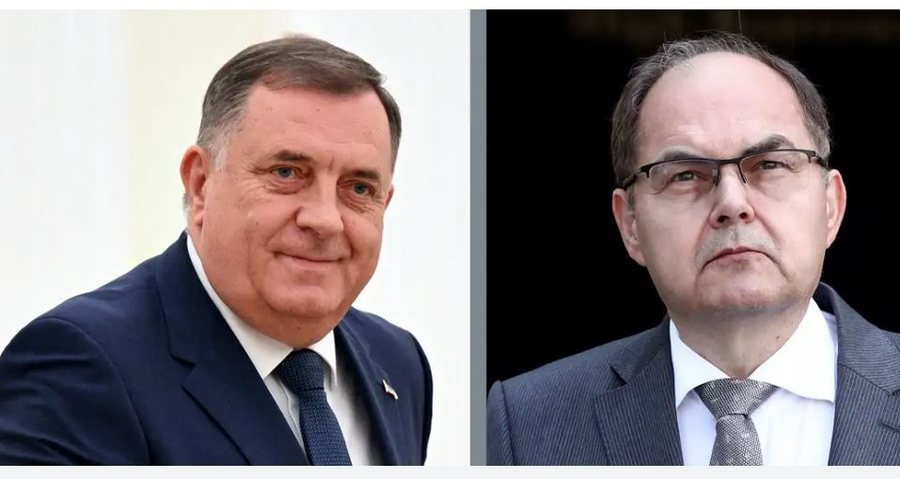
It sounded like a duel: "You are not the High Representative," Milorad Dodik, the president of Republika Srpska, wrote to the UN High Representative for Bosnia-Herzegovina, Christian Schmidt, in an open letter on Thursday. "You do not represent the international community in Bosnia and Herzegovina." In the event that Schmidt would travel from the capital Sarajevo to Banja Luka, the capital of Republika Srpska, Dodik had an open threat: He should wait for "arrest or deportation". A corresponding decree is "being prepared".
Since the 66-year-old Christian Schmidt, once Minister of Agriculture under Angela Merkel, took the post two years ago, many stones have been moved politically in the small Balkan country with 3.5 million inhabitants. Of the three powerful and corrupt leaders of the national parties of Bosniaks, Serbs and Croats, only one remains - Milorad Dodik. With strict decrees backed by Berlin and Washington, Schmidt succeeded in setting up elections that had been stalled for years.
The result: The Bosnian party, the Democratic Action Party, under Bakir Izetbegovic, the son of the popular wartime president, Alija, is no longer part of the government. Dragan Covic's respective Croatian party, accused of corruption three times and managed to escape at the last minute, is no longer politically relevant. The "Federation", which 50% of Bosniaks share with 15% of Croats, has functioning institutions again after four years of blockade.
Threatening gestures known specialty
As expected, Milorad Dodik is emerging as the most difficult man. After the High Representative's threat of arrest, Schmidt gave up the trip and commented on it with words. We are "in the Balkans", when not every word is "put on the golden scale". Dodik withdrew and was eventually told that the Republika Srpska police could not guarantee his safety. Threatening gestures are the specialty of 66-year-old Dodik. For years he has been talking about a referendum, in which the Bosnian Serbs will decide on the separation from Bosnia . So far he has not developed.
In reality, Dodik does not have the cards in his hand that good. Only verbal support comes from neighboring Serbia. Serbian President Aleksandar Vučić is trying with his country to maintain the balance between the EU and Serbia, which has become more difficult after the Russian invasion of Ukraine. Even from the economic point of view, the situation in Republika Srpska is not the best. Russia, which Dodik relies on, has nothing more to offer. Due to the recent dispute, Germany has canceled infrastructure projects worth 105 million euros.
Even in domestic politics, Dodik is not as invulnerable as he believes. A law against "defamation" with which he will restrict the media has caused protests. Since Bosnia-Herzegovina became a candidate for the EU last year, he no longer gets as many points with his support for Russia. The youth in the country leave en masse in the direction of the EU, not Russia. Even the arrival of Christian Schmidt was a failure for Dodik. Schmidt was chosen by the Peace Implementation Council PIC, unlike in previous cases involving the Security Council, as Russia had announced its veto there.
Schmidt uses full powers
Schmidt began the work with energy, and unlike his predecessors, he began to intensively use the competences known as the "powerful competences of Bonn". Dodik, who does not recognize the High Representative because the Security Council was not involved, kept this as an important card until June 2023, when he dared open confrontation. He decided that the High Representative's decrees would no longer apply in Republika Srpska, Schmidt fought back and threatened officials who ignored his rulings with five years in prison with a law he issued. The Prosecutor's Office in Sarajevo filed a case against Dodik, a court approved it.
That the war of nerves between the president of the Republika Srpska and the High Representative will escalate into a real war with weapons is seen as unrealistic both in Sarajevo and in Banja Luka Dodik, who in his youth refused military service in Yugoslavia, and in during the war years 1992-1995 from Bosnia he fled to Belgrade, he was afraid of military threats.
The peacekeeping force, EUFOR Althea, is still in place. Even if, as is rumored, the Security Council may not be able to extend this mission due to the threat of a Russian veto, the Althea mission would remain in place legitimized by the government in Sarajevo./DW


Lini një Përgjigje