


 Shkruar nga Pamfleti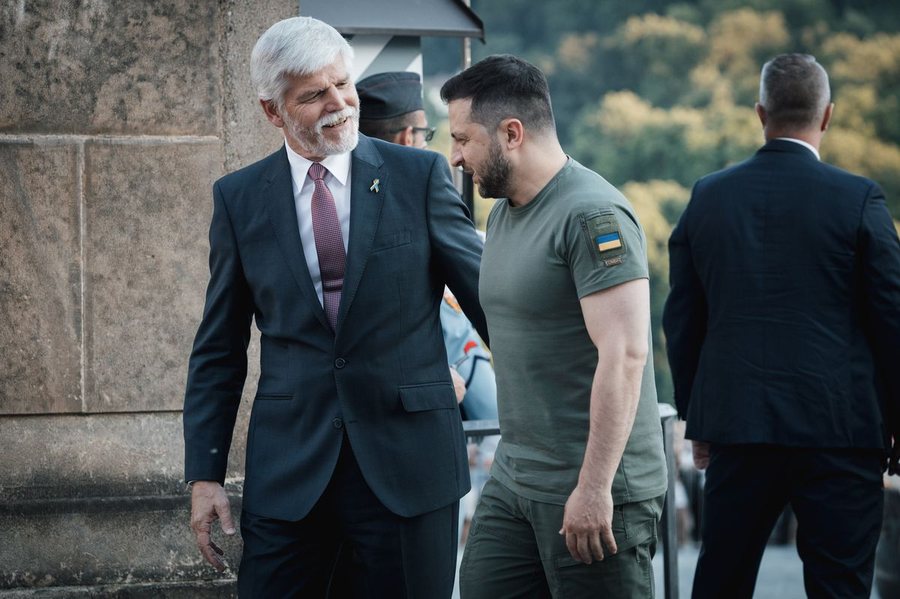
Czech diplomats have "found" artillery ammunition for Ukraine in third countries, Czech President Pavel recently announced. Germany also wants to support. Where does the ammunition come from?
Any possible support for Ukraine: Czech President Petr Pavel has left no doubt about his clear stance since the start of his term last year. On the second anniversary of the Russian invasion, he once again explained to thousands of Czechs in the historic City Ring in the heart of Prague why a Ukrainian victory was so important for the Czech Republic as well.
According to the head of the Czech state, Russia is not only waging war against Ukraine. Russian aggression is directed against the entire Western world and the European order of values. And the President is following through on his clear words. The Czech Republic is currently at the forefront of European procurement of ammunition for Ukraine.
A historically strong defense industry
The dismal lack of artillery shells and air defense missiles in particular is perhaps the biggest weakness of the Ukrainian military at the moment. The EU had originally promised Ukraine one million artillery shells within a year. However, only less than a third was delivered, due to production difficulties.
This is where the Czech Republic comes into play. This country has historically had a strong defense industry, and private companies trade on a large scale in remanufactured materials from Warsaw Pact arsenals. In the past, they often played a dubious role, but now contacts have proven their value.
Hundreds of thousands of rounds
At a time when the official ammunition market is empty worldwide, representatives of the Czech government were able to conduct discreet negotiations. President Pavel presented the result at the Munich Security Conference in mid-February: about half a million 155-millimeter cartridges and 300,000 122-millimeter cartridges had been "identified," that is, found abroad.
The Czech weekly "Respekt" spoke to people who investigate munitions around the world on behalf of the president and the government. Their activities are secret. Among those responsible is the government's special envoy for Ukraine, Tomáš Kopečný.
It does not say which countries the weapons come from. He says only that they are from countries that have remained neutral in the war or that did not want to openly oppose Russia with munitions supplies. The weekly quotes him as saying that it would be impossible to express himself more concretely, as this would jeopardize the entire process. All the more so that the Russians were looking for new sources of supply with the same intensity.
New impetus for aid to Ukraine
The Czech Republic wants to act above all as a mediator. The financing will be taken over by other countries, it amounts to 1.5 billion euros. According to the magazine "Respect", in reality the whole transaction had to be done behind closed doors.
However, when President Pavel realized at the Munich Security Conference how the unpromising situation at the front was also affecting the mood at the political level, he decided to make a public statement, hoping to give new impetus to aid to Ukraine . And at the same time cut short the protracted bilateral negotiations for the financing of supplies.
Germany is apparently involved
And indeed, immediately after Pavel's appearance, several countries were willing to provide funds, among them Denmark, Canada and the Netherlands. In response to ARD's question, the Federal Ministry of Defense stated that Germany also wants to participate in the financing and bear a "significant part" of the expenses. The talks are at a very advanced stage.
The Netherlands and Denmark already had positive experiences with the Czech Republic as a capable mediator at the start of the Russian offensive: at that time, Prague had arranged the transfer of 100 old Soviet tanks to Kiev. It was one of the first major shipments of heavy technology.
Pavel's voice is heard in the West
President Pavel's personal commitment also plays an important role today. The retired NATO general and former chairman of the NATO Defense Committee has a voice that is also heard in the West.
The task of the president and diplomats now is to secure the funding, much of which is still unsecured, it said. If this is achieved, the weapons could be delivered to Ukraine within two months, according to the government. For the Czech Republic, this will not be the last operation of this kind.
Respekt magazine reported on Thursday, citing President Pavel, that official Czech munitions searchers had found more urgently needed material, this time large rockets, specifically for air defense and threats. /DW


Lini një Përgjigje