


 Shkruar nga Pamfleti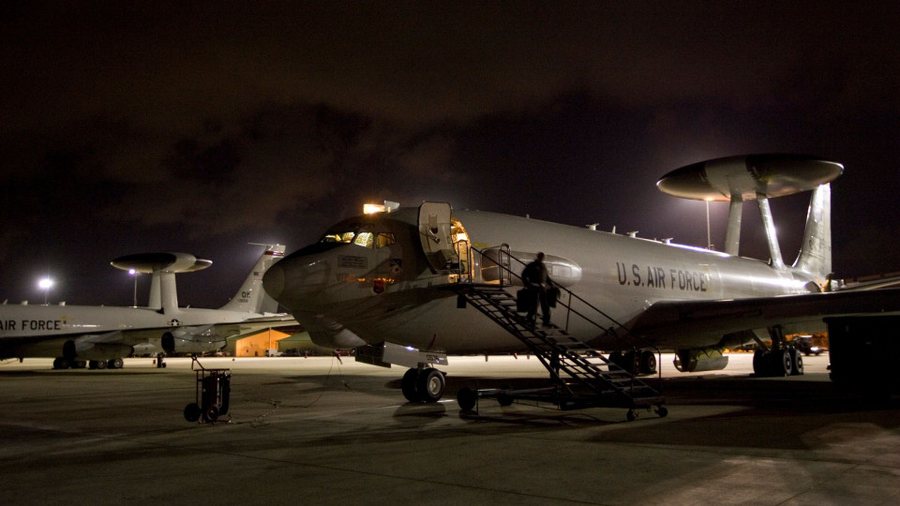
Wanting to monitor Russian activity along its eastern border, NATO is expected to use the E-3 Sentry, an old surveillance and control aircraft, from its base in Geilenkirchen, Germany.
According to CNN, this mission is codenamed "Eastern Sentry" and is the Alliance's response to the growing challenges from Russian aircraft and drones that have violated or come dangerously close to the airspace of NATO member states.

It is noted that the E-3's operation relies on its radar, which can detect aircraft at a distance of up to 650 kilometers. In addition to aircraft, it can track ships and vehicles on the ground far beyond NATO borders.
During the eight-hour surveillance trip covered by CNN, the plane flew over Poland, recording movements in areas such as Kaliningrad, Belarus and the Baltic Sea.
While most Russian flights were considered "routine," incidents in recent weeks show that tensions are rising dangerously.
Violation with 20 Russian drones
On September 9, about 20 Russian drones violated Polish airspace, forcing the Alliance to scramble fighter jets from various locations to intercept them.
A similar incident occurred a few days later in Romania, while in late September, three Russian MiG-31 fighter jets flew over Estonian territory for 12 minutes—an “eternity” for such a flight—before being intercepted by allied aircraft. Russia denies violations, but NATO says it has evidence.
Transnational cooperation in this field
The E-3 crew consisted of officers from different countries: the United States, Canada, Germany, Spain, Turkey, Portugal, Denmark, Romania and the Netherlands. “These borders are ours, we defend them as if they were our homeland,” said US Air Force Lieutenant Colonel Steven Wannon.
Teams like that of US Captain Jacob Anderson constantly monitor air traffic and signal “suspicious traces” that is, aircraft that may be approaching the border.
These indications are forwarded to national authorities for possible interception. In addition to surveillance, the crew also acts as an operations management center, directing Alliance fighters to the detected “traces”.
Missions often exceed 15 hours, requiring aerial refueling, a difficult process, especially for an aircraft the size of a commercial airliner. The E-3 crew also conducts regular drills for emergencies, such as in-flight fires or landings in a combat environment.
In addition to military violations, drone incidents recorded in countries like Denmark, where Copenhagen Airport was recently closed, are also causing concern.
Danish authorities are calling it a hybrid attack, without naming the perpetrators, although the country's prime minister has made clear accusations against Russia.
"Wall of drones"
At the European level, there is ongoing discussion about building a "drone wall", a system to protect borders from attacks by small unmanned aircraft, whether for espionage or sabotage.
“Russian provocations are increasing,” NATO Secretary General Mark Rutte said recently. “The Eastern Sentry mission adds flexibility and strength to the Alliance’s defense.”







Lini një Përgjigje