


 Shkruar nga Pamfleti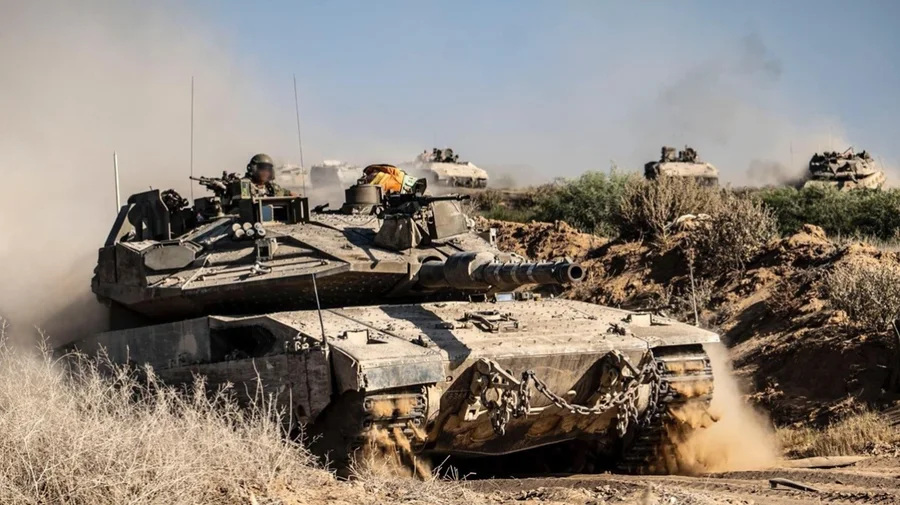
Israel controls about 1,000 square kilometers of territory it has occupied since the Hamas attack on October 7, while Benjamin Netanyahu shaped a new, more aggressive military doctrine after the worst security failure the country has experienced.
Israeli forces have since established positions in Gaza, Lebanon and Syria, controlling land corresponding to about 5% of Israel's borders since 1949, according to Financial Times calculations.
More than half of the roughly 1,000 square kilometers is in southern Lebanon (about 576 square kilometers), where Israeli forces have advanced up to twelve kilometers to create what Israeli officials call a “security zone.” Their goal is to push back Hezbollah, making it harder for the armed organization to fire anti-tank missiles at Israeli border communities.
Financial Times: Israel has occupied and controls 1,000 square kilometers in Gaza, Lebanon and Syria since October 7.
Yellow represents Israeli control in Gaza, blue in Lebanon and red in Syria.
“This security zone completely eliminates the immediate threat of invasion and anti-tank missiles,” Netanyahu declared last month. “They wanted to surround us with a ring of fire. We created a security ring.”
The rest of the territory is divided between Gaza (about 206 square kilometers), where Israeli forces now control more than half of the Palestinian enclave, and Syria (about 233 square kilometers), where Israeli forces took advantage of the fall of the Assad regime to occupy positions several kilometers inland.
However, unlike Gaza and Lebanon, where maps have been published by Israel, in Syria no Israeli or Syrian official has clearly stated the position of the troops.
In all three territories, Israeli forces also exercise control over additional areas through airstrikes, artillery, operations, and arrests.
In Gaza, Israeli forces are imposing an additional security zone beyond the so-called Yellow Line, which separates the part of Gaza under Israeli control from that still controlled by Hamas. A UN official said the additional zone is about 50-100 meters deep, further shrinking the enclave and leaving its 2 million inhabitants at about 40% of their pre-war area.
In southern Lebanon, Israel continues its attacks and has ordered the Lebanese to abandon areas north of its troop positions, with Defense Minister Israel Katz vowing to maintain control over territories up to the Litani River.
In Syria, Israeli forces have been conducting operations beyond their positions near the border, including a 50-kilometer-wide area inside Syrian territory. The Financial Times calculated Israel’s continued military presence by mapping confirmed IDF bases in the area, which covers about 233 square kilometers, from the strategic height of Mount Hermon in the north to an abandoned Syrian military base at Maariya, more than 70 kilometers to the south.
The Israelis declined to comment on the calculations, but stated that the troops "are deployed in areas near the border and in various operational areas," adding that "the deployment is carried out according to the instructions of the political leadership and current assessments of the operational situation."
Israeli officials have made it clear that they intend to maintain a permanent security zone in Gaza and have razed large areas along the border, but have sent mixed messages to Lebanon.
Netanyahu publicly declared last month that his forces " are not leaving," while in recent weeks the army has been razing entire villages near the border in an operation that Katz compared to the "Gaza model."
Diplomats point out that privately, Israeli officials, including Foreign Minister Gideon Saar, argue that Israel has no territorial ambitions in Lebanon.




Lini një Përgjigje