


 Shkruar nga Pamfleti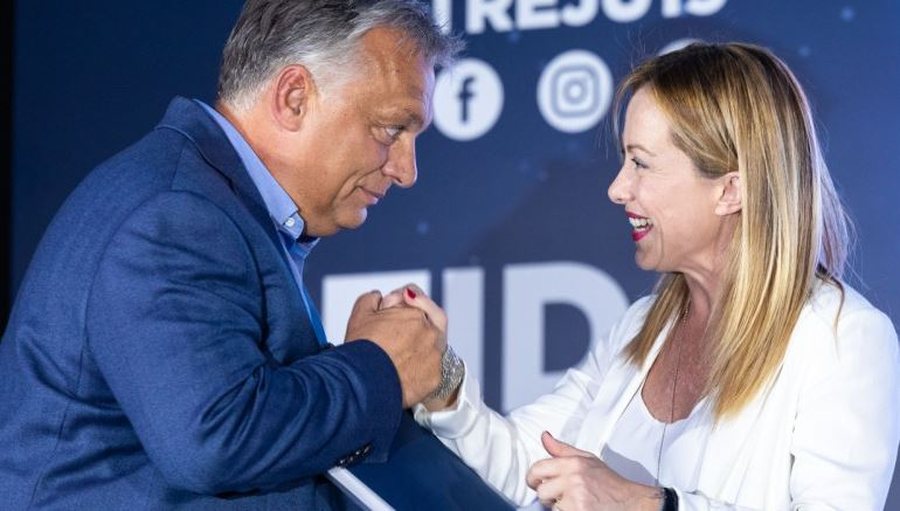
The decision, reached at a summit in Brussels on Thursday, was crucial for EU leaders, who wanted to demonstrate support for Ukraine by showing they were able to keep Hungary's rebellion in line.
It took several months of efforts by Italian Prime Minister Giorgia Meloni and several dinners by the French to get Hungarian Prime Minister Viktor Orbán to agree to support sending 50 billion euros in aid to Ukraine.
Meloni led talks with Orban thanks to their long relationship, said two diplomats from countries that do not share her far-right political views.
"She tried several times to be a bridge and the impression is that this time it worked," said one of the diplomats, writes Politico.
Orban eventually sat down with Commission chief Ursula von der Leyen, German Chancellor Olaf Scholz, French President Emmanuel Macron and Italian Prime Minister Giorgia Meloni.
The decision, reached at a summit in Brussels on Thursday, was crucial for EU leaders, who wanted to demonstrate support for Ukraine by showing they were able to keep Hungary's rebellion in line.
Orbán has repeatedly threatened to use tactical vetoes on a wide range of European issues.
" This sends an important signal to the US as well ," Swedish Prime Minister Ulf Kristersson said in the leaders' room after reaching an agreement.
Going into the meeting on Thursday, the leaders stressed that while a deal without Hungary was possible, it would signal a lack of European unity for Russia.
People familiar with the Italian prime minister's office said she began her diplomatic work months ago, with talks and meetings involving various ministers and officials, even before the 27 leaders failed to reach an agreement on aid for Ukraine in December. , because Orbán did not support it. On Wednesday night, delegations worked late into the night to secure a breakthrough with Orbán.
This week, Meloni stepped up her efforts, speaking to Orbán on the phone, meeting him at Brussels' Hotel Amigo for an hour-long chat and again on Thursday morning before the meeting began.
On Wednesday night, French President Emmanuel Macron also met with Orban, after spending weeks focused on building bridges with him. Earlier this month, he tried to get the Hungarian leader's green light during a lunch at the Elysée. During that meeting, Macron asked Orbán to share his vision of how to better integrate Eastern EU countries with several other leaders.
" He never wanted to antagonize Orbán, but rather take him on board. It is the approach that is being rewarded today ," said an official close to the French president.
Those offensives allowed European Council President Charles Michel to jumpstart the summit by announcing the long-awaited agreement, said an official briefed on the floor discussion.
Michel skipped the formalities, quickly laying out the details of the deal with Orbán, which neither leader objected to, including minor concessions to Hungary. An annual discussion on the aid package and "if necessary" a review after two years will "allow Orbán to save face at home," an EU diplomat said.
Hungary was quick to turn the result as a victory for the country. Orbán's political director Balázs Orbán claimed that Budapest got what it wanted from the summit.
" At the end of the first year, the aid to Ukraine must be renegotiated, and at the end of the second year, the whole issue will be reconsidered in the context of the EU budget for the next period ," wrote Balázs Orbán in X.
Scholz told reporters after the summit that he also had several "intense and credible" discussions with Orban before the summit. The German chancellor emphasized that he had particularly insisted on the fact that Hungary could not receive any concessions for its rule of law.


Lini një Përgjigje