


 Shkruar nga Pamfleti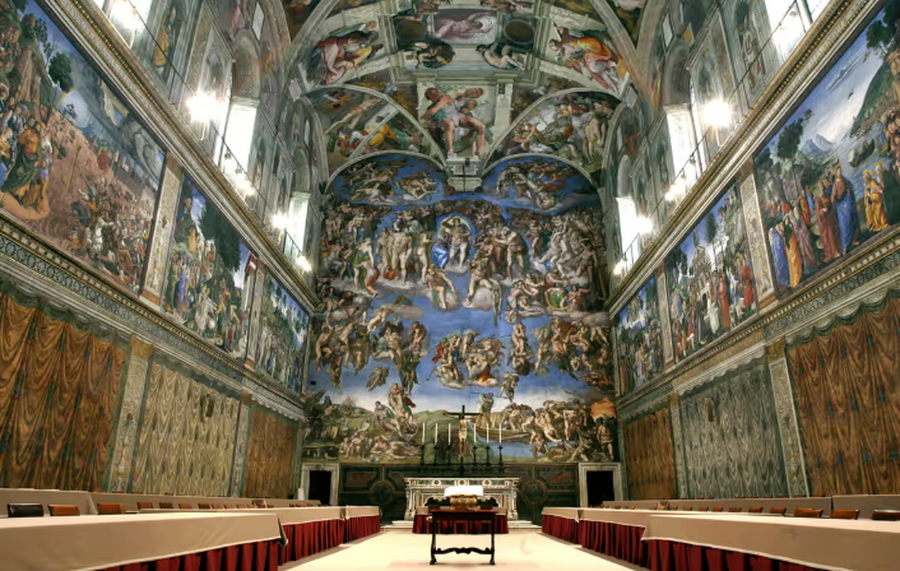
Francis has made an effort to lower the age profile and broaden the spread of the college of cardinals. This means that for most this is their first conclave.
Conservatives and progressives will intensify efforts to shape the future of the Roman Catholic Church in the coming days as 135 cardinals prepare to seclude themselves in the Sistine Chapel to elect a successor to Pope Francis.
The group of cardinals who will vote for the next leader of the world's estimated 1.4 billion Catholics is less predictable than ever before, with the vast majority having no experience in a papal conclave. A much wider geographical spread of cardinals adds to the uncertainty.
Eight out of 10 of those eligible to vote in the conclave were appointed by Pope Francis in the past 12 years. Twenty became cardinals in December last year alone. Many had never met each other before traveling to Rome last week, following the Pope's death last Monday.
The papal conclave is expected to begin formal deliberations next week. But discreet ad hoc discussions and lobbying in the corridors, dining rooms and magnificent gardens of the Vatican have gathered pace in recent days.
"In fact, the conversations have been going on for several months, probably since the beginning of this year, because the trajectory of Pope Francis' health has been clear," said Miles Pattenden, a historian of the Catholic Church at the University of Oxford.
More than 20 cardinals have been identified as papabile — candidates for the papacy — by Vatican observers. However, few of the leading candidates at the beginning of the process make it through successive rounds of voting. In 2013, Jorge Mario Bergoglio was not considered papabile, but by the end of the conclave he was Pope Francis.
Some cardinals who are not thought to be in the running are likely to push their favored candidates, especially among less experienced colleagues.
Among those likely to lobby for a conservative successor to Francis are Raymond Burke, an American bishop who supports Donald Trump, and Gerhard Müller, a German who warned last week that the church could split unless an 'orthodox' pope is elected.
The progressive camp includes Jean-Claude Hollerich from Luxembourg, Timothy Radcliffe from the UK and Michael Czerny from Canada.
Critics accused Francis of filling the college of cardinals with his supporters. But Pattenden said that "historically, no pope has been able to control the choice of his successor."
There were clear conservatives and progressives among the cardinals, but “it’s a spectrum,” he added. “There are some who have conservative views on certain issues, but liberal views on other issues – for example, sexuality and climate change.
"Francis was more inclined to promote his ideological peers, but he did not appoint exclusively those who seemed to agree with him. He had other priorities - to make the college of cardinals as inclusive as possible, which meant choosing men from very small Catholic communities such as Iran, Algeria and Mongolia and balancing it out from wealthy European and North American countries."
In 2013, more than half of the cardinal electors were European. Now, the proportion has fallen to 39%, while 18% come from Asia, 18% from Latin America and the Caribbean, and 12% from Sub-Saharan Africa.
Francis also tried to lower the age profile of the college of cardinals. Seven of those appointed last December were under 60, while Mykola Bychok, a Ukrainian-born bishop in Melbourne, is just 44.
Cardinals were appointed from Peru, Ecuador, Algeria and Iran in an attempt to tilt the balance away from Europe.
The first vote will take place immediately after the conclave convenes and then every morning and afternoon until a candidate secures a two-thirds majority.
The cardinals will be “under a lot of pressure to make a choice fairly quickly,” Pattenden said. “The eyes of the world are on them, and the Catholic faithful may find it a little unsettling if they are still in the conclave in June or July.”
In the past century, most conclaves have lasted two to three days. The longest conclave, in the 13th century, lasted two years and nine months, and the shortest was in 1503, when the result came within a few hours.
The betting favorites to succeed Francis are Pietro Parolin, the Vatican's top diplomat, and Luis Antonio Tagle, a Filipino cardinal.
Speculation on the outcome of the conclave has already become one of the most popular betting markets this year. Leighton Vaughan Williams, a professor of economics and finance at Nottingham Business School, told AFP that "what was once a pursuit largely confined to Roman bankers and Renaissance courtiers has transformed into a multi-million dollar global market accessible at the click of a button or a tap on a crypto wallet."
He said the speed with which betting activity had taken off this year “underscores an enduring cultural fascination with the papacy, reinforced by media coverage and popular culture.” / Adapted from The Guardian/



Lini një Përgjigje