


 Shkruar nga Pamfleti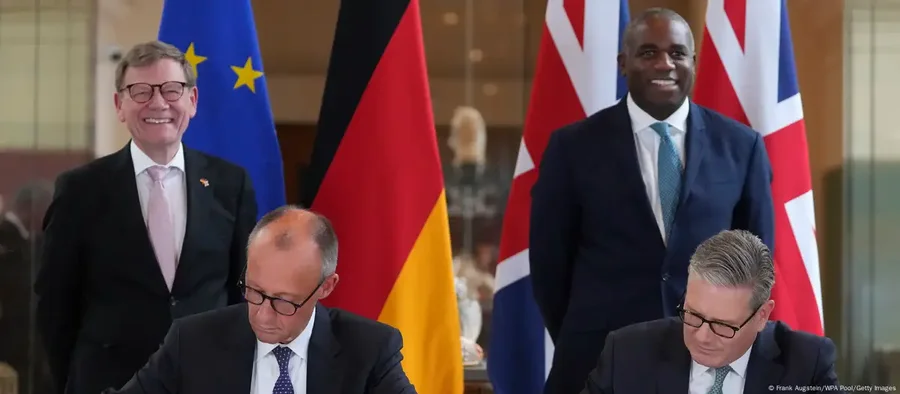
Germany and Great Britain sign a Treaty of Friendship. It provides for more trade, more exchanges – and above all, more security. The Balkans are also mentioned in the Agreement.
German Chancellor Friedrich Merz and British Prime Minister Keir Starmer signed the so-called Friendship Agreement: 27 pages that should not only confirm, but also expand the German-British partnership.
The aim of the agreement is for Germany and the UK to be "motivated by the desire to join forces to ensure a future characterised by prosperity, security and stability for their citizens, as well as their open and democratic societies in the context of fundamental changes in the geopolitical environment."
What does the agreement say?
After Brexit, Germany and the UK want to cooperate more closely again. What does the so-called friendship agreement provide for and what areas does it cover?
Here is a summary of the main points:
Safety
Germany and the United Kingdom confirm close cooperation in this area. A clause on mutual assistance is also being negotiated, which should complement Article 5 of the NATO Treaty bilaterally.
It states: “Aware of the close coincidence of their fundamental interests and convinced that there is no strategic threat to one party that is not also a strategic threat to the other, the contracting parties as close allies confirm their deep commitment to mutual defense and offer each other assistance in the event of an armed attack on the other contracting party, including by military means.”
This should also apply to new areas such as cybersecurity.
Weapons
For example, it has been agreed to develop a missile with a range of more than 2,000 kilometers. Germany and the United Kingdom already announced this goal in mid-May. Such a weapons system does not yet exist in European production.
Closer cooperation is also planned in the development of unmanned aerial systems, projects such as the Boxer armored personnel carrier, on NATO's eastern flank, and in the field of underwater security in the North Sea. Cooperation on arms exports should be expanded.
Exports of jointly produced military equipment should be made easier. Until now, Germany has often blocked such projects because of too strict rules. The British hope that the change of direction will bring additional exports worth billions.
ukraine
Both countries pledged to continue supporting Ukraine – in its defense against Russia, but also in its reconstruction.
Western Balkans
The UK also wants to participate in the so-called Berlin Process, which should bring the Western Balkan countries closer to the European Union, through enhanced interregional cooperation.
Migration policy
To combat illegal migration, the two countries want to create their own action plan. The fight against human trafficking will be improved, among other things, through mutual legal assistance, support in the prosecution of criminals and effective border control.
More than 20,000 refugees have crossed the English Channel since the beginning of the year. Germany is considered a transit point for boats and other equipment, and a stopover for migrants.
Cooperation in the fight against cross-border crime must also be strengthened. This applies in particular to money laundering, illicit financial flows and drug trafficking.
journeys
Visa-free travel for school groups between the UK and Germany should be possible by the end of the year. Currently, students without a German passport – for example from Syria or Afghanistan – must apply for a visa to the UK, which is often complicated.
To ensure that these children are not excluded from school excursions, some schools are currently completely abandoning exchanges with Great Britain.
From the end of August, it will be easier for Britons to travel to Germany via so-called “E-Gates” at border crossings. The reason for the current regulation is that the UK has not only left the EU, but has never joined the Schengen Area – creating significant difficulties for Britons when travelling to the EU.
Economy
A German-British economic forum was agreed. Cooperation should be expanded to the areas of high technology and business finance.
energy The
The two countries want to cooperate in supplying energy through the North Sea and in building infrastructure for hydrogen and CO₂.
Traffic
In ten years, the first direct trains from Germany to Great Britain should be in operation – under the English Channel. Currently, due to passport control, this is only possible with a transfer. A working group will be formed to implement the rail connection./ DW


Lini një Përgjigje