


 Shkruar nga Pamfleti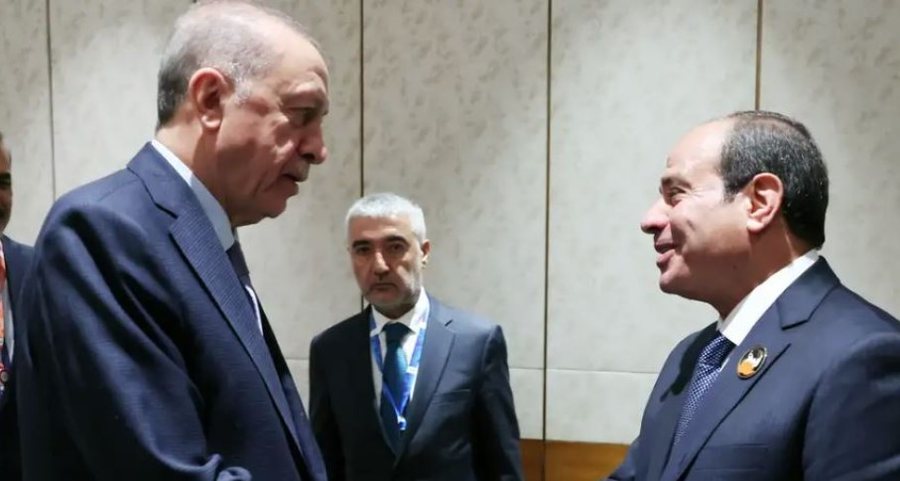
Erdogan called Al-Sisi a "murderer" in 2019, and now calls him "brother". How did it come to this turn and what could be the consequences?
"Some want to reconcile me with Al-Sisi. I reject this. I will not sit at the same table with an anti-democrat,” Turkish President Recep Tayyip Erdogan said in 2019 of his Egyptian counterpart Abd al-Fattah al-Sisi. While he called him "murderer". The reason is a military coup against Mohamed Morsi, who was democratically elected after the so-called Arab Spring. Al-Sisi was a military commander at the time.
The ideology of the Islamic Muslim Brotherhood, espoused by Morsi, also had an impact on Erdogan's policies. After the protests in Cairo's Tahrir Square in 2013, Erdogan used the gesture of the Muslim Brotherhood at every opportunity. Just before local elections in 2019, Erdogan called his party's Social Democrat opponent close to Al-Sisi's government: "Will we decide on Sunday for (our candidate) Binali Yıldırım or for Al-Sisi?"
From "murderer" to "brother"
But those times are now over. Al-Sisi and Erdogan met in 2022 during the World Cup in Qatar and shook hands. The viral photo was followed by an "earthquake diplomacy". After a devastating earthquake in Turkey in 2023, Al-Sisi immediately called Erdogan, while a few days later, Egyptian Foreign Minister Samih Shukri visited the area affected by the devastating earthquake. In September 2023, the two presidents met during the G20 summit in India. In February 2024, Al-Sisi hosted Erdogan in Cairo and both leaders smiled for the cameras. Erdogan suddenly changed his rhetoric and called the "murderer" "my respected brother".
Now Al-Sisi will be welcomed in Ankara on September 4 – for the first time. The two regional powers want to further deepen their relations.
Israel unites them
The two countries' similar attitude towards the Israeli-Palestinian conflict played an important role in bringing these countries closer together. "The war in the Middle East and the way Israel is waging this war has played a unifying role," says Celine Nasi, of the London School of Economics (LSE). The expert compares the relationship between these countries to a "marriage of convenience".
"Even though the two countries don't always agree, their interests are aligned. Both want a ceasefire, both want Israel's withdrawal from the Gaza Strip and the creation of a Palestinian state," says Nasi.
This is also confirmed by Gamal Abdel Gavad, a political scientist from the American University in Cairo. "There is a substantial agreement between the two countries regarding the resolution of this conflict," says Gavad. The cooperation between Cairo and Ankara will further facilitate the achievement of the goals that both countries have in the region, he believes.
But the rapprochement partly coincides with Israel's own interests, emphasizes Mithat Rende, the former Turkish ambassador to Qatar. "In fact, Israel has always wanted these two countries to get closer to each other. Israel wants Muslim-majority countries to unite and create a Muslim front against Iran,” says Rende.
Turkey intends to play a constructive role in Gaza – which is only possible with the cooperation of Egypt. "It is important that relations with Egypt are good. To be able to send humanitarian aid to Gaza, Turkey needs Egypt's help, because 90 percent of this aid is sent through the Rafah border crossing," says Nasi.
Economic benefit for both parties
Behind this improvement in relations, apart from geopolitical reasons, there are also economic interests. "The economies of both countries complement each other. Egypt is rich in energy, while Turkey has a developed industrial infrastructure. Turkish investors show great interest in Egypt," says Rende. "Egypt has become an important player in terms of energy," Nasi asserts, referring to the oil and gas deposits - which Turkey also wants to take advantage of. Egypt plays a key role in the East Mediterranean Gas Forum, because Cairo is the headquarters of this organization. Among the other Mediterranean countries included in this association are Greece, Cyprus, France, Israel, Italy, Jordan and the Palestinian territories - but not Turkey.
"good news"
The reduction of tension between the two countries has been seen by experts as a positive development - not only for the region, but also for the whole world. "This is an incredible development for everyone. Stability in the Eastern Mediterranean is important for all parties,” says Rende.
"Here we are talking about the two strongest armies and the two societies that are considered the most educated in the Islamic world. In addition, these countries control a significant part of global trade," the diplomat points out, pointing to the Bosphorus, the Dardanelles and the Suez Canal. "We are at a time when global supply chains are changing. In the future, the competition between the US and China may turn into a conflict. While Turkey and Egypt will serve as production bases." /DW




Lini një Përgjigje