


 Shkruar nga Pamfleti
A mother in Gaza fights to save her cancer-stricken daughter after losing her twins in the midst of war...
Nancy Abu Matroud has already lost three children during the war in Gaza. The 22-year-old Palestinian is fighting to save her only daughter, Etra, a two-year-old suffering from cancer and without access to life-saving medical care.
The pediatric hospital that treated him was closed last month during the latest Israeli attack on Gaza City.
"We are just looking for shelter. I don't want to lose the daughter I still have," says Abu Matroud.
A deadly mix of disease, displacement, lack of medical care and malnutrition has brought most families in Gaza to their knees during the nearly two-year war, but the unrest has placed a particularly heavy burden on young children and pregnant women like Abu Matroud.
She was six months pregnant with twins when, fleeing the Israeli bombardment of Gaza City last month, she arrived in the central Gaza Strip after a three-day hike, along with her husband and Etra.
After the family arrived in the Al-Nuwairy area, her stomach started to hurt and her water broke. She gave birth to twins prematurely, and one of them died at Al-Awda Hospital in nearby Nusseirat. The second child was transferred to the neonatal ward at Al-Aqsa Martyrs Hospital. After two days, he too died, said Al-Aqsa Hospital spokesman Khalil al-Dakran.

"What is our fault? What is our children's fault?"
Premature babies are extremely vulnerable to the pressures of war in Gaza. In particular, there are not enough incubators and ventilators to keep them alive, according to Jonathan Creeks, UNICEF's representative for Palestine.
"There is an increase in the number of babies being born prematurely," he told Reuters, adding "the incubators that are needed to keep the baby in a protective environment, the ventilators that help their lungs develop, all of these devices are not available in sufficient quantities in the Gaza Strip today."
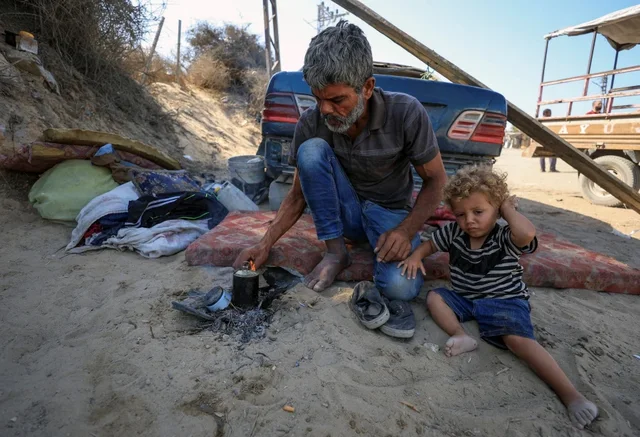
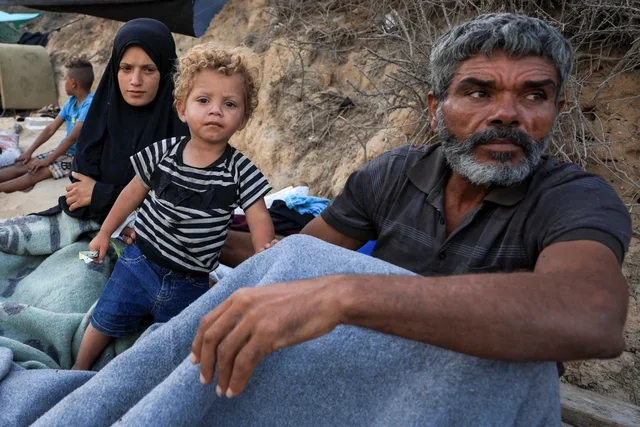
The children's father, Faraj al-Galayini, 53, sits on the ground by a road, heating a box of chickpeas for Etra on a fire he has lit with twigs.
"What is our fault? We have nothing to do with this. What is our children's fault? God gave me a daughter, she is now two years old, and I was expecting these twins who were born," he said.
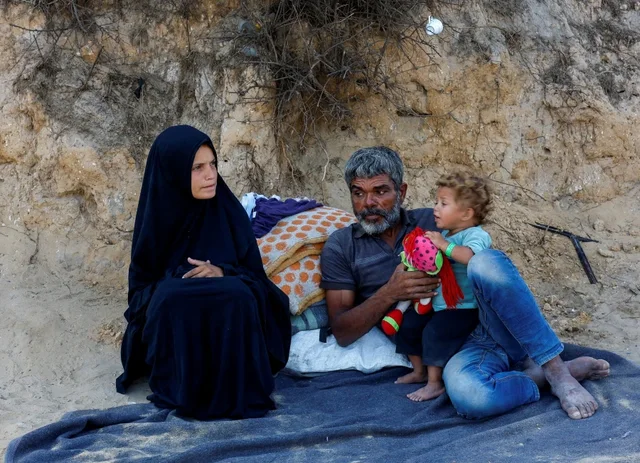
Now the parents don't know what will happen to their daughter, who sits on a blanket by the side of the road in a striped T-shirt and plays with a rag doll. "We don't know what to do, no one asks about us, no nation, not even our own people care about us," says al-Galaini.

With resources running low due to relentless Israeli bombardment, hospitals in Gaza have been forced to close. Only 14 of the 35 hospitals in the enclave are functioning, and only partially, Cricks said.
The Israeli military told Reuters that it is continuing to take steps to allow medical care and the continued operation of medical facilities in the Gaza Strip, in coordination with international humanitarian organizations.
Displacement and famine
Most of the enclave's population, about 2.2 million, has been displaced between the north and south several times during the war. Women who move from one place to another without proper care are at greater risk of premature birth, with malnutrition exacerbating the situation.
In August, the global hunger monitoring agency IPC declared famine in Gaza City, the enclave's largest urban center, before Israel launched a ground assault on the city, which it had long threatened, worsening the humanitarian crisis.
"UNICEF treated 13,000 children under 5 for acute malnutrition in August, a very large number, including babies, even those born prematurely," Cricks added.

Abu Matroud said her 4-year-old son from a previous marriage was lost early in the war. The loss of the twins was another unbearable tragedy.
"I named the boy and the girl," said Abu Matroud, who is mourning the loss of her twin children, Mahmoud and Farida.
Her only hope and desire is for Etra to be saved. /Adapted from Pamphlet/







Lini një Përgjigje