


 Shkruar nga Lorenzo Tondo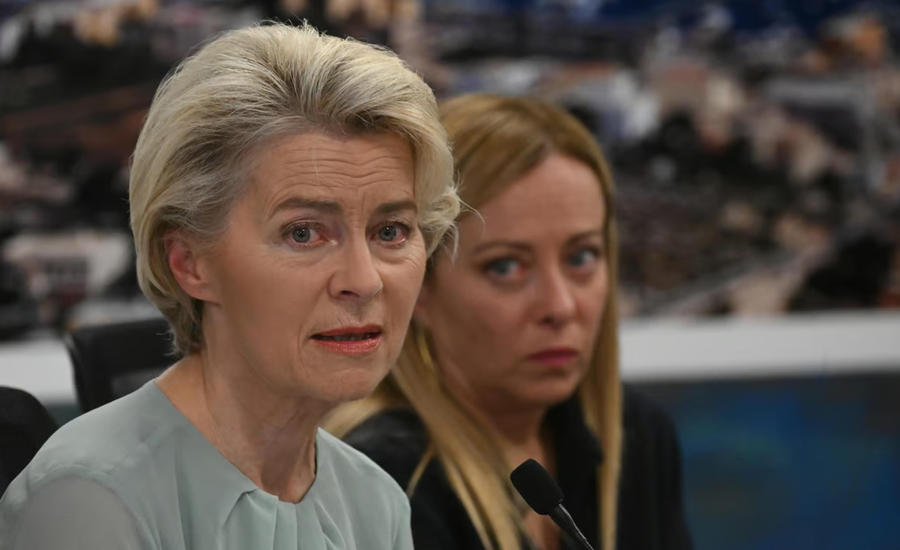
Neither von der Leyen nor Italy's far-right prime minister, Giorgia Meloni, had considered the existing law.
A multimillion-dollar migration deal between Italy and Albania aimed at curbing arrivals was presented by European Commission president Ursula von der Leyen as a new model for how to set up processing and detention centers for asylum seekers outside the EU.
The facilities in Albania were supposed to hold up to 3,000 men arrested in international waters while crossing from Africa to Europe. But it seems that neither von der Leyen nor Italy's far-right prime minister, Giorgia Meloni, had taken the existing law into account.
Only a month after the much-hyped opening, only 24 asylum seekers have been sent to Albania and none remain there now; five spent less than 12 hours in a detention center, while the rest stayed for just over 48 hours.
All were transferred to Italy after Italian judges ruled it illegal to detain them in Albania before repatriating them to countries, such as Bangladesh and Egypt, considered "safe" by Rome. In doing so, the judges were upholding an October 4 ruling by the European Union's court of justice (ECJ) that a country outside the bloc could not be declared safe unless its entire territory was deemed safe.
Italy's embarrassment over the scheme, attacked by opposition parties as a "total failure" that will cost around 1 billion euros over five years, has sparked a row between authorities and judges, who have been accused by far-right parties of obstruction of the project.
However, observers say Meloni and her allies knew from the start that there was a risk the deal would not work, with the ECJ ruling just one of many legal issues.
Chiara Favilli, professor of European Union law at the University of Florence, said: " Since 1993, several European states have proposed solutions similar to Italy's agreement with Albania. However, they are always rejected. Agreements like the one between Albania and Italy are incompatible with some basic norms .
Months before the signing of the agreement between Albania and Italy, many NGOs, academics and experts had raised doubts whether it could be considered humane or even legal under international law.
Their calls were ignored. Supporters insisted the scheme was more humane than sending people to developing countries, as the last UK government's main deportation scheme would have done, with the Italian state responsible for the men's fate and compliance with certain norms, and more less problematic than the EU's current practice of giving money to North African countries to improve their border controls.
As it looks set to face further legal challenges, the deal is becoming a fiasco. According to a recent poll, 55% of Italians dislike him.
Credibility is at stake for a government that has made immigration a central campaign issue and has in the past criticized predecessors for spending public money on managing the migration crisis. It cost €250,000 to transport the eight men who arrived in Albania last weekend by sea on an Italian military ship - more than €31,000 per asylum seeker on board.
In the face of the deal's gradual demise, the Italian government has launched a blunt attack against the judiciary, describing those who ruled against the deal as politicized magistrates who "would like to abolish Italy's borders".
Even Elon Musk has tried to influence, throwing his support behind his friend Meloni and denouncing the decision of the magistrates declaring: " These judges have to go ".
In a highly unusual move, Italy's president, Sergio Mattarella, gave Musk a peppery response: "Italy knows how to take care of itself ."
Last week, police stepped up protection for Silvia Albano, one of the six judges of the Rome court's immigration section, who on October 18 ordered the ban on asylum seekers in Albania. She has received death threats since the verdict.
Stefano Musolino, deputy prosecutor of Reggio Calabria and member of the national association of magistrates, said that if another judge were to make a different decision than the one made so far it would be against the law.
" What is not understood is that if a judge were to authorize the repatriation or detention of immigrants in Albania, contrary to the international laws that bind Italy, their verdicts would be illegal ," he said.
At a time when the government is struggling to balance the budget - by cutting funding for education, health and social security - opposition parties have described the deal as a "financial disaster".
Elly Schlein, the head of Italy's Democratic Party, accused Meloni of misusing citizens' taxes.
Meloni increases taxes and wastes almost a billion euros of taxpayers' money in immigrant centers in Albania. We could have used them to strengthen the national health service where more than 4.5 million people are unable to get treatment every year. Now it's time for Meloni to dismantle the centers. Then, it's time for her to apologize to all Italians ," she said./ Adapted "Pamphlet" from "TheGuardian"







Lini një Përgjigje