


 Shkruar nga Pamfleti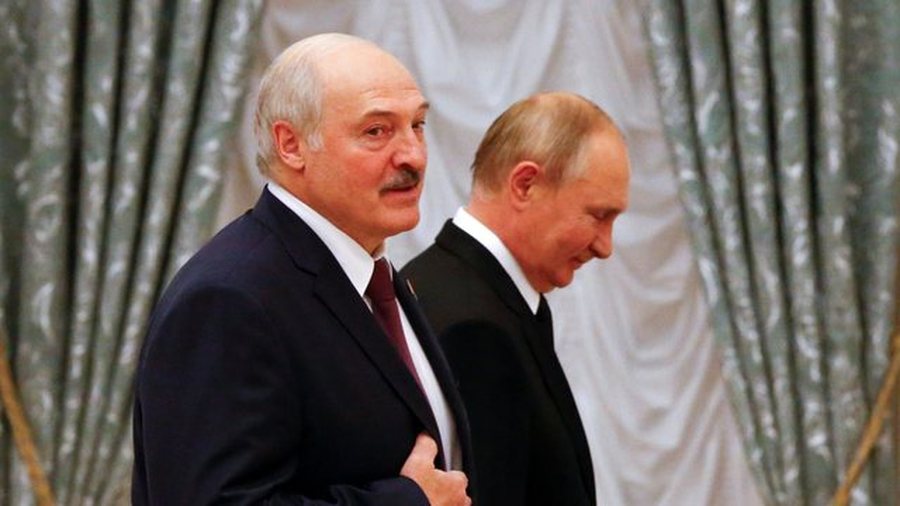
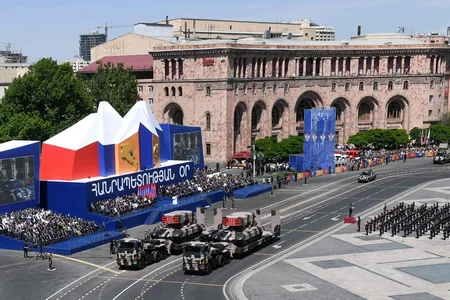
Belarusian President Alexander Lukashenko, following Vladimir Putin, has warned Armenia of the risk of repeating the "Ukrainian scenario" due to its rapprochement with the European Union, The Moscow Times reports for the Belarusian agency BelTA.
"Armenians should be very careful so that, God forbid, what happened in Ukraine does not happen again... In Ukraine, everything started exactly like this... So that they, the Armenians, who have just come out of a war, do not get into a difficult situation because of it. There is no need to rush. You just need to think, you need to be smart," Lukashenko said, speaking after the Eurasian Economic Union summit in Astana.
He added that the people of Armenia should "express their opinion" on the issue and criticized the country's leadership for "playing a game before the elections" scheduled for June 7.
"We all understand that this is a political game, tomorrow is the election in Armenia. Of course it is being manipulated... But the leadership of Armenia is wrong to act like this," Lukashenko said, calling Yerevan's actions a "humiliation" for the EAEU.
The Belarusian president also implied that what is happening in Armenia corresponds to external forces, citing Yerevan's recent contacts with EU representatives.
"Someone likes it. They came, gathered someone there (you know who it was from the Europeans), promised a whole mountain of things ," he said, adding that from the European side, criticism was heard mainly against Minsk and Moscow. "There were only conversations about how Belarus and Russia are like this or that," Lukashenko explained.
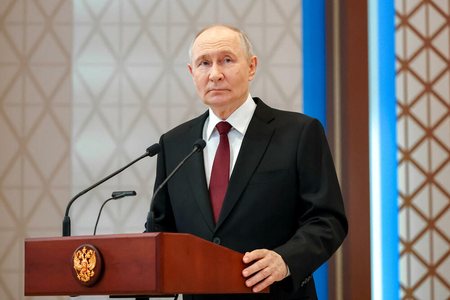
On May 29, Putin also threatened Yerevan with a "Ukrainian scenario."
"The crisis in Ukraine began with attempts to join the EU," he claimed. Earlier, on May 10, Putin made a similar statement, advising Armenian authorities to hold a referendum on EU membership and follow the path of a "gentle, civilized and mutually beneficial separation."
Meanwhile, Prime Minister Nikol Pashinyan's Civil Contract party could win a landslide majority in the June 7 elections. According to a study by the Breavis company, almost 65 percent of determined voters are ready to vote for the ruling party, which would allow Pashinyan to continue his policy of rapprochement with the West.
In this context, Russia imposed trade restrictions on Armenian products and also summoned Ambassador Sergey Kopyrkin for consultations, explaining the decision with "the steps of the Armenian leadership towards the European Union, which harm cooperation within the EAEU."
Reuters, citing Western intelligence sources, states that the Kremlin has formed a special unit for influence operations in Armenia and intends to interfere in the upcoming parliamentary elections in that country by repatriating 100,000 Armenians living in Russia (the total Armenian diaspora in Russia numbers more than two million people).


Lini një Përgjigje