


 Shkruar nga Pamfleti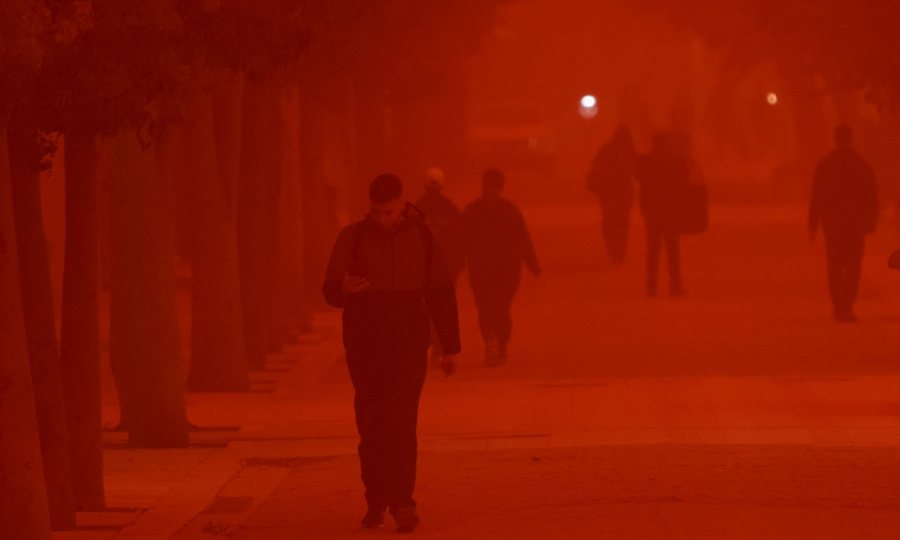
The purple-tinged sky that was observed on Wednesday (01/04) in areas of Greece, such as Crete and the Cyclades islands, during the passage of the bad weather "Erminio", is not a rare or unusual phenomenon, but an explainable physical process.
According to physicist Tina Nantsou, the phenomenon is related to the way African dust affects the propagation of sunlight in the atmosphere. She points out that sunlight is made up of all the colors of the electromagnetic spectrum and, when it enters the Earth's atmosphere, it undergoes a "filtering" process.
A key role is played by Rayleigh scattering, where small air molecules scatter short wavelength light, such as blue and violet, more strongly. As a result, these colors deviate from their original direction, while warmer hues, such as red and orange, reach the eye more.
However, when there are larger particles in the atmosphere, such as African dust or moisture, another mechanism, known as Mie scattering, comes into play. In this case, all wavelengths are distributed more evenly, but the red light, which already dominates, is emphasized even more, creating the characteristic purple hues in the sky.
The phenomenon becomes more noticeable during sunset, when the rays travel a greater distance through the atmosphere. This increases scattering and further reduces the presence of blue light in the field of view.
To illustrate this process, Nantsou proposes a simple experiment: a glass of water with a little milk can simulate the atmosphere, while a phone light represents the Sun. By observing the light from different angles, the effect of color dispersion becomes apparent.
As she emphasizes, physics is not an abstract concept, but a tool for understanding everyday experiences, even explaining impressive visual phenomena such as the colors of the sky from African dust.







Lini një Përgjigje