


 Shkruar nga Pamfleti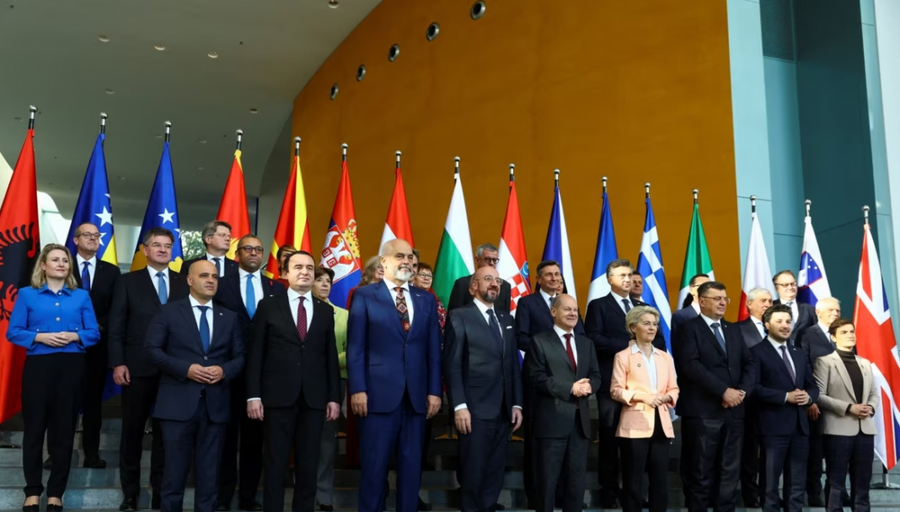
The European Union is used to crises, but the one it is facing now could surpass them all in seriousness. As the bloc’s 27 leaders prepare to gather in Brussels on Thursday, they know full well that the entire security architecture built after World War II and which relies on American defense could collapse at any moment. Since Trump returned to the White House, there has been much discussion among European leaders about issues of sovereignty and defense. However, officials from European governments acknowledge that the time has come to turn words into action, although some fear that things could go very wrong.
After Emmanuel Macron's statement on the need to wake up Europe and Friedrich Merz's assessment that the EU, diplomats' concerns now concern the speed with which events are unfolding. The "nightmare" scenario is that the US will soon announce a deal that accepts most of Russia's demands and then present it to Ukraine and Europe saying it's this or nothing, explains Malcolm Chalmers, deputy director general of the Royal United Services Institute in London.
The concern in Brussels is not just about the US, but also about leaders within the EU who could sabotage the talks. Thursday's emergency summit, convened just days after informal meetings in Paris and London, signals the leaders' intent to find a solution. However, diplomats are already bracing for the possibility that it could be undermined by a bloc of pro-Russian leaders under Hungarian Prime Minister Viktor Orban.
The sheer number of issues on the table, combined with a worrying lack of unity, means this summit could go in many different directions. Leaders will explore ways to quickly redirect resources to strengthen national militaries, while at the same time seeking to show support for Ukraine, for example by reaffirming its path to EU membership. At the same time, they will seek to emphasize their disgust with Vladimir Putin’s regime, perhaps by committing to another round of sanctions. In short: the task ahead is not easy.
"Europe faces a clear threat on a scale that none of us have ever seen in our adult lives. The future of a free and sovereign Ukraine – the future of a secure and prosperous Europe – is at stake," European Commission President Ursula von der Leyen wrote in a letter to EU leaders last Tuesday.
More than three years after Russia invaded Ukraine and just six weeks after Trump took office, Thursday’s summit will mark the end of a week of historic developments on the other side of the Atlantic. Although Macron and Starmer tried to create a positive moment by confronting Trump last week, the situation has deteriorated dramatically. After a disastrous meeting between Trump and Ukrainian President Volodymyr Zelensky in the Oval Office on Friday, Trump’s decision on Tuesday to suspend military aid to war-torn Ukraine came a day after the White House announced it would suspend military aid to the country. Funding militaries is not traditionally an issue for the European Union, but leaders will discuss ways to take action at a central level.
"Defense spending has now become a fixed cost. We have turned off the sun and now we have to pay for heating every day... Every day we have to pay for ammunition, at least for a few years until Trump dies," a European diplomat told Politico.
One of the first issues leaders will consider is the plan announced by von der Leyen on Tuesday to free up up to 800 billion euros in additional defense spending in the coming years. More specifically, von der Leyen's plan includes a proposal for the EU to borrow 150 billion euros, which would be made available to member state governments to finance pan-European defense equipment, such as air and missile defense systems, artillery systems, missiles, ammunition and drones.
The European Commission is proposing to ease EU fiscal rules so that governments can increase their defense spending. According to Ursula von der Leyen, if member states increase their defense spending by an average of 1.5% of GDP, this could create fiscal space of around €650 billion. euros over a four-year period.
Although the proposal had been planned for some time, von der Leyen's announcement on Tuesday was designed as a reaction to the U.S. decision to cut military aid to Ukraine, two EU officials said. The European Investment Bank also announced it is proposing to change its rules to make it easier to finance defense programs.
EU diplomats and officials are still working out the details of the proposals, but they are generally described as a first step in the right direction. “Von der Leyen is trying to take the bull by the horns,” said a French minister, who spoke to the website on condition of anonymity. But will the EU’s technocratic structure follow suit?
The leaders are also expected to discuss the use of Russian assets that have been frozen since the start of the war in Ukraine. Although interest from the 200 billion euros in frozen euro funds is already being used to finance aid programs, countries such as France have begun to look favorably on the more controversial proposal to seize the funds. However, critics of the idea warn that it could create legal hurdles and cause financial instability.
Controversy is already brewing over sending additional military aid to Ukraine. Officials had expected the summit communique to include a plan outlined last month by European foreign policy chief Kaia Kallas to send a large shipment of munitions and military equipment to Ukraine within the year, including anti-aircraft systems, missiles and drones.
Although the final communiqué will not be made public before the end of the summit, the latest draft, circulated Tuesday night and obtained by POLITICO, calls on ministers to find a way to continue arms deliveries. Officials said Hungary refuses to agree to the plan. The draft communiqué emphasizes that the EU will continue to provide Ukraine with regular and predictable financial support.
In 2025, the EU will allocate 30.6 billion euros to Ukraine, of which 12.5 billion euros will come from the European Facility for Ukraine, while about 18 billion euros will be disbursed from G7 loans under the Era Initiative. Additional funding is expected to come from the “Rearm Europe” plan, an initiative announced by von der Leyen on Tuesday. As European leaders prepare for the summit, Ukrainian officials are trying to appear calm after the Trump administration’s announcement to halt US military aid.
"It is a very painful development, but it will not be fatal. This will cost Ukraine unnecessary deaths and lost territory, but it will not lead to defeat," a senior Ukrainian official said./POLITICO


Lini një Përgjigje