


 Shkruar nga Francesca Salvatore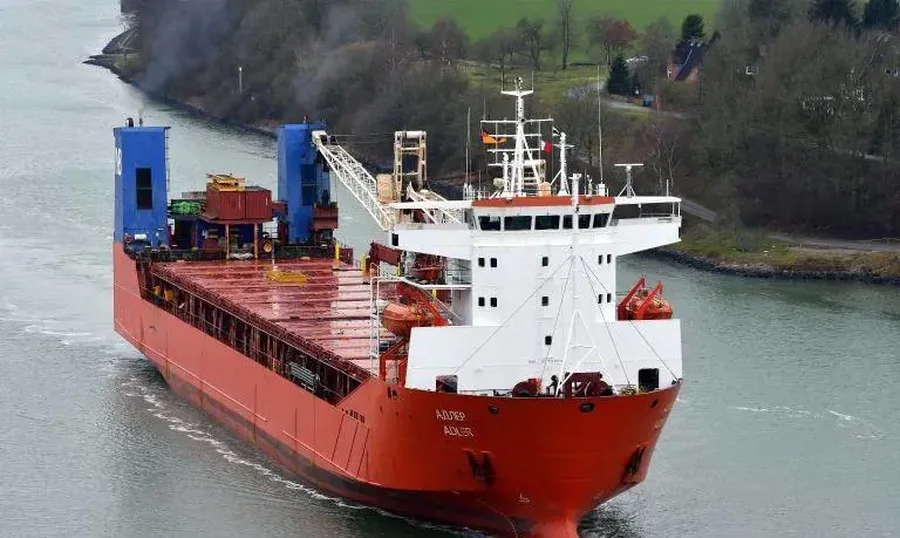
The Russian cargo ship Adler, suspected of military operations and under sanctions, was stopped in Portugal's Exclusive Economic Zone due to an unverified defect...
A Russian cargo ship under international sanctions, banned from European ports, remained at sea near Portugal's Exclusive Economic Zone (EEZ) in late August after a fault in its propulsion system sent it dangerously close to territorial waters.
The ship, the "Adler", which specializes in transporting automobiles, is suspected of carrying out much more sensitive missions: from delivering missiles to China to transporting weapons to Libya and Russia for the war in Ukraine.
The ship departed St. Petersburg on August 11, 2025, after a 17-day stop at the Morskoy Fasad terminal, a well-known loading point for sensitive and military cargo. As reported by an investigation by Portuguese newspaper Expresso, the Portuguese Navy confirmed that the merchant ship, registered in Russia, crossed the Portuguese continental EEZ from north to south between August 27 and September 2.
The area, the Navy emphasizes, is not subject to full national sovereignty except for economic exploitation. While underway, the Adler began to move towards the coast, but did not enter territorial waters. Contacted by the Maritime Operations Center, the captain reported a breakdown and cooperated with the authorities, agreeing to engage a tugboat to prevent the risk of accidents or marine pollution.
Russian cargo ship route
On August 29, the cargo ship was towed by the Spanish ship Roma, approximately 16 miles west of Póvoa de Varzim, and left the Portuguese EEZ on September 2. After reaching a stopping position north of Al Hoceima, Morocco (an area recently used by other Russian supply ships), the ship dropped anchor on September 4 and began its final leg to Oran, Algeria, on September 9, still under tow. It is not clear whether the ship was inspected or what cargo it was carrying.
Built in 1998, the Adler is operated by the sanctioned Russian maritime logistics company LLC "M Leasing" (CIF: 9701173086). Despite its age and poor mechanical reliability, it remains a functional element in Russia's current strategy of using dual-purpose civilian ships for covert military transport missions, an operational necessity given the restrictions imposed by international sanctions and maritime surveillance.
The Adler is no stranger to similar incidents: it suffered a breakdown in the Strait of Istanbul in 2019. The ship is also blacklisted by the Office of Foreign Assets Control (OFAC), the US Treasury agency responsible for international sanctions.
According to US sources, it shipped tanks to Russian mercenaries from the Africa Corp group in January 2025 and S-400 missile systems to China in 2018. The company it belongs to is also under European Union sanctions for participating in a network that transported North Korean weapons for the benefit of the Russian Defense Ministry. Its CEO, Svetlana Vladimirovna Savelyeva, has also been hit with individual sanctions by Brussels.
The Adler case highlights a structural weakness in the Russian maritime supply chain: overreliance on old, poorly maintained, and barely reliable merchant ships, which are nevertheless used in essential tasks.
Open-source maritime intelligence monitoring of these slow-moving vessels reveals recurring patterns: predictable routes, frequent mechanical failures, and a lack of military escorts. All of these factors underscore Moscow's logistical vulnerability in the Mediterranean. /Il Giornale/







Lini një Përgjigje