


 Shkruar nga Pamfleti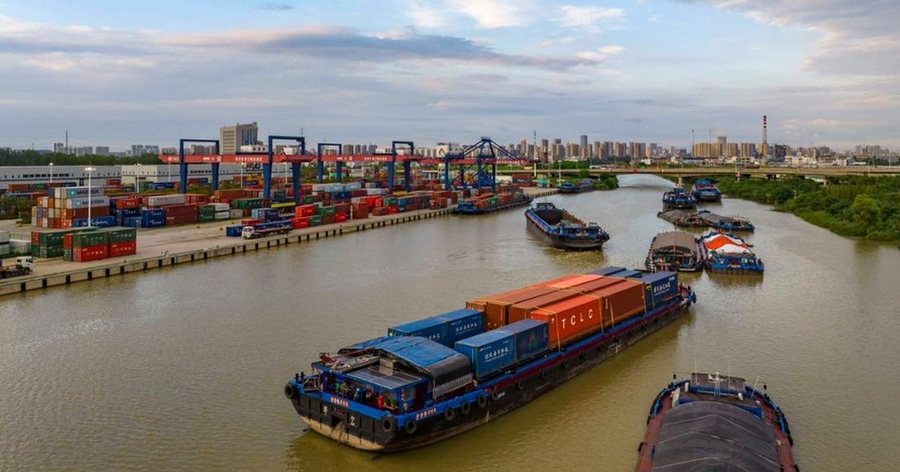
10 years ago China launched the giant project of the New Silk Road, a trade route across several continents. And how is the work with the New Silk Road today?
It all started with a speech by Chinese President Xi Jinping ten years ago in Kazakhstan. "To achieve closer economic ties, to deepen cooperation and development in the Eurasian region, we must take the initiative and jointly build an economic ring along the Silk Road," the Chinese president said then in Astana. "This giant initiative will help everyone along the way." It was the first time that the Chinese president agreed to an economic ring aimed at expanding China's infrastructure and economic ties towards Europe.
Xi Jinping had just come into office as president, and these were the first visions of a Chinese foreign policy during his time in power. a month later, Xi in Indonesia announced the "Maritime Silk Road", aimed at the sea route from China to Italy. Today, 10 years later, the "New Silk Road", officially Yi Dai Yi Lu, stretches across several continents, in Africa, South America, Southeast Asia and the Arctic.
All over the world China has invested huge sums in ports, dams, railways, highways and pipelines and proclaims this to the fullest in the Chinese media. In the first quarter of this year alone, the Federal Association for Economic Promotion, Germany Trade & Invest GTAI has connected 274 new "Belt-and-Road" projects around the world, including energy and digitalization projects. The number of projects is increasing.
New ways of funding
China is increasingly withdrawing from financing as well – the volume of investments after the peak in 2017 has been declining. This is also confirmed by prof. Vang Yivei, professor of diplomacy at Peking People's University. "China doesn't have that much money anymore, the domestic economy has slowed down. local debts in the country are high." Instead of Chinese banks, more and more private companies from China and the world are coming forward as investors. Investors from Arab and autocratic countries such as Saudi Arabia, the United Emirates, with whom China has expanded relations.
Criticism has increased in democratic countries. China uses infrastructure projects to win partners and expand geopolitical influence. Added to this is that the countries that are part of the projects are deeply in debt and have become dependent on China. Experts also warn against a military use of the infrastructure.
"Often, bailout loans are not directly about a rescue of Chinese banks, which would suffer if the loans were not repaid," says Alexander Sandkamp of the Kiel Institute for the World Economy, IfW.
The West has woken up late
Is it all worth it for China? Yes, answers Jürgen Matthes, China expert at the Institute for German Economics in Cologne. The financial weight is affordable for China. "I think the West has appreciated this initiative for a long time," says Matthes. "According to China, it's all a great success, because this country has managed to create partnerships with many countries."
This also partially applies to many European countries. "So countries that are, let's say, part of the influence of the EU or the Balkan countries. This means that a geopolitical competition has been created, which you can also classify under the sign of systems rivalry. And in the end the west has woken up too late to this."
To compete with China, the G7 countries agreed last year to invest around 600 billion euros by 2027 worldwide. "This is an attempt at an answer," says Matthes. "But against China it's a blot and not a real hit, these are very modest." According to the expert, the West is at the beginning of a compensation process, "because for a long time it has been sleepy about the geopolitical importance of the New Silk Road. The EU, the West as a whole, the G7, is trying to compensate for this now, but they are very slow and small in size."
This has to change. China itself has decided to celebrate the beginning of the New Silk Road in Beijing with great ceremonies in October./DW




Lini një Përgjigje