


 Shkruar nga Pamfleti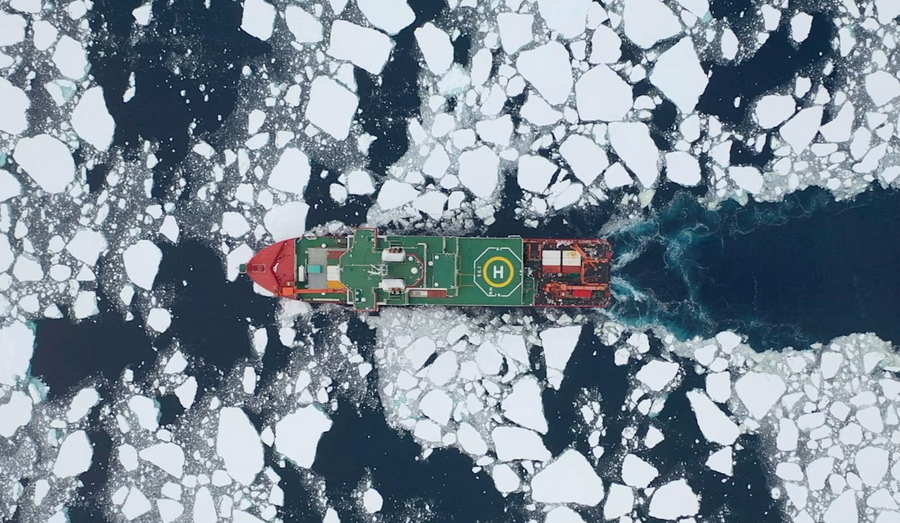
The new icebreaker and investments in the north deepen the rivalry with the US and increase concerns in the West about Beijing's presence in the region.
Capable of breaking through ice sheets up to 2.5 meters thick, China's latest Arctic icebreaker represents a powerful symbol of Beijing's ambitions in the far north, at a time when tensions have risen following US President Donald Trump's attempts to take control of Greenland.
The proposed ship, with a reinforced front and nuclear power, was unveiled as a concept in December. It is intended to serve as a prototype for the polar fleet that Beijing is developing. The state-owned 708 Institute, which designed the ship, says it will be a “multi-functional” vehicle for cargo transport and polar tourism.
While China describes its interests in the region in commercial and research terms, few analysts doubt the dual civilian and military nature of Beijing's Arctic program, from setting up research bases to oil and gas cooperation and joint military patrols with Russia near Alaska.
The icebreaker construction program has heightened concerns in the West about China and Russia's advances in the Arctic, which Trump has used to justify a US takeover of Greenland.
"China sees the Arctic as a new frontier that is essential to its geopolitical and geostrategic competition with the US and the West in general," said Helena Legarda, director of the foreign relations program at Merits.
"Beijing wants to expand its influence, presence and access to the Arctic," she added.
These ambitions have deepened concerns among experts and policymakers in the US and other Western capitals, who foresee a race to secure faster and cheaper shipping corridors and to take advantage of rich natural resources as the polar ice caps melt.
The Arctic offers numerous opportunities for military operations, from space and satellite warfare to the strategic positioning of nuclear-armed submarines, increasing the risk of tensions escalating into confrontation in the evolving race for control of the territory.
The shipyard that built China's first domestic icebreaker also produced the Fujian, the country's third aircraft carrier, which entered service late last year with some of China's most advanced military technology. The shipyard is run by state-owned China State Shipbuilding Corp.
China has nurtured ambitions in the Arctic for decades, but its activity has accelerated significantly in recent years, in line with its growing economic and geopolitical power.
Pekini bleu akullthyesen e parë, “Xue Long”, Dragoi i Borës, nga Ukraina në vitin 1993, përpara se të fillonte zhvillimin e flotës së vet. Në vitin 2004, Kina hapi stacionin e parë të përhershëm kërkimor në Arktik, në arkipelagun Svalbard të Norvegjisë, dhe një tjetër në Islandë në vitin 2018.
Po atë vit, Pekini prezantoi politikën e tij për Arktikun, e cila parashikon “një ‘Rrugë Polare të Mëndafshit’ përmes zhvillimit të rrugëve detare arktike”. Dokumenti thekson kërkimet dhe “studimet hidrografike” të Kinës në rajon, që synojnë përmirësimin e “sigurisë dhe kapaciteteve logjistike në Arktik”.
Akullthyeset janë thelbësore për projeksionin e fuqisë në rajonet polare, pasi u mundësojnë vendeve të hyjnë në territore shpesh të ngrira dhe të ruajnë praninë atje. Administrata Trump ka ndarë 9 miliardë dollarë për akullthyese dhe infrastrukturë në Arktik dhe Antarktik për të “siguruar aksesin, sigurinë dhe udhëheqjen e SHBA-së në rajonet polare”, njoftoi Departamenti i Mbrojtjes në dhjetor.
Në dokumentin e saj të vitit 2018, Kina e përshkroi veten si një “shtet pranë-Arktik”, duke nxitur reagim të ashpër nga sekretari i atëhershëm amerikan i Shtetit, Mike Pompeo. “Ekzistojnë vetëm shtete arktike dhe shtete joarktike”, tha Pompeo. “Nuk ka kategori të tretë, dhe pretendimi i kundërt nuk i jep Kinës asnjë të drejtë.”
Deri para disa vitesh, sipas Legardës nga Merics, Europa ishte partneri i preferuar i Kinës në Arktik. Por pasi Europa filloi të reduktonte rreziqet në marrëdhëniet me Kinën dhe Rusinë pas pandemisë Covid-19 dhe pushtimit të plotë të Ukrainës nga Moska në vitin 2022, Pekini u afrua më shumë me fqinjin e tij verior.
Rrugët kryesore detare nga Europa drejt Kinës kalojnë nëpër territore të kontrolluara nga NATO, përfshirë Kanadanë dhe Groenlandën.
Vitet e fundit, Kina ka treguar interes të veçantë për Rrugën Veriore Detare që kalon nëpër ujërat ruse.
Rrugët arktike “mund të shkurtojnë distancat e lundrimit me 30 deri në 40 për qind krahasuar me rrugën tradicionale përmes Kanalit të Suezit”, tha Yu Yun, studiues në Institutin 708, për gazetën shtetërore China Daily.
Sipas Kinës, në shtator një anije kontejnerësh me emrin “Istanbul Bridge” u nis nga Ningbo në provincën Zhejiang në lindje të vendit, përmes Rrugës Veriore Detare arktike drejt portit Felixstowe në Britani. Pekini deklaroi se ky udhëtim shënoi “hapjen zyrtare të linjës së parë ekspres arktike të kontejnerëve midis Kinës dhe Europës”, të cilën e quajti “China-Europe Arctic Express”.
Pekini ka investuar gjithashtu në projekte minerare, energjetike dhe infrastrukturore në veriun e Rusisë, nga qymyri pranë Murmanskut deri te një port me ujëra të thella në Arkhangelsk në Detin e Bardhë, të cilin kompania kryesore kineze e transportit Cosco planifikon ta përdorë si bazë kryesore arktike.
Megjithatë, ekspertët vlerësojnë se, ndonëse Rusia kërkon të shfrytëzojë mundësitë ekonomike me Kinën, ekziston një kufi në gatishmërinë e saj për bashkëpunim.
"Russia is cooperating closely with China, but there is a kind of ambiguity about allowing it to fully enter the Arctic, as Russia wants to be the dominant power," said Tore Sandvik, Norway's defense minister.
A senior Nordic official stated that the 8 Arctic states, including Russia, do not want China to take on any formal role in the region.
"China calls itself a near-Arctic state, and I think that's close enough for all of us. We don't want a form of governance that gives China a say in the decision-making process."
On the other hand, James Char, a China expert at the S Rajaratnam School of International Studies in Singapore, said that Beijing's strategy consists of building a long-term presence in the region, rather than overt force projection.
Most Chinese military activities, including joint naval and air patrols with Russia, take place near Alaska, about 4,000 kilometers from Greenland, according to Jo Inge Bekkevold, a senior researcher at the Norwegian Institute for Defense Studies.
"To date, there has been no known Chinese military ship that has sailed into the Arctic Ocean," he said.
Bekkevold added that the military importance of the Northern Sea Route is often overestimated. The narrow sea corridors and short season could make ships vulnerable in the event of conflict, while it would be difficult for China to introduce nuclear submarines into the Arctic through the Bering Strait without being detected.
He also stressed that, although the journey from northern China to Europe may be shorter through the Arctic, for exporters in the country's industrial south, the fastest route remains through the Suez Canal to Greece.
For its part, China tries to present its interests in the Arctic as primarily civilian rather than strategic.
The Institute's new icebreaker 708 will carry hundreds of passengers and cargo containers and offer a "luxurious, comprehensive and safe" polar travel experience, Cui Meng, a polar ship engineer at the institute, told China Daily.
Char stressed that China presents its activities as research, commercial or touristic, but at the same time aims to consolidate its presence and claims in some of the Arctic regions. /Adapted from FT /








Lini një Përgjigje