


 Shkruar nga Pamfleti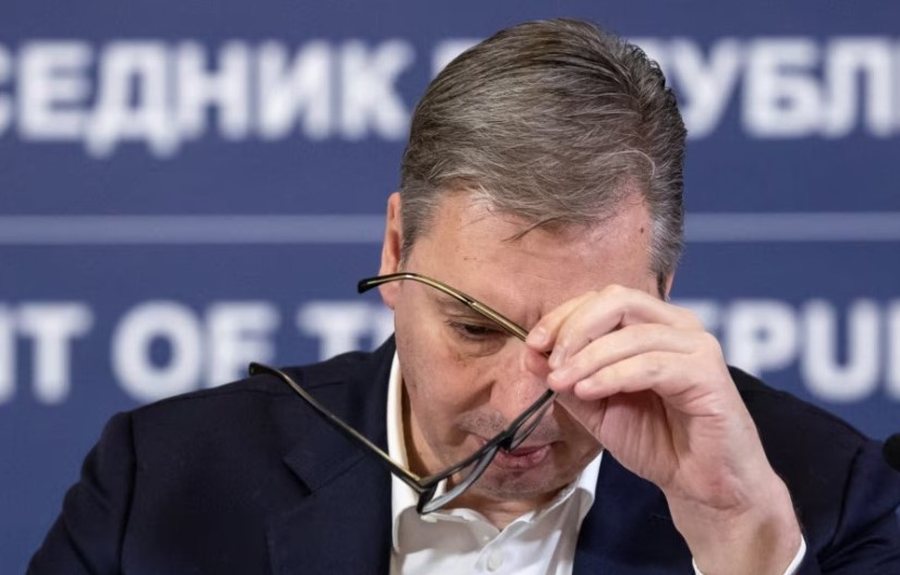
The EU is demanding a review of the laws, assessing that they undermine the independence of the judiciary, the autonomy and functioning of prosecutors' offices...
Serbia's approach to the so-called pillars of its diplomacy is currently determined by two concrete issues. Brussels has warned of the possibility of suspending funds from the Growth Plan due to new laws on justice.
The EU is demanding a review of the laws, saying they undermine the independence of the judiciary, the autonomy and functioning of prosecutors. Belgrade's relations with Moscow and Washington are defined by talks on lifting US sanctions on the Serbian Oil Industry (NIS).
The sanctions have been imposed due to Russian ownership, while negotiations are underway with Russia regarding its willingness to sell its stake, around 56 percent, in Serbia's main oil company, the Hungarian company MOL.
A special place in further developments has the departure from power of Viktor Orban, leader of the Hungarian Fidesz party, after 16 years. The populist Orban, whose departure facilitates agreements on key issues within the EU, may be a disappointment for the government in Serbia, given that Serbian President Aleksandar Vučić has not hidden his closeness to the Hungarian regime. He was also among the European leaders who supported Orban's forces in the election campaign.
Orban and Vučić were linked by cooperation with Russia, despite EU sanctions against the country, as well as accusations of centralization of power and pressure on the media, opposition and civil society. Therefore, comparisons of political processes in Serbia and its northern neighbor are inevitable.
-Similarities and differences with Hungary
"Hungary is a member of the European Union, so EU membership is not an issue for them. So in the case of Hungary, the issue of territorial integrity does not arise," emphasizes Zoran Milivojevic, a career diplomat, and Jelica Minic from the European Movement in Serbia.
Serbia does not give up on Kosovo as part of it, as stipulated in the country's Constitution, despite the fact that it has not had control over its former province since 1999, while the EU requires the normalization of relations between the two sides as a condition for membership.
" Therefore, things are incomparable," Milivojevic concludes.
He also recalls that Vučić's opponents do not have a leader who can be compared to the winner of the elections in Hungary, Peter Magyar, which is also emphasized by Jelica Minič. She adds that the government in Serbia has deeply polarized society, and that it is precisely here that similarities with the northern neighbor can be sought.
" We will see how it develops and whether the major changes that are now expected in Hungary are possible. Peter Magyar has managed to gather two-thirds of Hungarians, but across a broad political spectrum ," said Minic.
Even without changes in Hungary, however, the government in Serbia faces a number of different challenges that shape its foreign policy position.
-“Vučić's Games” in new circumstances
During the fourteen years of power of Vučić's progressives and their allies, the global balance of power has changed significantly. The policy of balancing between great powers, on which Vučić's diplomacy has insisted, is now facing numerous challenges.
Although a candidate for EU membership, Serbia has not opened any chapters in negotiations for four years, while among the main challenges is the lack of harmonization with EU foreign policy, first and foremost the failure to impose sanctions on Russia due to its invasion of Ukraine.
Although Belgrade speaks of "strong ties" with Moscow, some criticisms from the Kremlin, such as those regarding the alleged sale of weapons to Ukraine, have shaken the "traditional friendship".
A signal of more correct relations with Moscow was recently seen in Russia's readiness to remain Serbia's main gas supplier for three months, for which Vučić personally thanked Russian leader Vladimir Putin. The EU expects Serbia to follow the pace of reducing its dependence on Russian gas, which should be completely ended by January 2028.
The conversation with Putin is only a small change compared to the uncomfortable situation Vučić found himself in last September in Beijing, when Putin in front of the cameras flipped through documents while Vučić addressed him. As for the US, as Edward Joseph, an American expert, says, the Trump administration is not interested in “Vučić’s games.”
-What does the EU "protect" in Serbia?
Speaking about the EU's approach towards Serbia, but also towards the Western Balkans in general, Eric Gordy from the University of London emphasizes Brussels' focus on formal changes and economic issues.
As concluded in the recently published collection of papers “Captured States in the Western Balkans,” of which Gordi is one of the editors, a clearer approach to fundamental rights would be more desirable.
" I follow the pro-government media in Serbia and in recent years they have been strongly emphasizing the division between the EU and the US. Today, after the elections in Hungary, they are saying this openly. For example, 'Politika' has an article that the West is now divided into two camps, the EU and the US. And, of course, the regime uses the US against the EU. What can be hoped for in such a context is that the EU will step forward and take on its rightful role, as a defender of equality, human rights and democratic values," says Gordy.
Serbia in 2025 was among the countries in the world with the greatest decline in freedoms, according to a study by the international non-governmental organization Freedom House, published in March. With the status of a “partly free” country, the issue of freedoms and the rule of law becomes the core of the EU’s insistence on Serbia. It is precisely for this reason that Serbia is threatened with losing the remaining one and a half billion euros from the Growth Plan.
Jelica Minic estimates that, unlike the professional public that does not hide its concerns, the ruling elite in Serbia has a different approach.
" They seem to think that this is solvable and that it is not certain that the EU will take such steps ," she says.
Zoran Milivojevic believes that the threat from Brussels is serious and expresses confidence in Vučić's message that he will respect what the Venice Commission, which will give an opinion on the changes to the justice laws, decides. At the request of the Speaker of the Serbian Parliament, Ana Brnabić, for an opinion on the justice laws, the Venice Commission, an advisory body of the Council of Europe, gives opinions on legal issues. The new justice laws entered into force in January. The government claims that they make the judicial system more efficient, while the EU has expressed concern that the law strengthens control over the justice system.
-Where is Belgrade in relation to Washington?
Relations between the government in Serbia and the Donald Trump administration have changed from the previous to the new mandate of the American president.
"After the changes in Washington, it is certain that relations with Serbia have improved," says Milivojevic, supporting this with examples of meetings that Serbian officials hold with representatives of the State Department and other American institutions.
"I would not agree that Serbia has progressed in relations with the US. I think the expectations were high, a kind of euphoria after Donald Trump's victory. However, after that came disappointment," says Minic.
She points out that Serbia pays high US tariffs, 35 percent, on products it exports to the US, in accordance with the US president's decision from August 2025, with the aim of reducing the US trade deficit. However, in the statements of Aleksandar Vučić, as well as other government representatives, the assessments of the US or Russia are more restrained than those heard about the Brussels administration.
"Because Brussels is tougher on Serbia ," is Zoran Milivojevic's position.
Jelica Minic, on the other hand, believes that the language used by Belgrade towards European officials is unacceptable and that a price is being paid for this./ Adapted from "Pamphlet" by "The Geopost"


Serbia do plasi lufta midiis shqiperis presheva cernike vojdiniiaduhete te drejta shqiptarw dhe ish republika jugodllave dhe srs cernike me do filloje lufta e harta te vjetra te drejta shqiptare dhe serb
Serbia never ever have been between USA, Europe or Russia. Serbia is litter creation of Russia and always will be with Russia. If Russia goes down Serbia goes with it in seconds.