


 Shkruar nga Pamfleti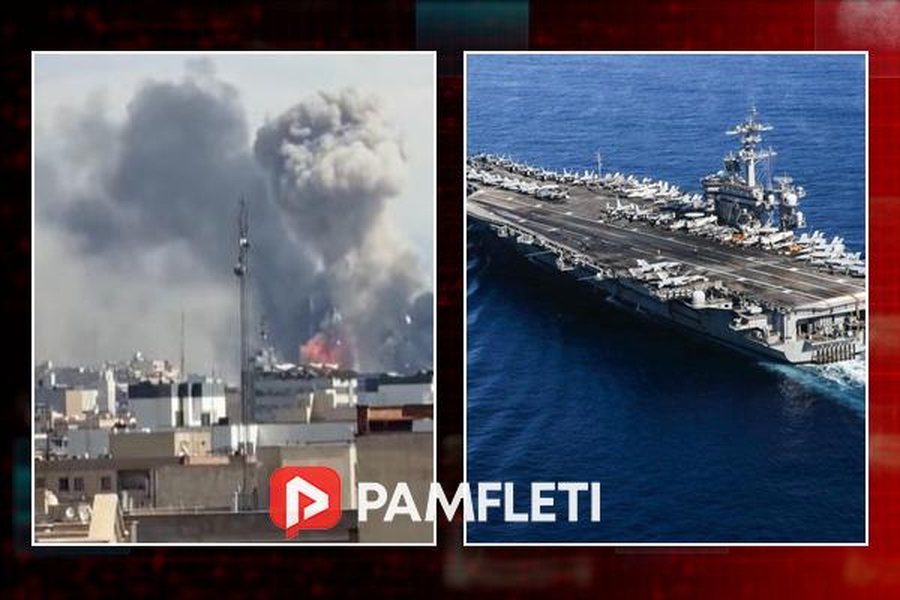
The US and Israel launched a new wave of intense attacks across Iran, as Tehran responded by targeting US and Israeli targets, including the aircraft carrier USS Abraham Lincoln, with four ballistic missiles. The strike has caused civilian casualties, damage to regional infrastructure and major disruptions to air traffic, raising the risk of a wider war in the Middle East and uncertainty in global energy markets.
The United States and Israel launched a new wave of intensive strikes on targets across Iran on the second day of a military campaign that Washington says is aimed at toppling the Iranian government. The operation, launched on Saturday with a series of missile and air strikes, has plunged the Middle East into a new regional confrontation with no clear deadline for its conclusion.
On Sunday morning, a powerful explosion rocked Tehran, sending a thick cloud of smoke over the capital. The blast occurred near police headquarters, Iranian state television, the Revolutionary Court and a Defense Ministry building. The Israeli Defense Forces said their aircraft were striking “the heart of Tehran,” with a focus on destroying Iran’s remaining air defense systems.
US President Donald Trump said the US would hit Iran "with a force like never before seen" if Tehran retaliated after the death of Supreme Leader Ayatollah Ali Khamenei, who was killed in an Israeli air strike the day before. Trump stressed that the campaign's objective is regime change and called on Iranians to "take back their country."
At the UN Security Council, Iranian Ambassador Amir-Saeid Iravani said hundreds of civilians had been killed or injured by joint US-Israeli strikes and accused the two countries of deliberately targeting residential areas in several cities. Iranian state media reported that the death toll from a rocket strike on a girls' school in the southern city of Minab had risen to nearly 150, including more than 100 children.
At the same time, Iran announced that it had targeted the US aircraft carrier USS Abraham Lincoln, a Nimitz-class aircraft carrier, with four ballistic missiles. According to reports from Tehran, the missiles were fired towards the ship's strike group in the Gulf waters, although US authorities have not provided full details on the damage or consequences. The attack on a US aircraft carrier constitutes a direct escalation against the US military presence in the region.
Iranian retaliation has also targeted Israeli territory, civilian infrastructure and US military bases in Gulf Arab states. Loud explosions were heard for the second day in a row in Dubai and over the Qatari capital, Doha. White trails from missile defense systems were seen in the sky over Dubai, while thick smoke rose over the city's port.
The Burj Al Arab hotel and Dubai airport, which handles over a thousand flights a day, suffered damage from Iranian attacks overnight, as did airports in Abu Dhabi and Kuwait. Dubai airport, one of the world's largest international air traffic hubs, remained closed, causing one of the biggest disruptions to global aviation in recent years. Several other airports in the Middle East suspended operations.
Ships in the region reported hearing a radio transmission purportedly from the Iranian navy, announcing a ban on passage through the Strait of Hormuz, a key corridor for global oil supplies. Authorities in Oman reported damage to at least one oil tanker, as international markets reacted with expectations of higher energy prices.
In Israel, air raid sirens sounded several times in the early hours of Sunday. Loud explosions were heard in Jerusalem and Tel Aviv as Israel's advanced air defense systems scrambled to intercept the latest wave of Iranian missiles.
British Defense Secretary John Healey described the situation as “serious and deteriorating,” warning of the risk of further retaliatory attacks by Iran. He accused Tehran of escalating the situation, while analysts warn that an open war with Iran could cause severe global economic consequences and months of instability.
Inside Iran, authorities have given few details about military damage but confirmed numerous civilian casualties. Senior security official Ali Larijani accused the US and Israel of aiming to divide and plunder Iran and warned separatist groups of dire consequences if they try to take advantage of the situation.
The conflict thus enters a new and dangerous phase, with direct confrontations between American and Iranian forces, while the region faces the risk of an expanded war, without a clear diplomatic horizon for a solution. /Pamphlet




Lini një Përgjigje