


 Shkruar nga Pamfleti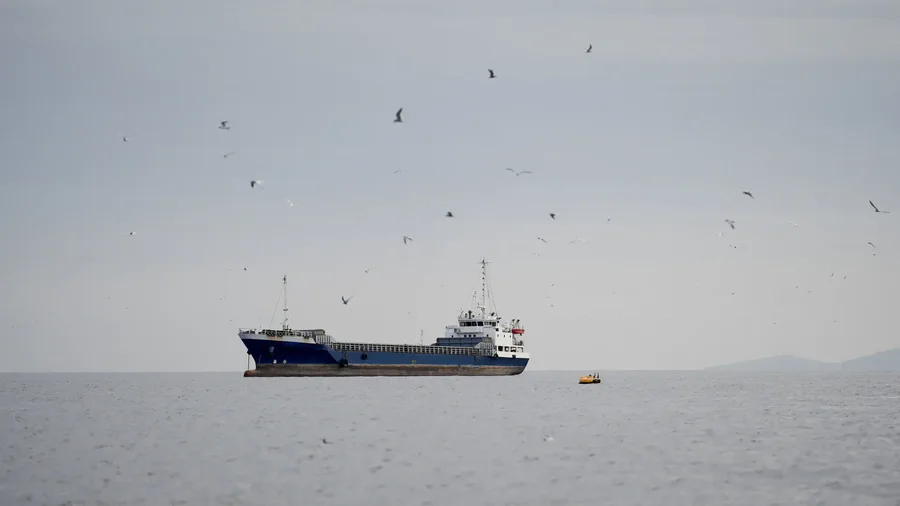
Decision after failed talks in Pakistan increases tensions and sends oil prices above $100 per barrel
United States President Donald Trump said the US Navy would begin blocking "any ship attempting to enter or exit the Strait of Hormuz" after peace talks with Iran in Islamabad collapsed over the weekend.
In a social media post on Sunday, Trump said he had also ordered the US Navy to stop and search any ship in international waters that has paid a fee to Iran. “No ship that pays an illegal fee will have safe passage on the high seas,” he declared.
The president added that "other countries" will also be involved in this operation, without providing further details on the international partners.
In the post published on the Truth Social platform, Trump accused Iran of extortion, claiming that Tehran is blocking the Strait of Hormuz, through which about 20 percent of the world's oil usually passes, by laying naval mines.
“They want money and, most importantly, they want nuclear weapons,” Trump wrote. He also warned that any hostile action by Iran would be met with a severe response: “any Iranian who fires on us or peaceful ships will be destroyed.”
According to recent statements, the US Navy has already begun operations to find and neutralize mines placed in the strait.
Meanwhile, the US military announced that it would impose a blockade on any ship entering or leaving Iranian ports and coastal areas, but added that it would allow other ships to pass through the Strait of Hormuz, hours after President Donald Trump declared that the United States would completely block this vital sea route.
The US Central Command said in a statement that the blockade of Iranian ports would begin at 10 a.m. Eastern Time on Monday. It stressed that US forces “will not impede the freedom of navigation of vessels transiting the Strait of Hormuz to or from non-Iranian ports.”
Although the statement stressed that the move was “consistent with the president’s announcement,” it appeared to soften Trump’s previous stance, which had promised to block “any and all ships attempting to enter or exit the Strait of Hormuz.” In an interview with Fox News, he insisted it would be a “complete blockade” and that passage through the route would be “all or nothing.”
Trump's announcement added to uncertainty over the already fragile ceasefire between Iran and the United States, after marathon peace talks between the two countries' top leaders in Pakistan ended without a concrete agreement.
An adviser to Supreme Leader Ayatollah Ali Khamenei warned that Iran has “huge untapped leverage” to respond to any naval blockade. Iran’s chief negotiator, Mohammad Bagher Ghalibaf, who is also the speaker of parliament, addressed American consumers, saying: “You will soon miss $4-$5 gasoline.”
Since the start of the war, Iran has restricted shipping through the strait, through which about 20 percent of the world's oil usually passes, allowing mostly only its own ships and a few others. As a result, global oil prices have risen by more than 50 percent during the conflict. The United States has demanded that Iran reopen the route and has made the ceasefire conditional on doing so.
Vice President JD Vance, who led the US negotiating team, said early Sunday that the talks in Islamabad, the highest-level direct meeting between the two countries since the 1979 Islamic Revolution, ended after Iran chose “not to accept our terms.” Ghalibaf, on the other hand, said on social media that the United States failed to gain the trust of the Iranian delegation.
Analysts estimate that the issues dividing the two countries are extremely complex and include the fate of about 900 pounds of enriched uranium, Iranian revenues frozen abroad, and control of the Strait of Hormuz.
Neither Trump nor Ghalibaf ruled out the possibility of further negotiations. Trump said his pressure had forced Iran to "come to the negotiating table" and added that he believed the US would achieve "everything" it wanted.
Oil prices rose on Sunday after the talks failed. Brent crude, the global benchmark, rose more than 7 percent to around $102 a barrel. Trump downplayed the economic impact of the war but acknowledged that prices could remain flat or slightly higher until the November election.
Investors and analysts are focused on the ongoing disruptions to shipping in the Strait of Hormuz, a narrow waterway between Iran and Oman through which about a fifth of global oil supplies and significant amounts of natural gas pass.
S&P 500 index futures fell about 1 percent. Markets in Asia fell, with Japan's Nikkei and South Korea's Kospi losing more than 1 percent. /Adapted from Pamphlet /




Trump po i vendos djemtë dhe vajzat e marinës si "ushqim" për kafshët e egra në Gjirin Persik. Gjë e çuditshme, prindërit në shtëpi janë në rregull me këtë akt të çmendur egoist dhe të paligjshëm! Do t'i gris diplomat e mia meqenëse tani jetoj në "Perëndimin e Egër".
Po na shkaterron te gjitheve o gomar!