


 Shkruar nga Pamfleti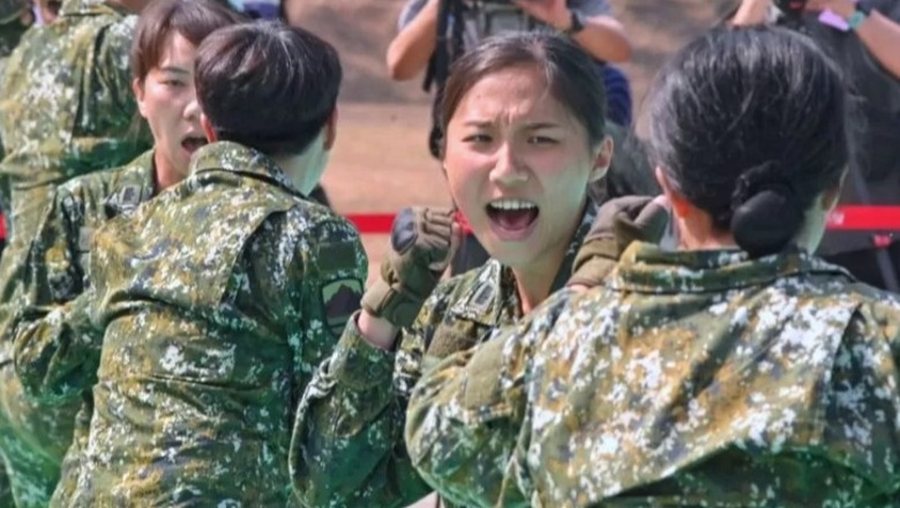
But the war in Gaza will undoubtedly tighten America's arms supply to Taipei, as the war in Ukraine has. President Biden is seeking military aid for Ukraine and Israel, which includes more money for Taiwan.
US President Joe Biden recently approved an $80 million grant to Taiwan that will be used to purchase US military equipment. The decision was strongly opposed by China.
It didn't seem like a huge amount to the casual observer. It was less than the cost of a single modern fighter jet. Taiwan already has more than $14 billion worth of US military equipment on order. Does this 80 million dollars matter?
While anger is Beijing's default response to any military support for Taiwan, this time something was different. The 80 million dollars is not a loan. It comes from the American taxpayer. For the first time in more than 40 years, America is using its own money to send weapons to a country it officially does not recognize. This is happening under a program called Foreign Military Finance (FMF).
Since Russia's invasion of Ukraine last year, the IMF has been used to send about $4 billion in military aid to Kiev. It was used to send billions more to Afghanistan, Iraq, Israel and Egypt and so on. But so far it has only been given to countries or organizations recognized by the United Nations, of which Taiwan is not a part.
After the US switched diplomatic recognition from Taiwan to China in 1979, it continued to sell arms to the island under the terms of the Taiwan Relations Act. The key was to sell enough arms so that Taiwan could defend itself against possible Chinese attacks, but not so much as to destabilize relations between Washington and Beijing. For decades, the US has relied on this so-called strategic ambiguity to do business with China, while remaining Taiwan's staunchest ally, the BBC reports.
But in the past decade, the military balance across the Taiwan Strait has tipped dramatically in China's favor. The old formula no longer works. Washington insists its policy has not changed, but, in crucial ways, it has. The US State Department has been quick to deny that the IMF implies any recognition of Taiwan.
But in Taipei it is clear that America is redefining its relationship with the island, especially given the urgency with which Washington is pushing Taiwan to rearm. And Taiwan, which is bigger than China, needs help.
"The United States is emphasizing the desperate need to improve our military capacity. It is sending a clear message to Beijing of strategic clarity that we stand together," said Wang Ting-yu, a ruling party lawmaker with close ties. with the President of Taiwan Tsai Ing-wen and the heads of the US Congress.
He says $80 million is the tip of what could be a very large iceberg and notes that in July President Biden used discretionary powers to approve the sale of $500 million worth of military services and equipment to Taiwan.
Deals involving military equipment can last up to 10 years, says Lai I-Ching, president of the Prospect Foundation, a Taipei-based think tank. "But with the IMF, the US is sending weapons directly from its own stockpiles and it's US money - so we don't need to go through the whole approval process."
This is important given that a divided Congress has withheld billions of dollars in aid to Ukraine, although Taiwan appears to have much more bipartisan support.
But the war in Gaza will undoubtedly tighten America's arms supply to Taipei, as the war in Ukraine has. President Biden is seeking military aid for Ukraine and Israel, which includes more money for Taiwan.
The list of problems is long. Taiwan's military has hundreds of aging battle tanks, but very few modern, light missile systems. Its army command structure, tactics and doctrine have not been updated for half a century. Many frontline units only have 60% of the manpower they should have. Taiwan's counterintelligence operations in China are said to be non-existent and its military recruitment system is broken.
In 2013, Taiwan reduced military service from one year to just four months, before bringing it back to 12 months, a move that takes effect next year. But there are bigger challenges. It has been jokingly referred to as a "summer camp" by the youngsters who go through it.
"There was no regular training. We went to a shooting range about once a fortnight and used old guns from the 1970s. We shot at targets. But there was no proper instruction on how to aim, so everyone kept on were absent. We did zero exercise. There is a fitness test at the end, but we didn't prepare for it," said one recent graduate
He described a system in which senior military commanders view these young men with complete indifference and have zero interest in training them, in part because they will be there for such a short time. There is a strong sense in Washington that Taiwan is running out of time to reform and rebuild its military. So the US is also starting to retrain Taiwan's military.
For decades, the island's political and military leaders have relied heavily on the belief that conquering the island is too difficult and dangerous for China to attempt. Like Britain, Taiwan prioritized its navy and air force - at the expense of its military.
"The idea was to engage them in the Taiwan Strait and annihilate them on the beaches. So we put a lot of resources into air and naval defense," Dr Lai said.
But now China has the largest navy in the world and a far superior air force. A war-gaming exercise conducted by a think tank last year found that in a conflict with China, Taiwan's navy and air force would be wiped out in the first 96 hours of battle. Under intense pressure from Washington, Taipei is moving to a "fortress Taiwan" strategy that would make the island extremely difficult for China to conquer.
Taiwan's weakness is forcing Washington to act. That is why Taiwanese ground troops are being sent to the US for training and American trainers are coming to Taipei to join Taiwan's marines and special forces.
A fierce debate has already begun in Washington about how far the US should go in supporting Taiwan. Many long-time China watchers say any public engagement from the US would provoke Beijing rather than deter it. But Washington also knows that Taiwan cannot hope to defend itself.
As one senior China watcher put it: "We should be silent on the whole matter of strategic ambiguity while we arm Taiwan to the teeth."


Lini një Përgjigje