


 Shkruar nga Pamfleti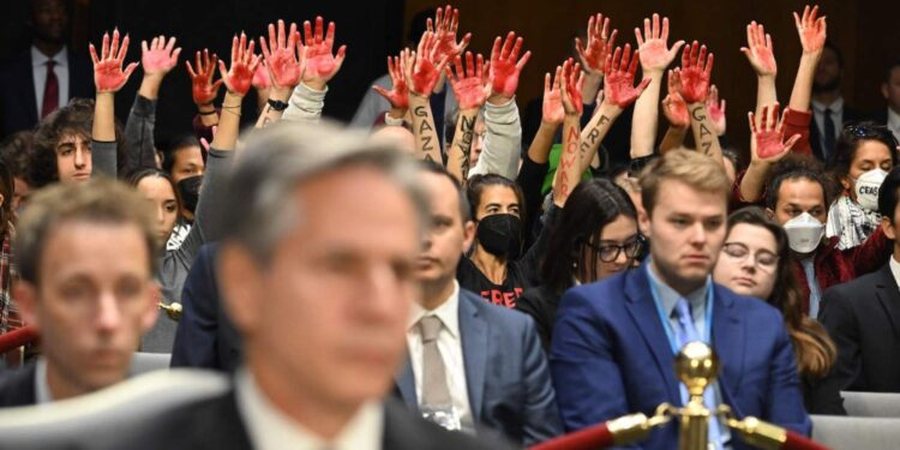
Privately, administration officials have expressed deep misgivings about how Israel's bombing campaign and attacks on Gaza have worsened the crisis and increased the civilian death toll.
After a marathon tour of the Middle East to address the massive regional crisis fueled by the Israel-Hamas war, Secretary of State Antony Blinken took time to send a lengthy message to the diplomatic corps.
In the Oct. 20 message, he wrote how "challenging" the current crisis was for State Department employees and repeated his and President Joe Biden's calls for Israel to respect "the rule of law and international humanitarian standards" by upholding the right to country to defend itself after the massive attack by Hamas militants on October 7.
"Let's also be sure to maintain and expand the space for debate and dissent that makes our policies and our institution better," he wrote in the message, a copy of which was obtained by Foreign Policy.
The last line in particular spoke volumes…
As Blinken moved between Middle Eastern capitals, a growing storm of dissent was brewing in the diplomatic corps at home (US), where many diplomats were angry and shocked by what they perceived as a de facto empty control from Washington. for Israel to launch a massive military operation in Gaza at a tremendous humanitarian cost to Palestinian civilians besieged in Gaza.
This anger became the basis of opposition to Biden's initial approach to the war among Americans.
Growing opposition within the State Department, National Security Council and other agencies — described by more than a dozen current and former officials in interviews with Foreign Policy — has coincided with a backlash against Biden's policies beyond Washington. and among progressive Democrats and Arab-American voters. . (About 59 percent of Arab-Americans backed Biden in 2020, but his support in the 2024 race has fallen to 17 percent, according to a new poll.)
In Washington, growing internal dissent poses one of the biggest challenges to Blinken's tenure at the State Department so far, several current and former officials say.
"In the 25 years I've worked at the State Department ... I've never seen anything like this," said Aaron David Miller, a fellow at the Carnegie Endowment for International Peace and a former State Department expert on Arab-Israeli negotiations. "It's like the administration is mediating its own internal Israeli-Palestinian conflict."
In the past week, as humanitarian aid tolls from Israeli attacks and military operations in Gaza have mounted, the Biden administration has shifted its approach, urging Israel both publicly and privately to take more steps to alleviate humanitarian suffering and to reopen Gaza's access to water, fuel and food.
Although the administration has not budgeted to send more weapons to Israel and has rejected calls for a permanent ceasefire to end the fighting, Blinken, testifying before the Senate on Tuesday, defended the idea of short "humanitarian pauses" for allowed humanitarian aid to enter Gaza. (Protesters loudly interrupted his speech a total of five times.)
Many officials agree with the scenes of carnage in Gaza and say warnings from humanitarian groups, as well as protests from other regional powers, have begun to distract the US. Privately, administration officials have expressed deep doubts that Israel's bombing campaign and attacks on Gaza have worsened the crisis and increased the civilian death toll, and that US officials were successful in pressuring Israel to resume water supplies to Gaza. / Foreign Policy






Lini një Përgjigje