


 Shkruar nga Pamfleti
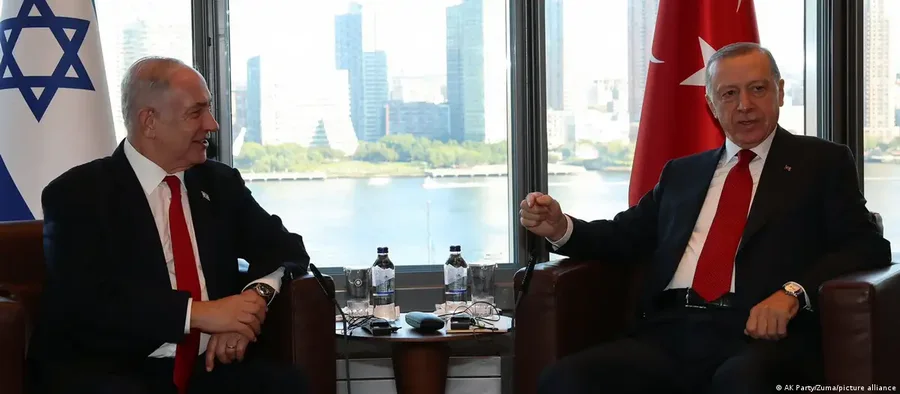
"The similarity of our ties is a sign that our bilateral relations are improving," Israeli Prime Minister Benjamin Netanyahu declared when he met with Turkish President Recep Tayyip Erdogan at "Türkevi" (Turkey House) in New York on September 20. The two posed amicably for the cameras in an atmosphere of good humor. Netanyahu told Erdogan: "I like your tie." And Erdogan replied: "Even the shirt and the tie are the same." The jokes were based on the fact that the English word "tie" means "tie" and "relationship" in English.
The photo that appeared a few weeks ago as a turning point in Turkish-Israeli relations looks like history today. In recent days, Erdogan has replaced the jokes in front of the cameras with completely different statements. Hamas is a freedom movement, not a terrorist organization, he said. He called Israel an occupier and went further: "We will tell the whole world that Israel is a war criminal," Erdogan told a pro-Palestinian rally in Istanbul last week.
In addition to Israel, Germany, the European Union, the US and several Arab states also classify Hamas as a terrorist organization. The Islamic militant organization Hamas does not recognize the state of Israel and, according to its statements, wants to destroy it.
After Erdogan's mass accusations, Israel withdrew its diplomats from Turkey: relations will be "re-evaluated", said Israeli Foreign Minister Eli Cohen. According to diplomatic circles in Ankara, it is expected that the Turkish ambassador in Tel Aviv will soon be declared "persona non grata". Israel has not yet commented on the matter. "But the dismissal of the diplomats speaks for itself," says the Middle East analyst at the foreign policy think tank ELIAMEP in Greece, who also does research at the Ben Gurion Institute in Israel.
"The role of mediator was never realistic"
Israeli society has undisguised anger towards Turkey, Haritos explains in an interview for DW. Today, Turkey is seen here as an ally of a terrorist organization that is "a new version of IS": "Erdogan was unpopular here anyway. Now he is even more.”
In the early days of the crisis, Turkey offered to mediate in vain. Afterwards, Ankara clearly sided with Hamas. Ambassador Emeritus Safak Göktürk worked for years in the Middle East department of the Ministry of Foreign Affairs of Turkey. He points out that it was clear from the start that Turkey could only play a limited role in finding a solution, partly because of ideological ties between the ruling AKP party and Hamas.
According to him, however, the positioning of the Turkish government should be understood mainly in terms of domestic politics: "It probably understood that it had to satisfy its base." And that base consists largely of conservative Muslim voters.
The positive spirit is destroyed
After many crises and exchanges of blows in recent decades, the latest attempt at rapprochement began in 2021, when the two countries appointed ambassadors for each other. This was prompted by the visit of Israeli President Isaac Herzog.
It was Erdogan's decision to open a new chapter with Israel, combined with the hope that common interests could be found in the energy sector, says Haritos. Although there was no official confirmation from the Israeli side, Erdogan announced in New York after his meeting with Netanyahu that joint drilling would take place in the eastern Mediterranean and that the energy ministers of the two countries would meet in November to discuss projects. common. Such a meeting is now unlikely to take place.
Economic cooperation is not affected
Despite numerous political obstacles in the past, bilateral economic relations between Israel and Turkey have not only remained strong in times of crisis, but have also improved. The volume of trade exchanges has increased sixfold during the 20 years of the AKP government, between 2002 and 2022: from 1.41 billion to 8.91 billion US dollars. Israel is Turkey's tenth largest export partner. In 2022, a record number of about 700,000 Israeli tourists also visited Turkey.
Good economic relations are expected to survive the current political crisis, says Bozkurt Aran, former ambassador and current director of the Trade Research Center of the Turkish Economic Policy Research Foundation (TEPAV). "The businessmen of both countries have known each other for a long time and trust each other."
Nor does Haritos expect economic relations to deteriorate: "On the contrary: the end of the political romance turned out to be the beginning of a business marriage for both countries."
In 1949, Turkey was the first Muslim-majority country to recognize the state of Israel. The founder of the State of Israel, David Ben-Gurion, had Ottoman citizenship, spoke Turkish and studied law in Istanbul. Shortly before the Islamist AKP came to power in 2002, trade and tourism were booming in both directions and defense cooperation was on the rise. Israeli fighter pilots, for example, trained in Turkish airspace and Israeli technicians modernized Turkish fighter jets.
Relations were severely damaged when the Israeli navy seized the Turkish ship "Mavi Marmara" on May 31, 2010, which was loaded with aid for the Gaza Strip. Nine Turkish activists died on the ship. Turkey recalled its ambassador. Netanyahu apologized to Erdogan in 2013 and offered Ankara $20 million in compensation. Since then there have been more crises, e.g. when then US President Donald Trump recognized Jerusalem as the capital of Israel.
"Turkey must regain trust"
Arani believes that Turkey's current stance towards Israel will have a greater impact in the long run. "Erdogan's statements about Hamas will certainly have an impact. Not only in relations with Israel, but also in relations with the West. This cannot be avoided", says the former diplomat. This attitude is damaging Turkey's global political image. Now the government will have to regain trust in foreign policy: "Trust is a precious asset. It is easy to lose and hard to recover.”
Haritos emphasizes that the future of bilateral relations will be clarified only after the war: "The only agenda of Israeli politics is to win this war and destroy Hamas. Only after the war will Israel remember which governments were friendly and which were not"./DW




Lini një Përgjigje