


 Shkruar nga Pamfleti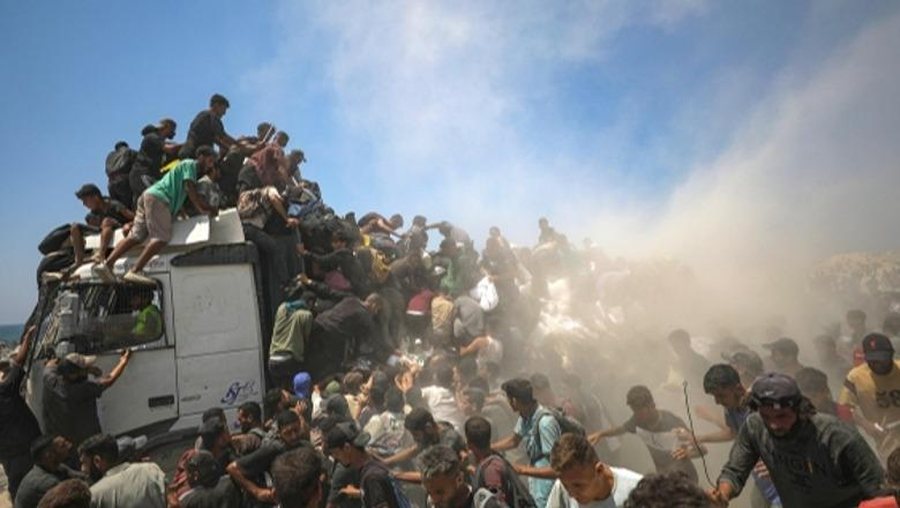
In an article published in the Jerusalem Post in January 2021, then-Israeli Prime Minister Benny Gantz wrote, recalling his time in the army, that “in every military campaign I led, my mother always told me to remember to provide humanitarian aid, medicine, and food to the civilian population on the other side.”
It’s a lesson that another former soldier, current Prime Minister Benjamin Netanyahu, seems to have ignored in the war on Gaza. Just think of last spring, when for two and a half months, from March to mid-May, Israel blocked the entry of food, medicine, fuel and other essential goods into the Gaza Strip. These entries resumed in late May, very slowly. The United Nations says that 500 to 600 trucks need to enter Gaza every day to meet the needs of the population. The average in recent weeks has been 69 entries per day.
alarm
This is why people in Gaza continue to die of malnutrition. And in an attempt to get some food, about a thousand people have been killed near distribution centers, from which the Gaza Humanitarian Foundation has distributed 94 million meals. That seems like a lot. Four times as many would have been needed. And the risk of Gaza falling into a full-blown famine continues.
The data from the World Food Program (WFP) speaks for itself: a third of Gaza's residents have gone without food for several days in a row and half a million are already living in conditions comparable to famine.
"Hunger has reached frightening levels," the agency wrote in a statement on Friday.
In May, a report from the FAO sounded the alarm: without a significant improvement in the situation, by next September, 470,000 Gazans are expected to live permanently in conditions that, according to the IPC criteria - a system for classifying the severity of emergencies related to food availability - fall into Category 5: "Catastrophe" or famine. This means that 20 percent of households suffer from "extreme food shortages, leading to malnutrition and death", 30 percent of children under 5 suffer from acute malnutrition and that every day, two to four adults out of every 10,000 die of hunger. Another million Gazans, within the same period, will fall into Category 4, "Emergency".
Boxes
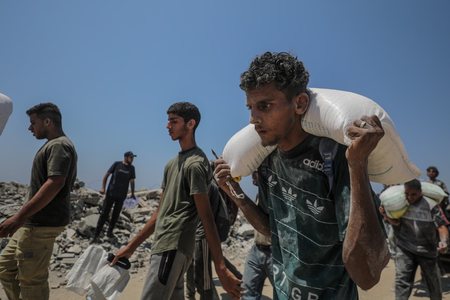
Then there's another issue: what do the few who manage to secure one of the GHF-branded boxes eat? On July 22, the Foundation itself published photos of the standard contents: flour, salt, pasta, chickpeas, peas, sesame paste, lentils, oil. Over 42,000 calories, "enough to feed 5.5 people for 3.5 days," GHF pointed out.
In reality, a professor from the London School of Economics explains to the BBC that this list "guarantees a full stomach, but an empty diet": "Following a similar diet for weeks would lead to 'hidden hunger' and increase the risk of diseases such as anemia and scurvy."
In Gaza, two essential cooking items are almost impossible to find: water and cooking gas. The latter, in particular, has not been distributed since May. It can only be found on the black market, at prices inflated by 4,000 percent compared to pre-war prices.
"Since the start of operations on May 27, we have distributed nearly 85 million meals through more than 1.4 million boxes directly to the people of Gaza.
"We call on everyone to join us. Together, we can provide more food aid to those in dire need," the Gaza Humanitarian Foundation wrote.
Destruction
Finally, the entry of new and more substantial aid into Gaza is vital for another reason: there is no other way for Gazans to secure food. After two and a half years of bombing, the level of destruction has reached enormous proportions.
As of April, the FAO reported that 83 percent of Gaza’s cultivated land, 83 percent of agricultural wells, and 71 percent of greenhouses had been fully or partially damaged. And 72 percent of fishing boats—a figure dating back to December 2024—are now out of action. Meanwhile, attacks have continued unabated, so it’s reasonable to assume that each of these percentages has increased.
Therefore, trucks are the only hope. The WFP claims that there are 170,000 tons of food already in the region or on the way there. This would be enough to feed the entire population of the Strip for three months. The residents of Gaza are waiting./Corriere della Sera







Lini një Përgjigje