


 Shkruar nga Pamfleti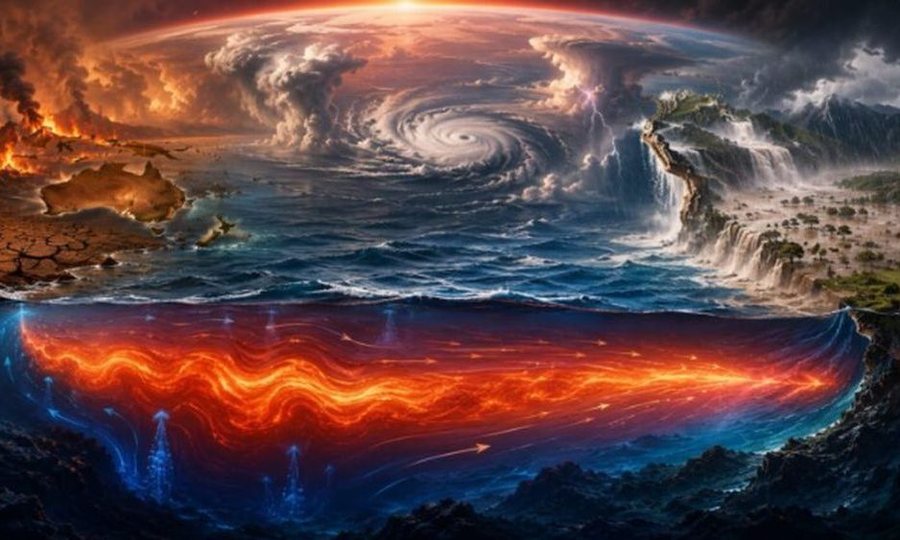
It's not just about the weather: El Nino could turn 2026 into a critical year, with serious consequences for climate and temperatures
The El Nino phenomenon is rekindling concern among scientists: an unusually intense climate phenomenon could develop in 2026, with potentially serious consequences for temperatures, rainfall, droughts and international stability. The fear is that the phenomenon could emerge in an already fragile global environment, exacerbating environmental, economic and food crises in many regions of the planet.
What is El Nino and why 2026 is causing so much concern
El Nino is a natural climatic phase that occurs periodically in the tropical Pacific Ocean and is characterized by an abnormal increase in the temperature of ocean waters. It is not just a “hot” episode: when the phenomenon is particularly strong, it can change atmospheric circulation and affect the climate in many regions of the world, causing droughts in some areas and torrential rainfall in others.
Scientists at the Strategic Climate Risks Initiative fear that one of the strongest El Niño events on record could occur in 2026. The event could cause widespread instability, with the risk of droughts, floods, agricultural crises and severe strains on global food supply chains. The warm phase of the event could push ocean temperatures to unusually high levels, creating ripple effects that would be difficult to contain.
The concern stems not only from the phenomenon itself, but also from the moment in which it may appear. A very strong El Nino will not affect a "neutral" planet: it will add to global warming, the vulnerability of agricultural systems, energy crises and geopolitical tensions. For this reason, experts speak of a risk that goes beyond meteorology and affects the economy, food security and social stability.
The precedent of 1877: the disaster that serves as a warning
The most disturbing comparison is with the great climate crisis of 1877-1878. During that period, a phenomenon related to El Nino contributed to prolonged droughts and a global famine that hit the tropics hard. Estimates cited in the publication speak of at least 50 million victims, while some calculations go as high as 60 million, about 3% of the world's population at the time.
This catastrophe is considered by scientists to be one of the worst environmental tragedies humanity has ever experienced, comparable in terms of loss of life to the world wars and the 1918-1919 flu pandemic.
Of course, today's world is very different: there are satellites, oceanographic sensors, forecasting systems, early warning networks, and more advanced agricultural techniques. For this reason, a famine on the same scale is not expected.
However, the reference to 1877 recalls a crucial element: El Nino can function as a crisis multiplier. Even if the scenarios of the 19th century are not repeated, a very strong phenomenon can worsen poverty, increase malnutrition, increase instability and put pressure on governments and markets. It is precisely this “domino effect” that worries scientists.
Economic damage, food and climate: the risk of a domino effect
The most recent example was the “super El Nino” of 2015-2016, which is said to have caused an estimated £2.9 trillion in damage to the global economy. If a phenomenon as intense as experts predict occurs in 2026, the losses could be similar, in an already strained international environment.
The most sensitive issue is related to food. A strong El Nino can disrupt the rainy season, reduce agricultural production, hit strategic agricultural regions and increase food prices. If this is added to the difficulties in producing chemical fertilizers, higher energy costs and geopolitical tensions, then a “perfect storm” can be created: less production, higher costs and greater vulnerability for poorer countries and social groups already exposed to crises.
The publication emphasizes that today the world has much more effective monitoring tools than in the past, but this does not mean that the risk has disappeared. On the contrary, it means that there is a window of time to prepare: strengthening meteorological warnings, protecting food chains, better planning of water resources and intervention in regions considered most vulnerable.






Tani do e kete fajin El Nino se demi i naftes eshte lule ne rritjen e cmimeve, qe te mbushin zorren te pangopurit.