


 Shkruar nga Pamfleti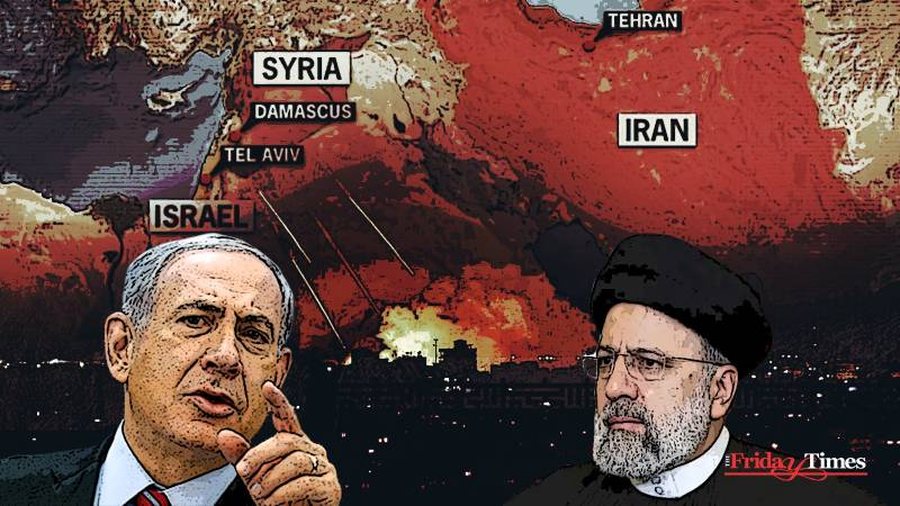
All-out war may have been averted for now, but the danger to the Middle East and beyond is far from over.
Almost immediately after the explosions at an airbase near Isfahan in the early hours of Friday, Iran did its best to downplay Israel's retaliatory strike against the Islamic Republic.
Iranian commanders said there was no damage and that the explosions were caused by air defense batteries firing unidentified objects. There were no accusations against Israel or calls for retaliation.
President Ebrahim Raisi did not mention the attack when he delivered a live televised address hours later, although officials have previously vowed to immediately retaliate against any direct Israeli attack on Iranian territory.
In Israel, there was a similarly muted response. Since Iran launched its first direct attack on Israel from Iranian soil last week, there was no doubt that Benjamin Netanyahu's government would respond. The only question was when and to what degree.
But when the response came, it seemed — so far — to be limited. And Israel neither confirmed nor denied the attack, choosing not to take ownership.
Netanyahu, known to be risk-averse despite his belligerent rhetoric, appears to have heeded the advice of other Western allies of the US and Israel rather than his far-right allies, who called for a counterattack "overwhelming". The measured and targeted response to Iran's attack for now mitigates the risk of igniting an all-out regional war.
Last weekend's Iranian attack, while large in terms of projectiles fired, was telegraphed well in advance and also caused minimal damage. Tehran, which launched that attack in response to an Israeli attack on its consulate in Damascus this month, also made clear it was "mission accomplished" and did not want a further escalation.
But even if the region, which has been on the hook for days, breathes a sigh of relief, it will only be momentary.
Since Hamas' brutal attack on October 7 and Israel's vicious retaliatory offensive in Gaza, the Middle East has been in a dangerous spiral of escalation.
Hostilities have erupted on multiple fronts between Israel and Iran-backed militants. US troops have been drawn into combat in Iraq, Syria and Yemen. Israel and Hezbollah, the Iranian-backed Lebanese militant movement, are engaged in daily cross-border fighting that at any other time would be considered all-out war.
The pre-existing red lines between Israel, Iran and its proxies have blurred, while old precedents have been swept aside. Iran's direct hit on Israel was a big play by Ayatollah Ali Khamenei, the supreme leader. He set aside, at least temporarily, his long-held strategy of "strategic patience" to underscore that he was willing to risk his top priority — the survival of the republic — and direct conflict if he felt Israel crossed the line.
By striking Iran's diplomatic mission in Damascus, Israel had also pushed Tehran too far, crossing a critical line for the regime. For Netanyahu, the attack was a signal that no target was off limits as Israel seeks to restore its deterrence after the major intelligence failure it suffered on October 7.
Friday's overnight attack bore the hallmarks of Israel's more traditional approach to striking Iranian assets through targeted strikes and assassinations. But it is too early to assume that the long Israeli-Iranian conflict has returned to the shadows. Israel can be expected to continue targeting Iranian assets, particularly in Syria, where it has already killed at least 18 members of the Revolutionary Guard, including top commanders, since October.
Israeli jets reportedly hit military targets in Syria during Friday's attack on Iran.
Even if both sides, as they claim, want to avoid an all-out war, another miscalculation or provocation could light the fuse for further escalation. The volatile situation becomes even more precarious because the rules are constantly changing and the stakes are rising: what one side considers a calculated action, the other may consider an unacceptable provocation.
Both are also determined to show that their respective setbacks are rebounding, and both face pressure from domestic constituencies to respond to the other's hostility.
This is the grim reality that has existed since the Hamas attack killed 1,200 people, according to Israeli officials. And the longer Israel's offensive in Gaza continues, adding to the death toll that Palestinian officials say has reached almost 34,000 people, the greater the risks.
All-out war may have been averted for now, but the danger to the Middle East and beyond has not yet passed. / Adapted "Pamphlet" from "Financial Times"







Lini një Përgjigje