


 Shkruar nga Pamfleti
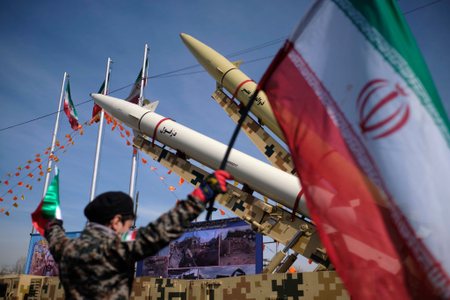
In response to Israeli attacks on its nuclear facilities and senior military leaders, Iran has launched hundreds of ballistic missiles toward Israel, some of which have hit ground targets.
Although Israel has managed to intercept many of the rockets in flight, some of them have penetrated defenses and caused extensive damage and casualties, including hits in central Tel Aviv and other areas.
The exact size of Iran's ballistic missile arsenal remains unknown, but it is widely thought to be one of the largest and most advanced in the region.
How do ballistic missiles work?
Ballistic missiles are long-range weapons that send warheads – conventional or nuclear – along a curved trajectory.
They are launched with powerful rocket engines that lift them into the upper atmosphere, even into space. After the engines stop, the missile follows a defined trajectory and re-enters the Earth's atmosphere at high speed to hit the target.
How far can they travel?
Ballistic missiles range from a few hundred kilometers to more than 10,000 km, i.e. to other continents. Their classification is based on their range:
BRBM (battle range) – less than 200 km
SRBM (short range) – less than 1,000 km
MRBM/IRBM (medium and intermediate range) – from 1,000 to 3,500 km
LRBM (long range) – from 3,500 to 5,500 km
ICBM (intercontinental) – more than 5,500 km
At what speed are they traveling?
Ballistic missiles travel at extremely high speeds. Speed is measured in the unit “Mach,” which is equal to the speed of sound (about 1,225 km/h).
Short-range missiles often reach supersonic speeds (more than Mach 1).

Longer-range missiles can reach hypersonic speeds, beyond Mach 5 (over 6,125 km/h).
How long does it take for Iranian missiles to reach Israel?
The distance between Iran and Israel is about 1,300–1,500 km. A missile traveling at Mach 5 could cover this distance in about 12 minutes, although this depends on the type of missile and the launch site.
Why are ballistic missiles difficult to intercept?
The danger lies in the combination of long range, extreme speed, and difficulty of interception.
Their high trajectory and high-speed reentry into the atmosphere give little time for defense systems to react. Some missiles also use decoys to confuse radars.
What is the difference between ballistic and cruise missiles?
Iran has also used cruise missiles in the current conflict. Unlike ballistic missiles that fly at high altitudes, cruise missiles fly at low altitudes and on straight trajectories, similar to drones – which helps them evade air defenses.
Cruise missiles are slower, but harder to detect.
They are maneuverable and can avoid obstacles and defensive missiles.
Iranian ballistic missiles can reach Israel in 12 minutes. Cruise missiles can take up to two hours, while drones can take up to nine hours to reach their target. / Aljazeera







Lini një Përgjigje