


 Shkruar nga Pamfleti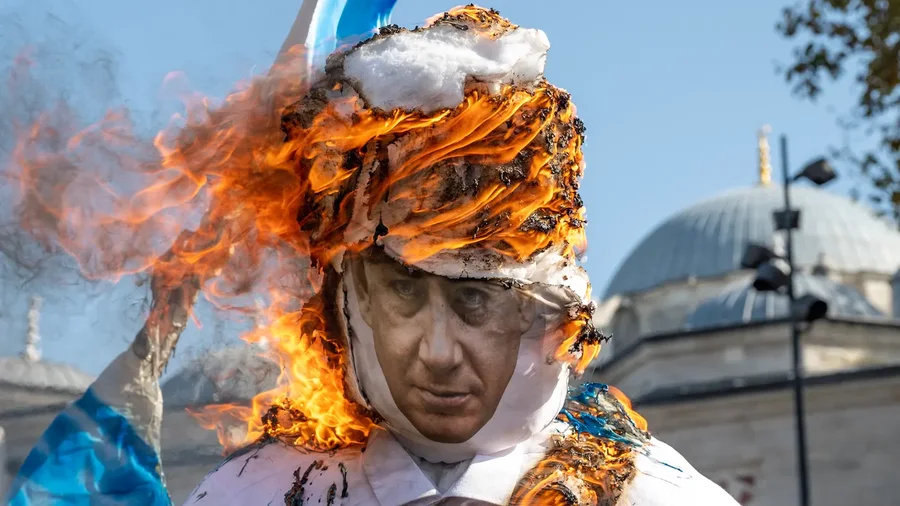
Netanyahu believed that if he authorized the flow of billions of dollars over a decade the money would help keep the peace in Gaza and keep Hamas focused on governance rather than war.
For years, the Qatari government sent millions of dollars every month to the Gaza Strip, and Israeli Prime Minister Benjamin Netanyahu not only tolerated these payments, but encouraged them, according to a report by The New York Times.
A few weeks before Hamas launched its deadly October 7 attacks on Israel, the head of the Mossad arrived in Doha to meet with Qatari officials.
Netanyahu believed that if he authorized the flow of billions of dollars over a decade the money would help keep the peace in Gaza and keep Hamas focused on governance rather than war.
Qatari money, although supposedly secret, has been widely discussed in the Israeli media for years. Netanyahu's critics say it was part of a distraction strategy.
Netanyahu responded to critics that the claim that he tried to empower Hamas was "ridiculous."
However, through interviews with at least 25 current and former US and Qatari officials, as well as officials from other Middle Eastern governments, The New York Times has uncovered new details about Netanyahu's tactics.
The payments were part of decisions by Israeli leaders, military officers and intelligence officials, all based on the deeply flawed assessment that Hamas was neither interested in nor capable of a large-scale attack against Israel.
Although the Israeli military had intercepted Hamas attack plans and analysts observed intensive terrorist training just over the border in Gaza, the payments continued.
For years, Israeli intelligence officers even accompanied a Qatari official to Gaza, where he distributed cash from suitcases filled with millions of dollars.
The money from Qatar had humanitarian purposes, such as government salaries in Gaza and the purchase of fuel to keep a power plant running.
But Israeli intelligence officials now believe the money played a role in the success of the October 7 attacks, if only because it allowed Hamas to divert funds to military operations.
"Prime Minister Netanyahu acted to significantly weaken Hamas. He led three major military operations against Hamas, which killed thousands of terrorists and senior Hamas commanders ," an official said.
Hamas has always declared its commitment to the elimination of the state of Israel. But each payment was evidence of the Israeli government's view that Hamas was a low-intensity concern, even a political asset.
Netanyahu's critics say his approach to Hamas has had, at its heart, a cynical political agenda: to keep Gaza quiet as a means of staying in power without addressing the Hamas threat or Palestinian discontent.
" Netanyahu's perception for a decade and a half has been that if we buy silence and pretend the problem isn't there, we can wait and the problem will go away ," said Eyal Hulata, Israel's former national security adviser.
Netanyahu and his aides have slowly begun to rethink their strategy toward the Gaza Strip after several bloody and inconclusive military clashes against Hamas.
" Everyone was fed up with Gaza. We all said 'forget about Gaza' because we knew it was a dead end ," said Zohar Palti, a former director of Mossad intelligence.
After the crisis in 2014, Netanyahu pursued a new strategy of trying to "contain" Hamas, while Israel focused on Iran's nuclear program and the armies it supported, such as Hezbollah.
This strategy was supported by repeated intelligence assessments that Hamas was neither interested nor capable of launching a major attack inside Israel.
Yossi Kuperwasser, a former Israeli intelligence official, said some saw the benefits of maintaining a "balance" in the Gaza Strip.
" Israel's logic was that Hamas should be strong enough to rule Gaza, but weak enough to intimidate Israel ," he said.
Of course, not everyone was in favor of this plan. Avigdor Lieberman, who became defense minister in 2016, wrote a secret memo to Netanyahu that year saying Hamas was slowly building up its military capabilities to attack Israel and argued that Israel should strike first.
An attack at the time could eliminate most of the leadership of Hamas' military wing. Netanyahu rejected the plan, preferring to rein in Hamas.
Yossi Cohen, who handled the Qatar file for many years as head of the Mossad, also questioned Israel's policy on Gaza money, believing there was too little oversight.
In June 2021, Cohen gave his first public speech since retirement, saying that the Qatari money being sent to the Gaza Strip was no longer known what it was being used for. /The New York Times






Lini një Përgjigje