


 Shkruar nga Pamfleti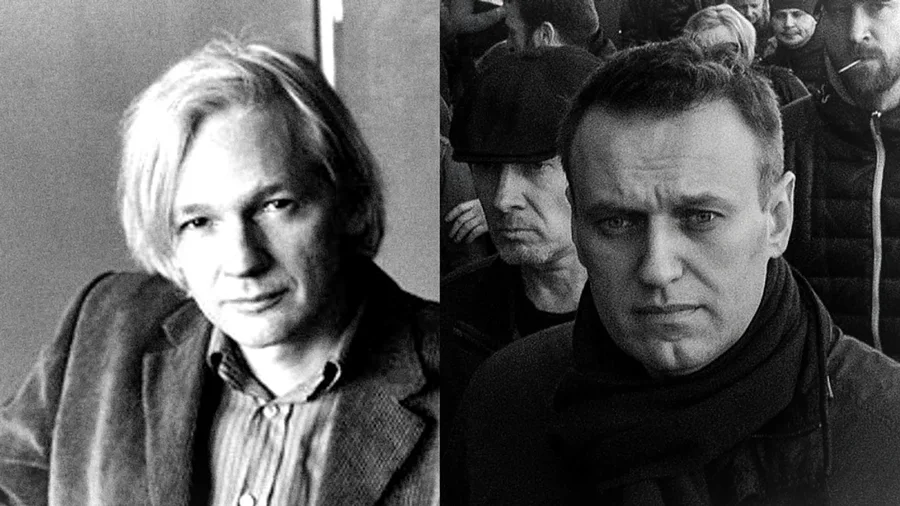
If the mission of the press is to report what the powerful do not want known, that is exactly what Navalny and Assange have done.
As the world mourns the Putin critic and the WikiLeaks founder faces extradition to the US, Spanish journalist Juan Carlos Laviana argues that while these men may not be "ordinary" journalists, they both used investigative tools and technological skills to light on those in power. And they were right.
US prosecutors argued before the UK High Court late last month that WikiLeaks founder Julian Assange is not an "ordinary journalist". However, their understanding of the "ordinary journalist" remains unclear, in our new age where the practice of journalism extends far beyond traditional media.
The same can be said for Alexei Navalny, a whistleblower-turned-activist who was recently killed while in the custody of Russian authorities. The connection between the cases is obvious. Assange's wife, Stella, told the British press that her husband was in serious health and that his life would be in danger if he were extradited and imprisoned in the US.
The alleged importance of their crimes, without confusing them, is spreading unpleasant information about the rulers. Inconvenient for the Kremlin in one case, inconvenient for the US Department of Defense and State Department in the other. And in both cases, the information turned out to be true.
What we have here is investigative journalism pure and simple. If they had committed a crime, they would be protected by the overriding right to freedom of expression and in no way deserve a life sentence—much less death. This was after a poisoning attempt in 2020 that nearly cost him his life. At the time, President Vladimir Putin said that if Russian security services were responsible for the poisoning, the opposition leader would not be alive. This time he's dead, so it must have been them.
Assange has been awaiting a UK High Court decision on extradition for five years in a London jail. That's in addition to the seven years he spent sheltering in the Ecuadorian embassy in London. If extradited to the US, he could face up to 175 years in prison based on the 17 espionage charges he faces there, many of them covered by the laws of war.
Two journalists
No one doubts that Assange is a journalist, however unconventional he may be. We do not know whether he worked for an enemy power or whether he had other objectives than the dissemination of genuine information of public interest.
What the Australian journalist did was to find the information agency WikiLeaks, which, thanks to new tools on the Internet, receives and distributes the relevant information. It has released hundreds of thousands of documents, including some documenting the US military's abuse of civilians during the wars in Afghanistan and Iraq. Newspapers around the world shared his discoveries. Should Washington also go after them?
There is also no doubt that Navalny is a journalist, an unusual journalist. Last week, the prestigious Columbia Journalism Review listed enough arguments on its website to prove it.
Putin killed Navalny because of his ability to put people in touch with the truth."
Masha Gessen, a journalist at The New Yorker, wrote for example that, having embraced ethno-nationalist politics, Navalny "found his agenda and his political voice in documenting corruption".
Frustrated that most of the Russian media was censored and controlled by Putin, he created his own investigative online media. His work created "a whole generation of independent Russian investigative media, many of which continue to work in exile."
For Anne Applebaum, noted journalist at The Atlantic, Navalny's "extraordinary gift" was that "he could take the dry facts of kleptocracy—the numbers and statistics that usually trip up even the best financial journalists—and make them fun". Putin killed him because of his ability to reach people with the truth, and because of his talent for breaking through the fog of propaganda that now blinds his countrymen, and some of ours too.
State secrets
Both cases are unpleasant for the powers that be – Navalny will continue to be so after his death, as Putin has made him a martyr. Leaders argue that men endanger national security. In other words, they discovered abusive practices by the state, which are secret precisely because they are illegal.
Instead of persecuting whistleblowers, the state should be more careful not to use illegal practices and protect such sensitive information because if a journalist can find it, it is even easier for an enemy spy to find it.
No one but readers and viewers can give the journalist the title, let alone Putin or the US Department of Justice. Only dictatorships claim the power to create a registry of journalists or issue press cards. In Spain, journalists of a certain age speak from our experience.
Assange and Navalny have earned the title of being called journalists. They were not "ordinary" journalists, of course, but they deserve this title because they managed to use new technologies in the service of information, and because they took freedom of expression to its maximum consequences.
If the mission of the press is to report what the powerful don't want known, that's exactly what Navalny and Assange have done./ Adapted Pamphlet from WorldCrunch


Lini një Përgjigje