


 Shkruar nga Laura Dubois & Adam Samson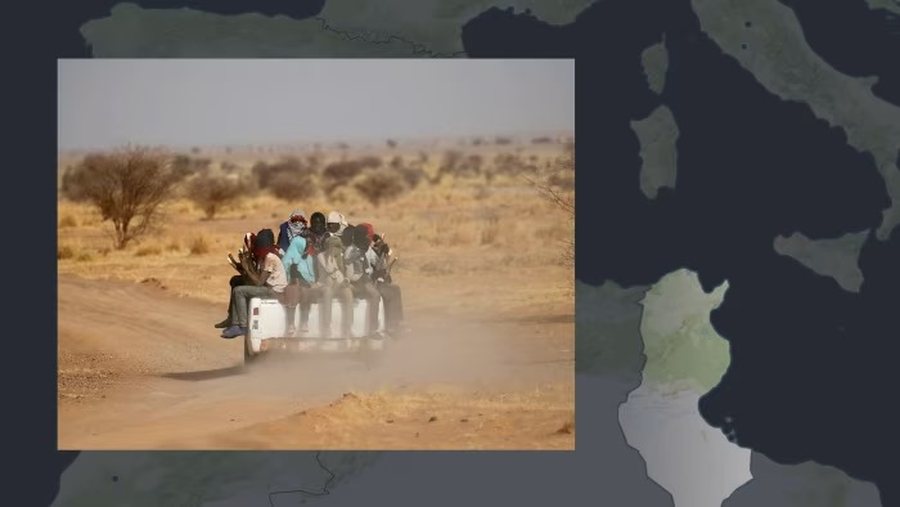
European countries are fortifying their borders with fences, speeding up asylum-seeking procedures in closed centers and transferring these processes to a string of countries on Europe's periphery, including authoritarian Tunisia. But can these controversial policies solve the issue, and if so at what cost?
Hidden behind tall cacti surrounding an olive grove in the small Tunisian town of Jebiniana, around 300 people are sheltering in some makeshift plastic huts, waiting to cross the Mediterranean Sea and arrive in Europe. One of them is Aruna, a 39-year-old from Sierra Leone who arrived in Tunisia last year.
He has survived an arduous journey of 5,000 km across the Sahara desert. However, it is still at risk. The coastal area around the Tunisian port of Sfax - just under 190km from the Italian island of Lampedusa - is the target of a strong crackdown on illegal immigration by the Tunisian authorities, who receive millions of euros in annual EU funding to help curb the landings in Europe.
In mid-February, when Aruna left the camp to buy food, she was spotted and arrested by the local police. "They took my phone, tied me up, beat me. Then they took me to the desert" - he says. Then Tunisian national guard officers put him on a bus and took him with 70 other people to the border with Algeria, where they were abandoned at 2 am without food or water.
It took Aruna 13 days to return to the camp, hiding during the day and walking at night with legs swollen from exhaustion, to be reunited with his 7-year-old son, teenage brother and relatives of others. His family is among thousands of people from many countries across Africa willing to take one of the deadliest routes to Europe to escape conflict and poverty.
Last year around 292,000 people arrived in the EU irregularly, without permission to enter or stay. According to the UN's International Organization for Migration, this is the highest figure since 2016. The surge in the influx, which plunged Europe into a 10-year search for a solution, is now testing the EU's values and commitment. for the protection of human rights.
Under the pressure of the far-right parties, which on the eve of the campaign for the European parliamentary elections in June have as their main cause opposition to immigration, Brussels has adopted increasingly harsh measures to prevent the arrival of asylum seekers and immigrants.
European countries are fortifying their borders with fences, speeding up asylum-seeking procedures in closed centers and transferring these processes to a string of countries on Europe's periphery, including authoritarian Tunisia. But can these controversial policies solve the issue, and if so at what cost?
Experts have accused the EU, which recently signed agreements with Mauritania and Egypt, of turning a blind eye to flagrant violations of human rights. "Clear priorities for the EU: to minimize departures from Tunisia, regardless of the humanitarian damage" - says Romdhane Ben Amor, spokesperson for the Tunisian Forum for Economic and Social Rights (FTDES).
The agreement between the EU and Tunisia is emblematic of an unprincipled bargain. Traces of people at sea by Tunisian authorities doubled last year to 81,000, FTDES says. Two-thirds of the 105 million euros promised to be given to Tunisia under the agreement go to border management.
In general, it is predicted that until 2027 Brussels will spend 278 million euros
for the management of illegal immigration in Tunisia. But according to European diplomats, international humanitarian missions and NGOs, during the last months the Tunisian authorities have arrested and forcibly removed thousands of immigrants and asylum seekers to Algeria and Libya, in open violation of international and humanitarian law.
Some people interviewed by "Financial Times" say that they were arrested arbitrarily and sent by force to the border areas. Others say they were held in Libyan prisons. The horse, which arrived in Jebiniana from Nigeria, says it was sold to Libyan authorities by the Tunisian national guard after it was captured at sea in October 2023.
"They gave them an envelope in our presence," he adds. The Nigerian says he and 40 others were taken to a prison near Tripoli, where they were forced to pay 700 euros each to be released.
International officials have confirmed that there have been individual allegations of human trafficking against Tunisian authorities. The Tunisian Foreign Ministry describes these accusations as "baseless".
"This is the dilemma the EU is facing. On the one hand, it has extremely high standards of fundamental rights. On the other hand, it is facing this very contested issue of immigration" - says Emily O'Reilly, the EU ombudsman who leads independent investigations into the bloc's administration.
Tougher policies on illegal immigration were first tested after 2015 and 2016, when a record number of people sought asylum in the EU, many fleeing the Syrian civil war. The sudden arrival of more than 2 million men, women and children put a lot of pressure on southern countries like Italy and Greece, where most irregular migrants first arrive.
Under the Dublin Regulation, migrants are obliged to register for asylum wherever they first enter the EU. At the time wealthier countries such as Germany complained that migrants were traveling north without registering, accusing the bloc's southern countries of deliberately tolerating it.
To ease the pressure, in 2016 the EU reached an agreement with Turkey, which agreed to host Syrian refugees heading for Europe in exchange for 6 billion euros over several years. That amount was supplemented in 2021 with an additional 3 billion euros.
Politicians hailed the pact as a success, and in fact between 2016 and 2017 irregular arrivals in the bloc fell by 50 percent. EU funds have contributed to border management, but also to healthcare, education and remittances for migrants in Turkey.
In the provinces bordering the EU, "it is thought that European aid is helping them to face this phenomenon," says Nikolaus Meyer-Landrut, head of the EU delegation in Turkey. Since then, Brussels has increased its efforts in this direction.
Another example is the 2017 agreement between Italy and Libya, under which the EU pledged funds to curb immigration, including 59 million euros to strengthen the Libyan coast guard. But the imprisonment, enslavement and torture of migrants and asylum seekers in Libyan prisons is well-documented.
In 2023, a UN report accused the Libyan authorities of possible war crimes and crimes against humanity. European diplomats and humanitarian organizations told the FT that detention of migrants in Libya continues, and that at least 7,000 people caught in Tunisia have been sent there since last summer.
"And what else do we need to know to suspend the financing of such agreements?" asks Tineke Strik, an EU lawmaker for the Greens, arguing that the EU's support for third countries gives it "co-responsibility". for human rights violations.
But instead of slowing its efforts, the EU is increasingly strengthening its external borders to prevent people from coming. After years of wrangling, a major reform of the common asylum and immigration system was agreed in December, but without significantly revising the Dublin Regulation.
Instead, there will be more demands from hapless people who will be heard in the closed centers at the border, which activists say are de facto detention facilities.
Meanwhile, many migrants in the Jebiniana camp and elsewhere are determined to complete their journeys despite the dangers. Aruna worked as a security guard at a school in Sierra Leone. But he was forced to flee after his wife was shot dead by security forces during an anti-government protest in Waterloo, once a haven for Africans freed from slavery. The house he left behind no longer offers him security. "I want to go to Europe to save my life," he says. / Adapted "Pamphlet" from "Financial Times"



Lini një Përgjigje